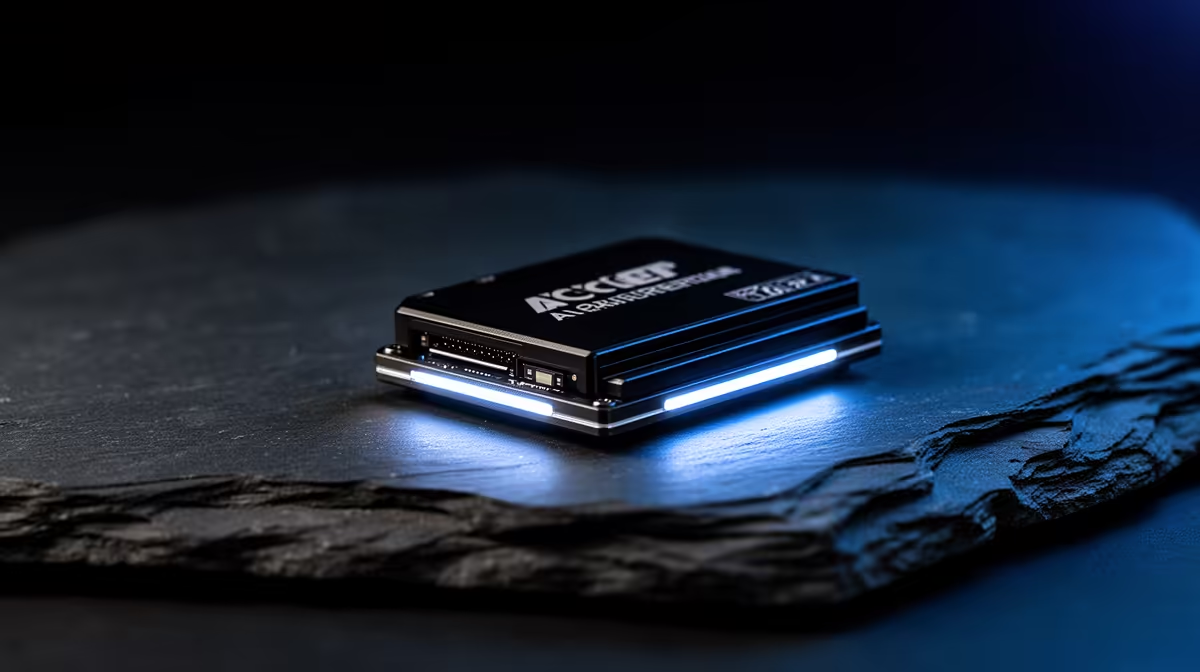
The NVIDIA DGX Spark is a desktop the size of a thick paperback that NVIDIA pitches as a personal AI supercomputer, and the first thing worth saying is who it is not for. It is not a gaming box, not a general home PC, and not a value play for someone who just wants a fast machine. It is a focused tool for people who run AI models locally, and if that is not your daily work, your money is better spent elsewhere.
Quick Answer
The DGX Spark is built for AI researchers, developers, data scientists, and serious prosumers who prototype, test, and run large models on their own desk. Its 128GB of unified memory lets it fine-tune models up to around 70 billion parameters and run inference on models up to roughly 200 billion, which is its real selling point. Gamers and general users are not the audience.
What the DGX Spark Actually Is
At its heart sits the NVIDIA GB10 Grace Blackwell superchip, pairing a Blackwell GPU with fifth-generation Tensor Cores alongside a 20-core Arm CPU built on Cortex-X925 and Cortex-A725 cores. NVIDIA quotes up to one petaFLOP of AI performance at FP4 precision. The number that matters more for most buyers is the 128GB of unified system memory shared between CPU and GPU, backed by 4TB of NVMe solid state storage.
That unified memory pool is the whole story. On a normal gaming PC, the GPU only has its own VRAM to work with, so an RTX-class card with 16GB or 24GB hits a hard wall on model size. The Spark treats its full 128GB as a single addressable pool, which is how it holds models that a consumer graphics card simply cannot fit. It ships with NVIDIA's AI software stack preinstalled, so it is a turnkey appliance rather than a parts project.
The People It Is Genuinely Built For
AI Researchers and Data Scientists
Researchers who need to iterate on model architectures, run experiments, and perform targeted fine-tuning without queuing for shared cluster time are the core audience. Having a 70B fine-tune run on the desk next to you, with no cloud bill ticking over and no data leaving the room, changes how quickly you can test ideas. For anyone working with sensitive datasets, keeping everything local is a compliance advantage as much as a convenience.
NVIDIA also provides frameworks such as Isaac, Metropolis, and Holoscan directly on the Spark, which means robotics researchers, computer vision teams, and smart-city developers can run their specific stacks without reconfiguring the base system. That readiness removes a real barrier for domain-specialist research.
Developers Building AI Products
The second clear group is developers building on top of large language and reasoning models. The Spark can locally handle current-generation models from the major open-weight families, then deploy the same workload to a data centre or cloud without rewriting it. That develop-locally, deploy-anywhere path is the practical reason a small team might choose one. You can see where it sits against more general builds in the AI PC range at Evetech.
Performance improvements from TensorRT-LLM optimisations and speculative decoding delivered up to 2.5 times throughput gains over launch-day speeds, which significantly shifts the value proposition for developers who held off buying at release.
Startups and Prosumers
For an early-stage startup, a Spark on a desk can replace months of cloud GPU rental while a product finds its feet. For a well-resourced prosumer who runs local models seriously as a hobby or side project, it is the appliance that removes the VRAM ceiling. The honest filter is simple: if you are not regularly loading models too large for a single graphics card, you do not need it.
Who Should Skip It
Gamers gain nothing here. The Spark is not built for high frame rates and is not a substitute for a gaming graphics card. General users who browse, write, and do office work would be paying a steep premium for capability they will never touch. And anyone whose AI work fits comfortably inside a 16GB or 24GB graphics card should buy that card instead. For those buyers, a well-chosen desktop GPU is the smarter spend, and the graphics card best sellers list is the place to start.
The one genuine limitation even for target users is sustained training. The Spark's thermal envelope can cause throttling during marathon training runs lasting many hours, so teams doing heavy multi-day pre-training are still better served by dedicated cluster hardware.
How It Fits the South African Picture
For SA researchers and teams, the appeal is twofold. Local inference sidesteps the latency and recurring cost of cloud GPU instances billed in US dollars, and it keeps proprietary data on home soil. The trade-off is the upfront price, which puts the Spark firmly in the professional-tool bracket rather than the enthusiast one. There is no official local distribution channel yet, so units are imported, adding duty and shipping to the dollar price.
The decision comes down to whether you run large-model workloads often enough that owning the hardware beats renting it, and whether keeping data local carries real weight for your work. SA teams that handle sensitive local user data have extra reason to keep inference on-premises.
Frequently Asked Questions
Is the DGX Spark good for gaming?
No. It is a specialised AI appliance built around large-model workloads, not high frame rates. A dedicated gaming PC with a strong graphics card is the right tool for gaming.
What size models can it run?
The 128GB of unified memory supports fine-tuning models up to around 70 billion parameters and inference on models up to roughly 200 billion parameters, depending on the model and settings. That is its main advantage over a single consumer graphics card.
Why not just buy a graphics card with lots of VRAM?
If your models fit within a 16GB or 24GB card, you should. The Spark earns its place only when you routinely need models too large for any single consumer GPU, where its unified memory pool removes the VRAM ceiling.
Does it need cloud access to work?
No. The point is local operation. It runs models on the desk with no data leaving the room, which suits sensitive datasets and removes recurring cloud costs, though you can still deploy the same work to the cloud later if you choose.
Who is the ideal buyer?
An AI researcher, developer, data scientist, startup, or serious prosumer who works with large models often enough that local hardware is worth more than renting cloud compute. If that is not you, it is the wrong machine.
How has performance changed since launch?
TensorRT-LLM optimisations and speculative decoding updates delivered up to 2.5 times the throughput available at launch, so the machine's practical value has grown considerably since first reviews.
Not everyone needs a personal AI supercomputer, but if local large-model work is your daily reality, the right hardware pays for itself. Explore in-Rand options across the AI PC and component range at Evetech.