Quick Answer
4K 240Hz requires approximately 63 Gbps of display bandwidth for an uncompressed signal. This demands DisplayPort 2.1a UHBR20 (77.4 Gbps usable), a certified UHBR20 cable, and a GPU that supports this output standard. Using a DP 1.4 cable or an older GPU caps you at 144Hz uncompressed at 4K, or 240Hz only with Display Stream Compression enabled.
The Bandwidth Calculation Behind 4K 240Hz 🔧
Display bandwidth is calculated from resolution, refresh rate, colour depth, and colour format. For 4K (3840x2160) at 240Hz with 8-bit colour and 4:4:4 chroma (no subsampling), the raw pixel clock is approximately 3840 times 2160 times 240 times 24 bits, which equals roughly 47.8 Gbps before encoding overhead. After 128b132b line encoding used in DisplayPort 2.1a, the total link bandwidth required rises to approximately 63 Gbps.
Cables: The Component Most Often Overlooked 🎮
The display cable is consistently the component that limits 4K 240Hz setups. A DP 1.4 cable and a DP 2.1a cable use the same DisplayPort connector and are physically interchangeable, but only a UHBR20-certified cable carries the 80 Gbps signal. Using a DP 1.4 cable on a UHBR20-capable GPU and monitor forces the link to negotiate down to HBR3 speeds, capping the connection at DP 1.4 bandwidth. This typically manifests as the monitor reporting a maximum resolution of 4K at 144Hz or enabling DSC at 240Hz automatically without the user realising.
GPU Requirements and What Current Hardware Delivers 💡
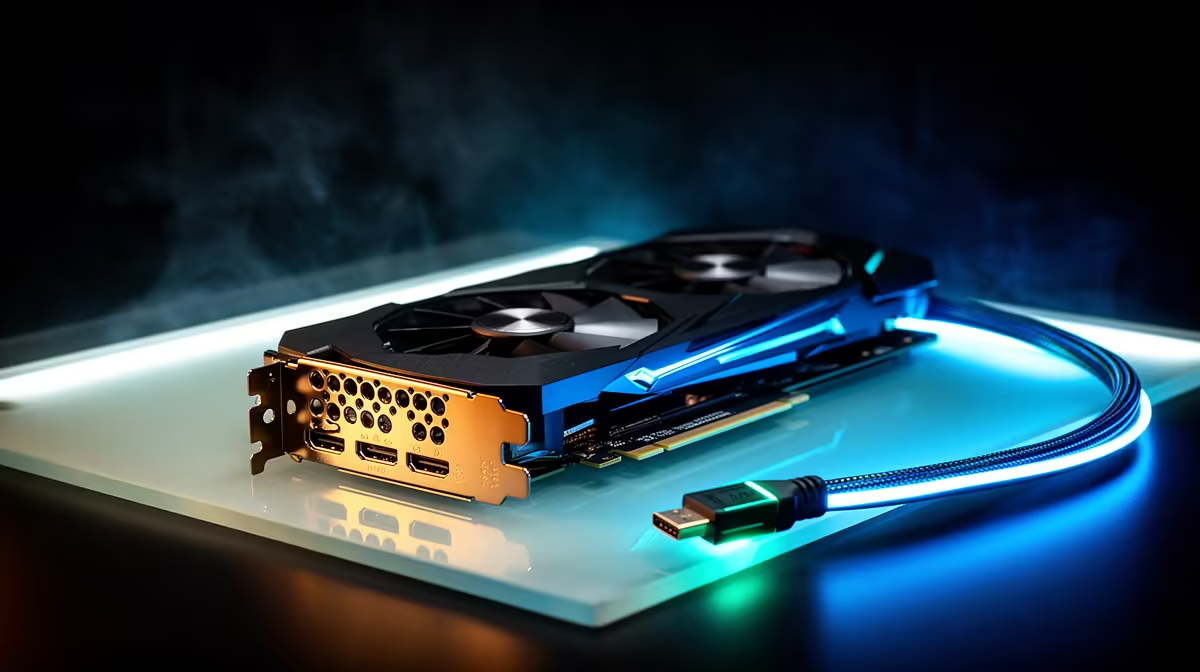
The GPU must both output DisplayPort 2.1a signals and have the render throughput to benefit from 4K 240Hz. On the output side, RTX 50-series GPUs (RTX 5060 Ti and above) support DP 2.1a UHBR20. RTX 40-series GPUs support DP 1.4 HBR3 only, meaning 4K 240Hz requires DSC. AMD RX 9000-series GPUs also support DP 2.1a. On the render throughput side, even an RTX 5090 will not natively push 240 fps at 4K in demanding games without DLSS 4 Multi Frame Generation. Expect native 4K rendering to deliver 80 to 140 fps on an RTX 5080 in AAA titles, with DLSS 4 raising the effective output to 200-plus fps for display purposes.
Buy the Cable Separately if Needed ⚡
Many 4K 240Hz monitors include a DisplayPort cable in the box, but this is not always a UHBR20-rated cable. Check the cable's packaging for UHBR20 or 80 Gbps certification before trusting it for uncompressed 4K 240Hz. If the included cable is not rated, purchase a dedicated UHBR20 cable from a reputable brand. The cable is the least expensive component in a 4K 240Hz setup and the most commonly overlooked.
FAQ
Can HDMI 2.1 run 4K 240Hz without compression?
No. HDMI 2.1 provides 42.6 Gbps of usable bandwidth, which is below the 63 Gbps required for uncompressed 4K 240Hz at 8-bit 4:4:4. HDMI 2.1 can carry 4K at 240Hz using Display Stream Compression, which is visually lossless in gaming, or 4K at 144Hz without any compression. For uncompressed 4K 240Hz, DisplayPort 2.1a UHBR20 is the only current option.
What happens if I use a DP 2.1a monitor with an RTX 40-series GPU?
The RTX 40-series GPU outputs DP 1.4 HBR3, so the connection negotiates at HBR3 speed regardless of the monitor's DP 2.1a capability. 4K at 240Hz will engage DSC automatically. This is visually lossless for gaming and is a practical workaround until you upgrade to an RTX 50-series or RX 9000-series GPU that supports UHBR20 natively.
Does DSC affect gaming performance or input lag?
No. Display Stream Compression is a fixed-function hardware codec that operates at the GPU and monitor level with no CPU involvement. It adds no measurable input lag and has no impact on GPU render performance. The only scenario where DSC matters is high-precision colour work where visually lossless is not the same as mathematically lossless.
Building a 4K 240Hz setup and need the right GPU and monitor?
Evetech stocks RTX 50-series GPUs with DP 2.1a UHBR20 output alongside 4K 240Hz monitors ready for the full bandwidth. Visit Evetech to pair the right GPU and display for your build.