Quick Answer
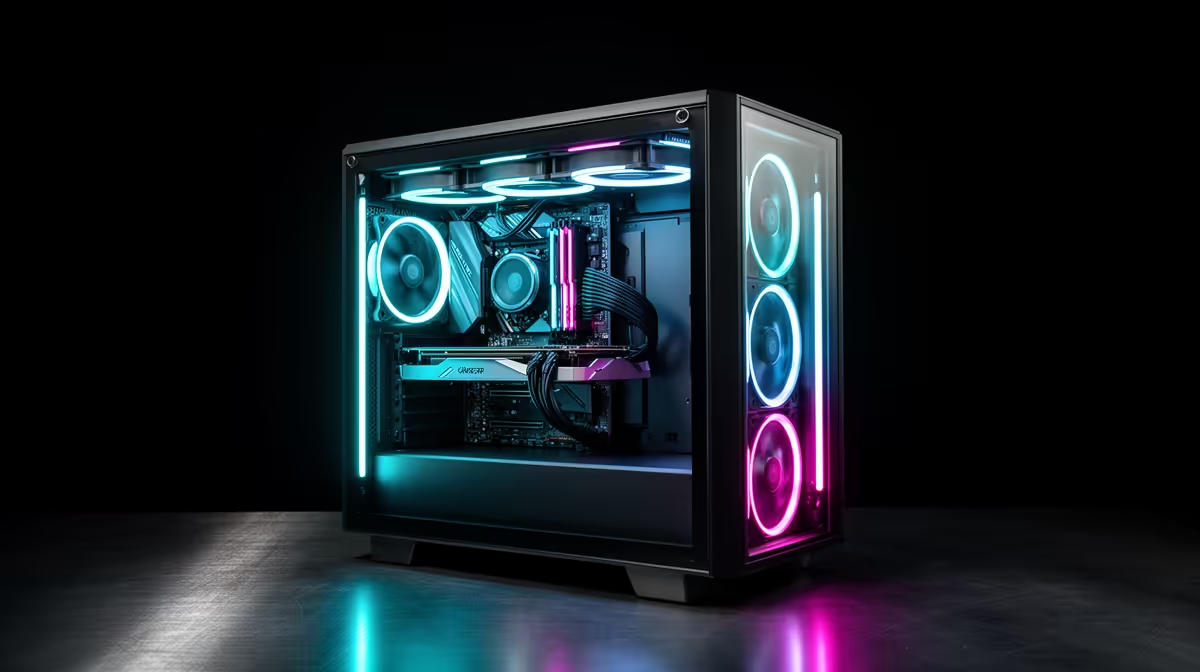
Case size is a hard constraint for multi-GPU and workstation builds because dual full-length GPUs require E-ATX or XL-ATX motherboards, extended PCIe lane spacing, and airflow volume that only full-tower cases provide. For creator PCs with large storage arrays and high-wattage components, full-tower is the minimum viable form factor.
Multi-GPU and Its Physical Requirements 🏗️
Dual-GPU setups using NVLink require two GPUs adjacent in PCIe x16 slots on a motherboard with dual x16 slots at full PCIe 5.0 bandwidth, found only on E-ATX or HEDT boards. E-ATX boards require E-ATX cases. Two triple-fan GPUs occupy six PCIe slot positions and can draw 1,000 to 1,400W combined, producing heat that makes airflow volume the limiting factor. Mid-tower cases cannot accommodate this. For SA video production studios or AI inference workstations, a full-tower at R4,000 to R8,000 is a prerequisite.
Creator and Production PC Requirements 🎬
Content creators using Premiere Pro or DaVinci Resolve need four to eight NVMe drives for scratch storage and multiple 3.5-inch HDDs for archives. A full-tower with six to twelve drive bays, a long PSU basement for 1,200 to 1,600W modular PSUs, and 420mm radiator support is the foundation for a durable creator workstation. SA-based creators in game development or broadcast production often run a Threadripper PRO CPU alongside an RTX 5090 for render acceleration. Full-tower cases at Evetech range from R4,500 to R8,000.
Thermal Management in High-TDP Builds 🌡️
A system running a 350W CPU plus an RTX 5090 at 575W simultaneously generates 925W of heat to remove from a closed case. At SA summer ambient temperatures of 28 to 32 degrees Celsius in uncooled rooms in Gauteng, this is significant. A full-tower with three 140mm front intakes, two 140mm top exhausts, one 140mm rear exhaust, and a front 420mm AIO manages this load. A mid-tower running the same components will struggle to keep GPU temperatures below 90 degrees Celsius under sustained workstation loads, because the GPU has insufficient cool air volume.
Add a Dedicated GPU Exhaust Fan If Possible ⚡
In a high-TDP GPU workstation build, add one or two 120mm fans directly above the GPU blowing upward toward the top exhaust vents if your case has those mounts. This creates a dedicated hot-air extraction path from the GPU zone that does not compete with CPU cooler exhaust. This addition can reduce GPU temperatures by 6 to 10 degrees Celsius in a thermally stressed workstation environment.
FAQ
Can I run a dual-GPU setup in a full-tower ATX case without an E-ATX board?
For gaming with two consumer GPUs (which rarely benefits since modern games do not scale well across multiple GPUs), an ATX board with two PCIe x16 slots can work in a standard full-tower. For professional NVLink workstation setups requiring E-ATX boards, an E-ATX case is necessary.
How many 3.5-inch drive bays does a workstation case need for video production?
For a functional video production workstation in SA, four 3.5-inch bays accommodate a typical storage array: two 8 to 16TB archive HDDs and two additional HDDs for project backup. An eight-bay configuration provides future-proofing for growing libraries.
Is a full-tower case with wheels worth the premium for SA studio setups?
For production studios where the workstation is moved between editing bays, wheeled cases save significant effort. A loaded full-tower can exceed 25kg, making wheel mounts essential for regular repositioning. For fixed desk setups, wheels add cost and bulk without benefit.
Building a workstation, creator PC, or multi-GPU system in SA?
Evetech stocks full-tower and E-ATX cases engineered for high-component-count builds, with drive bay capacity and radiator support for the most demanding configurations.