Quick Answer
High-precision optical sensors eliminate the tracking errors, acceleration artefacts, and jitter that cost South African competitive esports players fractions of a second in target acquisition. In titles like Valorant, CS2, and Apex Legends, where the difference between winning and losing a duel is measured in milliseconds and pixels, sensor quality is a direct performance variable.
How Sensor Quality Affects Esports Performance 🎯
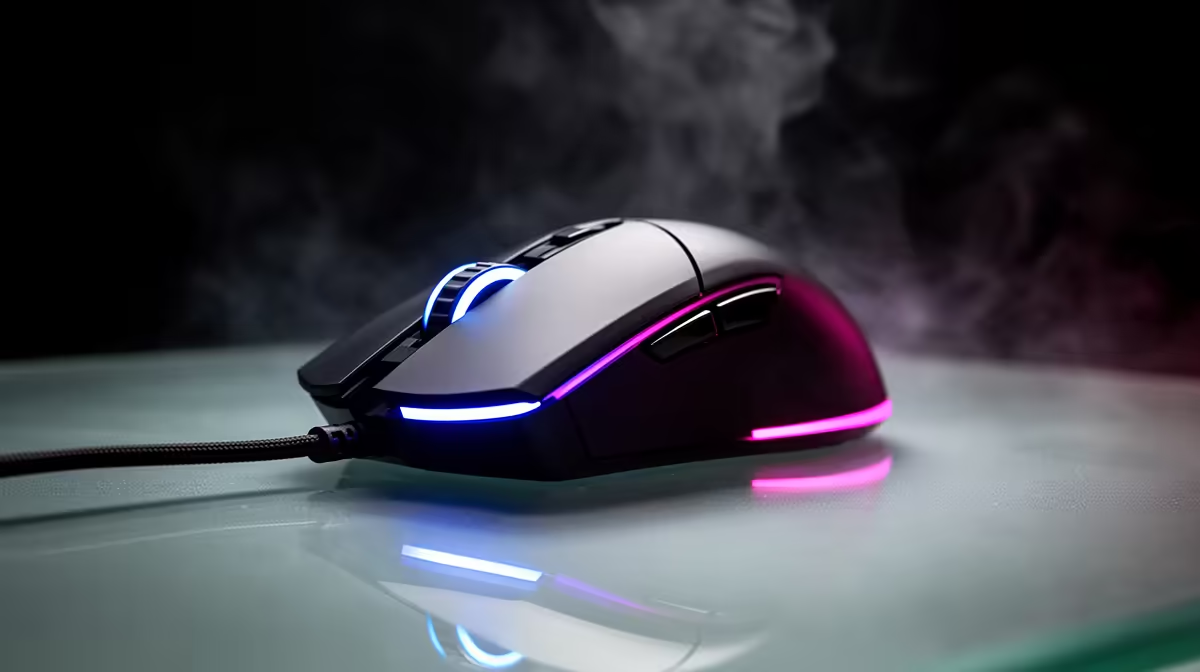
A competitive optical sensor translates physical movement into cursor displacement with sub-pixel precision. Premium sensors like the PixArt PAW3395 and PAW3950 track at up to 300 inches per second with zero measurable acceleration. Budget sensors introduce acceleration above 1 to 1.5 metres per second: during a fast flick, the cursor overshoots because the sensor added extra displacement beyond what your hand actually travelled.
For South African players competing in the Mettlestate Valorant circuit, ACGL CS2 ladders, or Riot Games regional qualifiers, this hardware gap is real. Players using sensors with acceleration must compensate unconsciously with micro-corrections that increase reaction time.
SA Esports Context: Why Local Hardware Access Matters 🏆
South African esports players face an additional challenge: hardware availability. Getting specific sensor models shipped internationally involves import duties, courier delays of 2 to 4 weeks, and limited warranty support. Buying locally means next-business-day delivery to Johannesburg, Pretoria, Durban, and Cape Town hubs, which matters when you are mid-season and your primary mouse fails.
Locally available high-precision mice in 2026 include the Razer Viper V3 HyperSpeed (PAW3950, around R1,600 to R1,800) and the Logitech G Pro X Superlight 2 (HERO 25K, around R2,400 to R2,800), both of which meet the performance threshold for professional-grade esports play.
Training Efficiency and Muscle Memory Benefits 🧠
A consistent sensor builds muscle memory faster. When cursor displacement is always proportional to hand movement, your brain builds a reliable internal model of how far to move your arm for each aiming task. With an inconsistent sensor, your muscle memory is constantly disrupted by unexpected over- or undershoot, forcing active cognitive correction during aim rather than automatic motor execution.
Players grinding aim trainers like Aimlabs or KovaaK's on a premium optical sensor build transferable skills more efficiently than those practising on hardware that introduces artificial variance into every shot.
Match Your Sensor to Your Monitor ⚡
Running a 360 Hz monitor with a budget sensor is like fitting premium tyres to a car with faulty steering. Upgrade sensor quality before spending on a high-refresh display, as input consistency from the mouse has more impact on competitive performance than refresh rate above 144 Hz for most players.
FAQ
What is the minimum sensor standard for SA esports competition?
For Mettlestate and ACGL-level competition, any sensor with confirmed zero acceleration and native tracking above 200 IPS is adequate. This rules out most mice below R500 and sensors not based on PixArt or equivalent optical designs from major brands.
Do professional SA esports players all use the same mice?
No, but there is strong convergence around a small group of sensors. PixArt PAW3395 and the Razer Focus Pro are the most common choices at the top of the local competitive scene, appearing in at least 60 percent of professional player setups across multiple titles.
How often should a competitive player replace their gaming mouse?
With a premium optical-switch mouse rated at 80 to 100 million clicks, the sensor is unlikely to degrade before the rest of the mouse. Most competitive players replace every 2 to 3 years due to physical wear on grip tape, glide pads, or cable rather than sensor degradation.
Equip yourself for competitive play.
Evetech stocks precision gaming mice from Razer, Logitech, and HyperX used by competitive esports players across South Africa. Browse the full range at Evetech.