Quick Answer
Military-grade PSU components matter more in South Africa than in most markets because local gaming environments combine high summer ambient temperatures, variable mains quality in some regions, and extended daily PC usage, all of which accelerate capacitor ageing and increase failure risk in units built with standard-grade parts.
South Africa's Unique Stress Profile for Power Supplies 🌡️
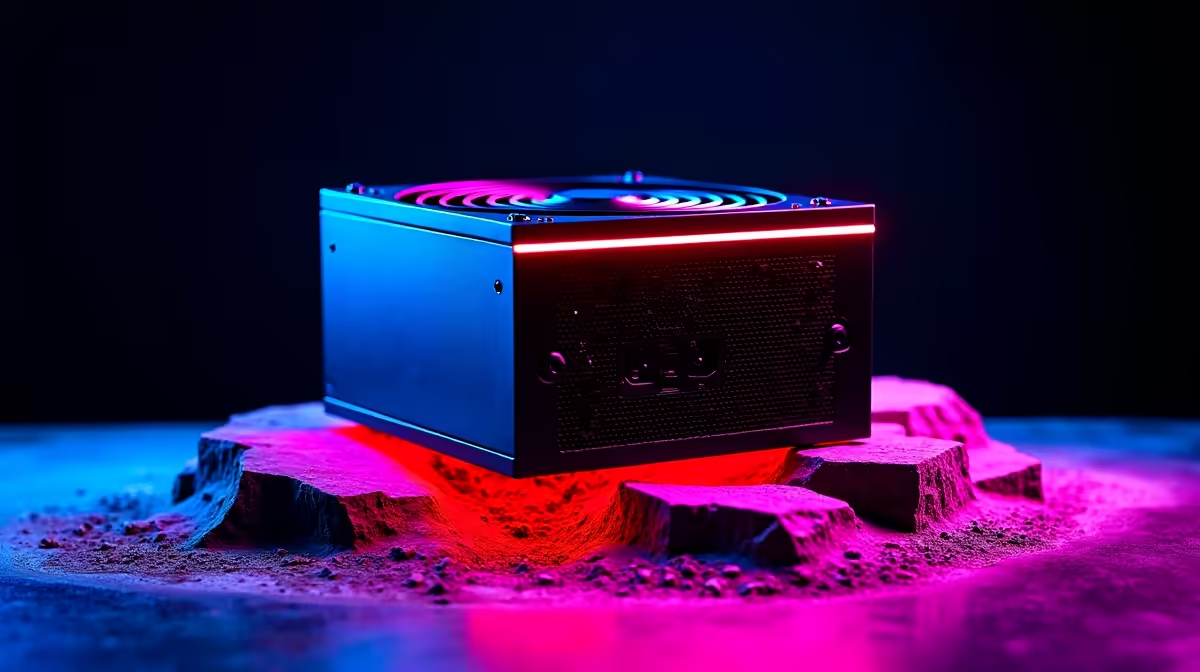
Consumer PSUs are reviewed and rated in 23-degree Celsius lab environments. South African gaming rooms in Gauteng and the Western Cape regularly reach 34 to 38 degrees indoors in summer without air conditioning. A PSU in a 34-degree room runs its primary capacitors roughly 15 to 20 degrees hotter than in a 23-degree lab, because the delta from ambient to internal temperature remains constant while the baseline shifts. Using the Arrhenius model, a 15-degree temperature increase approximately halves remaining capacitor service life. An 85-degree-rated standard capacitor lasting eight years in a European home might last three to four years in a warm SA gaming room under equivalent load. Military-grade 105-degree capacitors begin with a far longer baseline and tolerate this offset without reaching end-of-life prematurely. Premium PSUs with these components retail from around R4,000 to R6,000 for 1000W to 1200W output at Evetech.
Mains Variability and Long-Term Cost 🔧
Older residential areas in South Africa still experience occasional voltage transients as heavy loads switch on and off. A PSU's primary bulk capacitors absorb brief deviations before the switching converter processes them. Standard-grade capacitors lose this capacity as they age; military-grade capacitors with higher rated ripple current maintain it further into their service life. For long-term cost, a quality PSU in the R4,000 to R6,000 range should last eight to twelve years versus three to six years for a budget unit in the same conditions. Over ten years, two or three budget replacements at R2,500 each cost R5,000 to R7,500: more than one quality military-grade unit purchased once.
Combine Premium PSU With a Surge Protector ⚡
A military-grade PSU handles internal thermal and ageing stress well, but external voltage events hit whatever is plugged into the wall first. Pairing your premium PSU with a surge-protected multi-plug rated at least 1,000 joules adds a second layer of protection. This combination costs under R500 extra and is the most cost-effective insurance for your entire hardware investment.
FAQ
Does military-grade refer to a specific certification standard for PSUs?
No universal MIL-SPEC certification applies to consumer PSUs. In the PC market, military-grade refers to component choices: 105-degree-rated capacitors and high-saturation-current chokes. Verify claims by checking explicit temperature ratings in the product specification rather than relying on headline marketing copy.
Are SA summers consistently hot enough to shorten standard PSU life?
For systems in rooms without air conditioning, yes. Gauteng summers average 28 to 32 degrees Celsius indoors in afternoon peak heat, with many days above 35 degrees. Sustained operation under these conditions for four to six gaming hours daily creates cumulative thermal stress that measurably shortens standard-grade capacitor life over a five-to-seven-year ownership period.
Can better case cooling compensate for standard-grade PSU components?
Partially. Improving case airflow lowers PSU intake temperature, reducing internal component temperatures. However, the PSU's own conversion losses set a floor that case cooling alone cannot overcome without active room cooling. A quality PSU with military-grade internals provides a more reliable baseline.
Building a rig that thrives in South African conditions?
Evetech stocks power supplies with military-grade capacitors and extended warranty terms across 850W to 1600W. Visit the power supply category to find units built for the long haul.