Quick Answer
Reinforced tubing prevents micro-cracks and coolant seepage that destroy motherboards over time, while a high-quality pump maintains consistent flow rates that keep CPU temperatures stable for years. Cheap tubing degrades within 18 to 24 months under heat cycling, and a failing pump is the most common cause of catastrophic AIO failure.
Why Tubing Degrades Faster Than You Think 🔧
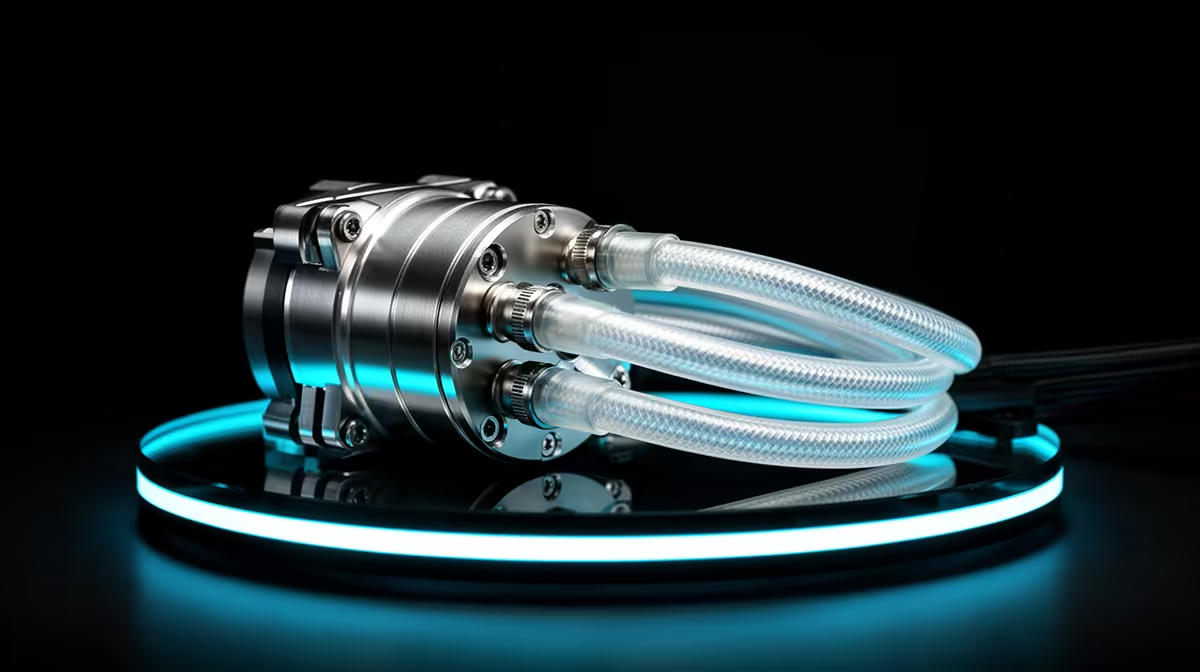
Most budget AIO coolers ship with plain rubber or thin PVC tubing that softens and eventually weeps coolant when subjected to repeated heat cycles. Reinforced tubing, typically sleeved with braided nylon or a multi-layer polymer jacket, resists kinking and maintains its internal diameter under pressure, ensuring steady flow to the radiator. Look for tubing rated to at least 60 degrees Celsius continuous. SA summers, where ambient room temperatures regularly hit 30 degrees Celsius or higher in coastal provinces, accelerate the ageing of inferior tubing noticeably faster than cooler climates.
Pump Quality and Flow Rate Explained 💧
The pump in an AIO is a ceramic-impeller motor rated for 50,000 hours or more on quality units like Corsair iCUE Elite Capellix or NZXT Kraken series. A weak pump running below 1,200 RPM may allow hot spots at the CPU cold plate, especially on high-TDP chips like the Ryzen 9 9950X pushing 200 watts under all-core loads. Better pumps run at 2,000 to 3,000 RPM with micro-fin cold plates. Check for a pump MTBF rating above 50,000 hours when comparing units stocked at Evetech.
What Happens When Either Component Fails 🖥️
A failed pump produces sudden CPU temperature spikes above 95 degrees Celsius under loads that previously stayed under 75 degrees. Weeping tubing may drip coolant for weeks before you notice discolouration on the motherboard. Either failure can write off a CPU, motherboard, and RAM, representing R15,000 to R30,000 in components on a mid-to-high-end SA build. Quality AIO brands back their products with five-year warranties. Monitor pump-speed telemetry through your motherboard software and set an alert if it drops below 800 RPM.
Check Your Coolant Colour Annually ⚡
Most AIO coolants are pre-mixed and sealed, but you can spot early degradation by looking for discolouration around tubing fittings. If coolant turns brown or you see residue at fittings, contact the manufacturer about warranty replacement before a leak develops.
FAQ
How long should quality AIO tubing last in a South African climate?
Braided or reinforced tubing from reputable brands typically lasts five or more years even in warm SA conditions. Plain rubber tubing from budget units may show cracking in as little as 18 months if the PC sits in a hot room without air conditioning.
Can I replace the tubing on my existing AIO if it degrades?
Most sealed AIOs are not designed for tubing replacement. If your tubing shows wear, replacing the entire unit is safer and more cost-effective, especially since pump health cannot be easily serviced independently.
Does pump quality affect noise levels as well as cooling performance?
Yes. A worn pump introduces rattling or grinding sounds as the impeller bearing wears. Premium pumps with ceramic bearings run near-silently at rated speeds, which matters in open-plan home offices or streaming setups where background noise is an issue.
Ready to upgrade to a cooler built to last?
Browse the full range of AIO liquid coolers at Evetech, including reinforced-tubing units backed by five-year warranties. Search "AIO cooler" on the Evetech site to compare current stock.