

Complete Gaming Setup Guide for the SA Esports Athlete in SA 2026
Complete Gaming Setup Guide for the Esports. Clear setup instructions with SA-specific considerations, troubleshooting tips & recommended components.
Read moreStruggling with WiFi clashes in South Africa? 💡 Optimise channel settings for faster, stable networks. 🔥 Avoid interference now.
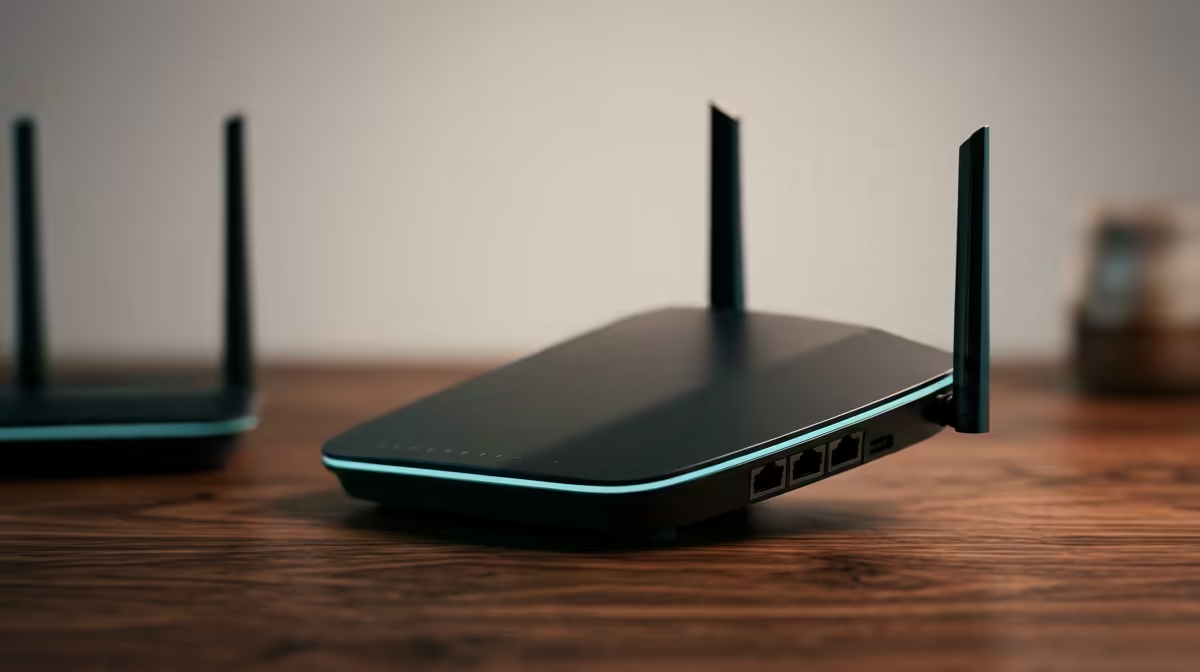
Is your fibre connection feeling more like dial-up during peak hours? You’re paying for 100Mbps, but your game of Apex Legends is a laggy, stuttering mess. It’s a classic South African story, especially in dense complexes. Before you phone your ISP in a rage, the solution might be hiding inside your router. A few simple tweaks to your WiFi channel settings can dramatically boost your speed and stability, and it won't cost you a cent.
Think of WiFi bands like the N1 highway. The 2.4GHz band is the old, original highway with only a few lanes... everyone uses it, from your smart toaster to your neighbour's printer. It gets congested quickly. The 5GHz band is the newer, wider highway with more lanes, offering much faster speeds with less traffic.
Each of these bands is split into smaller lanes called channels. By default, most routers in South Africa are set to "Auto," which often means they all pile into the same popular lanes (channels 1, 6, or 11 on 2.4GHz). When your router and your neighbour's router are both shouting on the same channel, they interfere with each other. This digital noise is what causes random disconnects and those infuriating lag spikes. The right WiFi channel settings move your traffic to a quieter lane.
Imagine living in a complex in Fourways or Century City. Dozens of routers are all broadcasting at once. If everyone is on the default "Auto" channel setting, it's chaos. Your router is constantly fighting to be heard over the noise, slowing everything down. This is why a simple settings change is one of the most effective fixes for poor performance. Manually selecting a less congested channel gives your signal a clear path, often resulting in a more stable and responsive connection for everything from streaming Showmax to landing headshots. For most homes, a quality router from a trusted brand like TP-Link provides the flexibility needed to make these crucial adjustments.
Ready to take control? It’s easier than you think. Finding the best WiFi channel settings for your home takes just a few minutes.
First, you need to see which channels are the busiest.
netsh wlan show networks mode=bssid command in Command Prompt or download a third-party app.Option key and click the WiFi icon in your menu bar. Select "Open Wireless Diagnostics," then go to Window > Scan in the menu bar.Look for the quietest channels… the ones with the fewest networks on them. For the 2.4GHz band, stick to channels 1, 6, or 11 as they don't overlap and interfere with each other.
Find your router's IP address, which is usually printed on a sticker on the device itself (commonly 192.168.0.1 or 192.168.1.1). Type this into your web browser. You'll need the admin username and password, also found on the sticker. Once you're in, look for "Wireless," "WLAN," or "WiFi Settings."
If your devices and router support it, prioritise the 5GHz band for gaming and streaming. It's like having your own private fast lane on the N1... without the e-tolls. It offers more channels and much less interference.
Inside your wireless settings, you'll see options for both 2.4GHz and 5GHz channels. Change the setting from "Auto" to the quietest channel you identified in step one. For the 2.4GHz band, choose whichever of 1, 6, or 11 is least crowded. For 5GHz, you have many more options, so just pick an empty one. Save your settings, and your router will reboot. That's it! You've just optimised your WiFi channel settings. Many modern routers, including affordable yet powerful options from brands like Cudy, make this process incredibly straightforward.
Optimising your channels is a powerful fix, but it can't solve everything. If you've tweaked your settings and still face dead spots in your double-storey house or constant buffering, your hardware might be the bottleneck. An older router may not be able to handle the demands of multiple 4K streams and gaming sessions. For absolute, rock-solid stability for a gaming PC or console, nothing beats a physical connection. Exploring a wired networking setup can eliminate WiFi variables entirely, giving you the lowest possible latency.
Ready for a Lag-Free Life? Optimising your settings is a great first step, but old hardware can still hold you back. Explore our massive range of powerful wireless networking gear for performance that leaves lag in the dust.
Selecting non-overlapping channels like 1, 6, or 11 in 2.4GHz and 36-64 in 5GHz reduces interference significantly.
Optimal channel settings avoid overlapping signals, which minimises interference, improving speed and connectivity.
High router density in SA causes interference. Proper channels ensure smoother, more reliable home network performance.
Access your router’s admin panel, find wireless settings, choose the appropriate channel, and save the changes.
The 5GHz band offers more channels and less congestion, making it ideal for minimising interference and maximising speed.
Yes, overlapping channels cause interference, leading to slower speeds, buffering, and poor connectivity.
Use WiFi analyser apps like WiFi Analyzer (Android) or iNet (iOS) to identify congested channels and choose optimal ones.
Most modern routers offer manual settings, although some automatically select channels, which might not always be optimal.
Complete Gaming Setup Guide for the Esports. Clear setup instructions with SA-specific considerations, troubleshooting tips & recommended components.
Read more
AIO Liquid 360mm Installation Guide for Your PC. Clear setup instructions with SA-specific considerations, troubleshooting tips & recommended components.
Read more
MacBook Display Colour Looks Wrong? Calibration. Everything you need to know with SA pricing, step-by-step instructions & expert recommendations.
Read more
Printer Terminology Guide. Everything you need to know with SA pricing, step-by-step instructions & expert recommendations.
Read more
Git on Mac: Complete Setup Guide for Beginners. Clear setup instructions with SA-specific considerations, troubleshooting tips & recommended components.
Read more
Ryzen 9 9900X Thermal Paste Dry: Reapplication. Everything you need to know with SA pricing, step-by-step instructions & expert recommendations.
Read more
AMD RX 9050 XT: Rumoured Specs, Price & Release. SA-focused analysis with local pricing data, real-world insights & actionable buying advice.
Can RTX 4080 Super Run AI Workloads for SA Developers Detailed answer with SA data, expert analysis & practical recommendations for local buyers.
Can RTX 4090 Run AI Workloads for SA Developers Detailed answer with SA data, expert analysis & practical recommendations for local buyers.
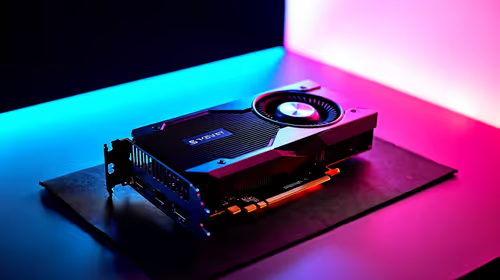
Top Settings for Intel Arc B580 at Ultrawide 1440p picks evaluated on performance, value & SA availability with current Rand pricing from Evetech.

RTX 4060 CS2 Low Settings at 1080p: FPS Results. Real-world benchmark data, FPS numbers & performance analysis. What SA gamers can actually expect.

Visual Artifacts: Possible GPU Issue Issue #1. Diagnosis steps, proven fixes & when to seek professional help. SA-specific support info included.
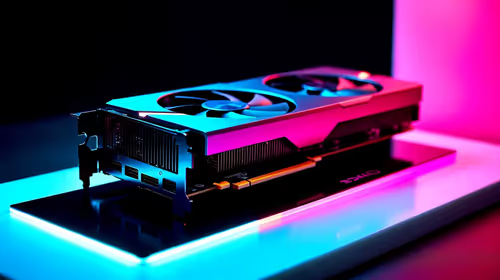
Can the RTX 4090 Handle 1440p 144Hz Gaming. Performance testing verdict with real data & practical recommendations for SA buyers.

Top ASUS GPU Under R15000 picks evaluated on performance, value & SA availability with current Rand pricing from Evetech.
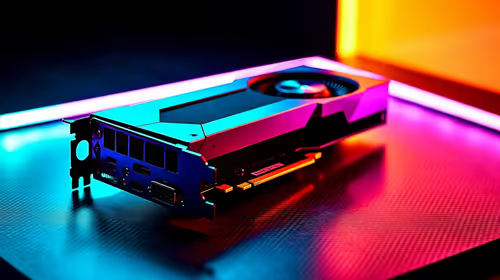
GTA 6 Max Settings on RTX 5070. Tested & verified settings for best FPS and visual quality on SA hardware budgets.
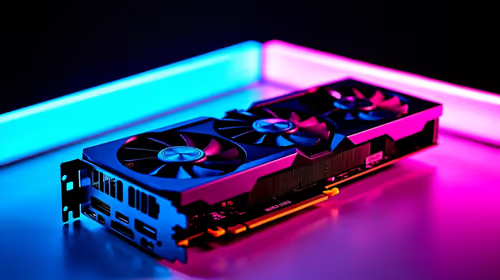
Cyberpunk 2077 Max Settings on RTX 5080. Tested & verified settings for best FPS and visual quality on SA hardware budgets.
Starfield Max Settings on RTX 5070 Ti. Tested & verified settings for best FPS and visual quality on SA hardware budgets.
Top RTX 5090 Under R5000 picks evaluated on performance, value & SA availability with current Rand pricing from Evetech.