Search for a release date and you will find dozens of confident articles, leaked screenshots and YouTube thumbnails promising a launch any month now. Almost all of it is noise. The honest state of Windows 12 in 2026 is that Microsoft has not announced it, has not given it a name on any official roadmap, and has not committed to a single requirement. Here is what holds up to scrutiny and what is recycled speculation.
Quick Answer
As of mid-2026, Windows 12 does not officially exist. Microsoft has made no announcement, set no release date, and confirmed no system requirements, and informed assessments now point to 2027 at the earliest for even an announcement. The widely repeated 40-TOPS NPU requirement is leak-and-rumour material, not a Microsoft statement. If you need a machine now, buy for Windows 11, which is current, supported and stable.
What Microsoft has actually said
Microsoft's public messaging has pointed in the opposite direction to the rumour mill. At CES, an executive framed the period as the year of the Windows 11 PC refresh, language that signals investment in the current operating system rather than a successor waiting in the wings. There has been no keynote unveiling, no developer preview branded Windows 12, and no entry on Microsoft's release-health pages for such a product.
That matters because real Windows releases follow a visible pattern: insider builds, named feature updates, published lifecycle dates. None of that exists for Windows 12. What does exist is a steady drumbeat of articles that trace back to abandoned internal codenames and to one another, a feedback loop where speculation gets cited as though it were confirmation.
Where the rumours come from
Most of the Windows 12 chatter has a traceable origin. An early modular architecture project, sometimes referenced as CorePC, and a codename that circulated years ago got stitched together with newer AI-PC marketing into a single imagined product. Add AI-generated summaries that confidently restate the guesswork, and you get a body of content that looks authoritative but rests on very little.
The 40-TOPS NPU figure is the clearest example. The idea that a future Windows might demand a neural processing unit above 40 trillion operations per second comes from leaks and from Microsoft's existing Copilot Plus PC marketing, where a similar NPU threshold already applies to certain on-device AI features in Windows 11. Extrapolating that into a hard requirement for an unannounced operating system is plausible-sounding, but it is not a published specification. Treat any spec sheet for Windows 12 as fiction until Microsoft puts its name on it.
The picture that actually affects your buying decision
The genuinely important dates are about Windows 10 and Windows 11, not Windows 12.
Windows 10 reached end of support on 14 October 2025. Microsoft no longer ships it free security updates, with paid Extended Security Updates extending protection only until October 2026 for those who enrol. If you are still on Windows 10, that is the deadline driving your decision, not a phantom future release.
On the current side, Windows 11 keeps moving through ordinary servicing. Version 25H2 shipped as an enablement package on the same underlying platform as 24H2, meaning the codebase barely changes when you move between them, and Microsoft has been pushing eligible machines onto 25H2 automatically. A separate 26H1 release is scoped narrowly for new hardware arriving in early 2026 rather than as a feature update for existing PCs. This is the normal cadence of a healthy, supported operating system, and it is the environment any computer you buy today will run in.
Should you wait for Windows 12?
No. Waiting for an unannounced product with no date is a recipe for sitting on ageing or unsupported hardware indefinitely. The Windows news pages tracking this story consistently land on the same conclusion: there is no Windows 12 to wait for in 2026. If your current machine is slow, out of support or struggling, the right move is a current Windows 11 system now, not a pause for something that may be two years or more away and whose requirements nobody can confirm.
How to read the next round of rumours
This story will not go quiet, so it helps to have a filter for the next wave of headlines. Apply three simple tests before believing any Windows 12 claim. First, is the source pointing to an official Microsoft channel, a keynote, a published lifecycle page, an insider build actually branded as the new version? If it is citing leakers, anonymous insiders or another article, treat it as rumour. Second, does the claim restate a number or feature that already exists in Windows 11, like the Copilot Plus NPU threshold, and simply attach it to a future release? That is extrapolation dressed as news. Third, does a date come with any commitment behind it, or is it a guess phrased confidently?
Almost everything circulating fails at least one of those tests. The genuine signals, when they come, will look completely different: a named preview build, a published set of requirements, a clear lifecycle entry. Until those appear, the responsible reading is that nothing has changed and the Windows 11 you can buy today remains the current, supported platform.
What actually would change your timing
There is one development worth watching, and it is not a Windows 12 announcement. It is the end-of-support calendar. The dates that should drive a purchase are concrete: Windows 10's support ending, the paid extended-update window closing in October 2026, and the ordinary servicing cadence of Windows 11 feature updates. Those are real, published and binding, and they are what should shape when you upgrade. A phantom future release should not. If you let an unannounced product dictate your timing, you risk running unsupported software while you wait for something that may never arrive on the schedule the rumours promise.
Buying with confidence today
The good news is that a Windows 11 machine bought now is not at risk of obsolescence from a surprise launch. Even in the unlikely event Windows 12 arrived sooner than expected, modern hardware bought for Windows 11, with a capable processor, a TPM 2.0 security chip and a sensible amount of memory, sits exactly where any AI-focused future Windows would want it to be. You are not buying a dead end.
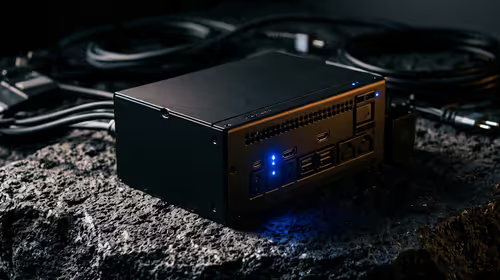
For most people the practical question is simply which form factor fits. A compact, low-power mini PC from the Evetech range suits a tidy desk, a media setup or a light home office, while a full tower makes more sense for gaming or heavy work. Whatever you choose, look at the best-selling PCs at Evetech for machines already specced for a long, supported life on Windows 11 rather than holding out for a release that has not been announced.
Frequently Asked Questions
Has Microsoft officially announced Windows 12?
No. As of mid-2026 there has been no official announcement, no release date and no confirmed requirements. Microsoft's public statements have focused on the Windows 11 refresh, and there is no Windows 12 entry on its official release-health pages.
Is the 40-TOPS NPU requirement for Windows 12 real?
It is unconfirmed speculation. The figure echoes the NPU threshold already used for some Copilot Plus features in Windows 11, but Microsoft has not published any system requirements for a Windows 12, so treat that number as a rumour rather than a specification.
When will Windows 12 actually launch?
Nobody outside Microsoft knows, and Microsoft has not said. The most grounded assessments now suggest 2027 at the earliest for even an announcement, with several pointing out that there are no plans to ship it in 2026.
Should I wait to buy a PC until Windows 12 arrives?
No. There is no confirmed product or date to wait for, and waiting risks running unsupported hardware. A current Windows 11 machine with a modern processor and TPM 2.0 is the sensible buy and will be well positioned for whatever comes next.
What happened to Windows 10?
Windows 10 reached end of support on 14 October 2025 and no longer receives free security updates. Paid Extended Security Updates run only to October 2026, so moving to a Windows 11 machine is the practical path for anyone still on Windows 10.
Do not put off an upgrade waiting for a release that has not been announced. Pick a supported, ready-for-the-future machine from the mini PC range at Evetech and get on stable Windows 11 today.