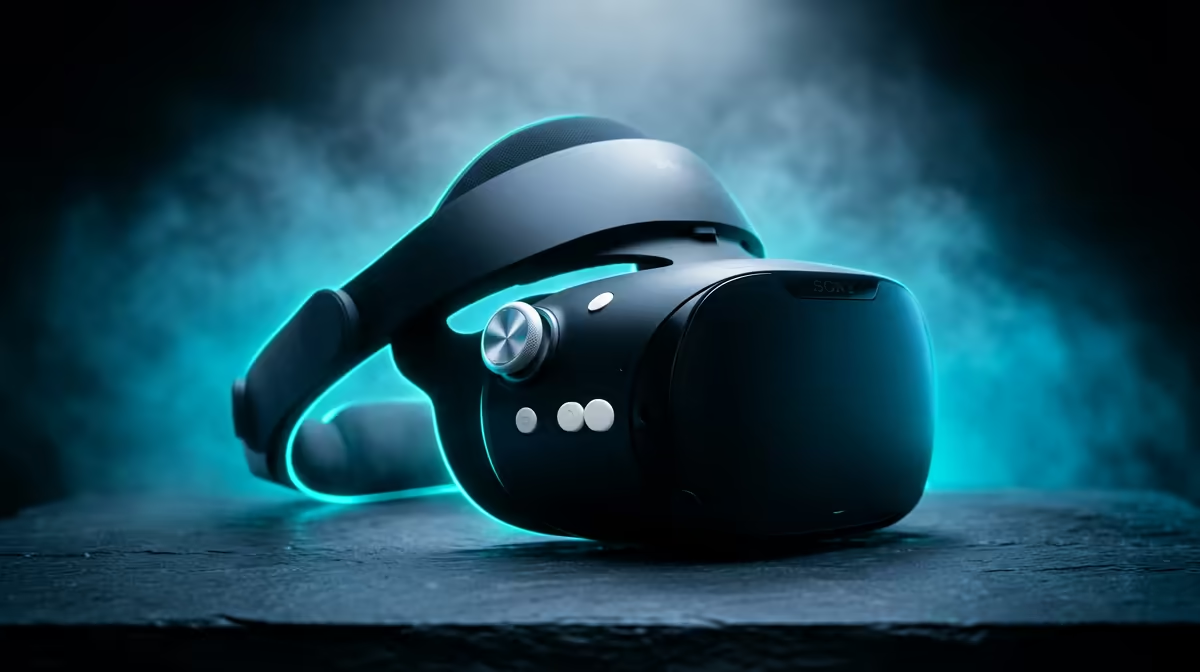
Three ways to feed your gaming PC's horsepower into a Meta Quest, three very different experiences. Choosing between Wired Link, Air Link, and Steam Link decides whether your PC VR looks razor-sharp and stable or soft and laggy, and on a typical South African home network the gap between them is bigger than most people expect.
Quick Answer
Wired Link, using a USB-C cable, gives the most stable bandwidth with the least compression, which makes it the safest pick for consistent, sharp PCVR. Air Link and Steam Link stream wirelessly over your network and add latency and compression. On patchy SA home Wi-Fi, a wired USB-C Link cable delivers the most reliable frame rates.
How the Three Connections Differ
All three do the same job: send rendered frames from your PC to the Quest and send your head and controller movement back. The difference is the pipe.
Wired Link
A USB-C cable carries the video directly from PC to headset. Bandwidth is high and consistent, compression is minimal, and your network conditions are irrelevant because nothing touches Wi-Fi. The trade-off is a tether: a cable running from your PC to your face, which you feel during room-scale movement.
Air Link
Meta's own wireless solution streams over Wi-Fi. It is convenient and frees you from the cable, but it leans heavily on your network. The PC compresses each frame, sends it over Wi-Fi, and the headset decompresses it, all of which adds latency and can introduce compression artefacts in busy scenes.
Steam Link
Valve's app streams SteamVR titles to the Quest over Wi-Fi, similar in concept to Air Link but routed through SteamVR. It is handy if your library lives on Steam, though it shares the same wireless dependency and compression compromises.
Why Your SA Network Matters So Much
Wireless PCVR is only as good as your Wi-Fi. The two wireless options need a strong, low-interference 5GHz or 6GHz connection, ideally with the PC on wired ethernet and the headset close to the router. In a flat or townhouse where the router is shared across phones, TVs, and a household of devices, congestion and interference cause stutters, sudden quality drops, and latency spikes that break immersion.
This is the core reason wired wins for many SA setups. A USB-C cable bypasses every network variable. If your home Wi-Fi is crowded or the router sits a couple of rooms away, no amount of in-headset tweaking fully fixes wireless PCVR. The wired path simply does not have that problem.
Latency and Image Quality Compared
Latency is the delay between moving your head and the image updating. Wired Link keeps this lowest and most consistent. Air Link and Steam Link add encode, transmit, and decode time on top, and that figure swings with network load. A stable wireless link can feel close to wired; a congested one feels noticeably behind.
Image quality follows the same pattern. Less compression on the wired link means cleaner detail, especially in fast motion and high-contrast scenes where wireless compression tends to smear. For competitive or precision titles, that clarity is worth the tether.
Where wireless still makes sense
Wireless is not a write-off. If you have a dedicated VR-grade router placed close by, a strong signal, and you value freedom of movement over absolute fidelity, Air Link or Steam Link can be excellent. Room-scale and rhythm games in particular benefit from losing the cable. The decision is genuinely about your space and your network, not a blanket "wired is always better".
Encoding, Bitrate, and What You Can Tune
Wireless PCVR gives you settings to play with, and they change the experience a lot. Bitrate controls how much detail survives compression: higher bitrate looks cleaner but demands more from your network, and pushing it too high on a weak connection causes stutter instead of clarity. Finding the bitrate your network sustains reliably is the single most useful wireless tweak.
The encoder on your graphics card also matters. A capable GPU compresses each frame quickly, which keeps latency lower, so a stronger card helps wireless PCVR as well as wired. If your PC struggles to encode frames in time, no network tuning rescues it, which is part of why a solid GPU underpins good VR either way.
Wired Link has fewer dials because it needs fewer. With ample bandwidth down the cable, you can simply run a higher quality setting and leave it, without the constant balancing act that wireless demands. That simplicity is part of its appeal for people who would rather play than tune.
Comfort, Movement, and Real-World Use
The cable is the honest downside of wired. For seated or standing games it barely registers, but for room-scale titles where you spin and duck, a tether can catch or tug. A ceiling pulley or cable management clip relieves most of this, turning the cable into a non-issue for many players.
Wireless removes the tether entirely, which is genuinely freeing for active games. The compromise is that you are now at the mercy of your network for the whole session, and a single interference spike can yank you out of immersion. Many SA players end up keeping a wired cable for demanding, precise titles and switching to wireless for casual, movement-heavy ones, getting the best of both rather than committing to one.
Setting Each One Up
For Wired Link, you need a high-quality USB-C cable that supports sufficient data bandwidth; not every charging cable qualifies. A compatible cable plus a free USB 3 port on your PC is all it takes. Picking the right cable matters as much as picking the method, and the AR and VR accessories at Evetech are a good place to match a cable or headset to your rig.
For Air Link and Steam Link, the priority is your network: wire the PC to the router by ethernet, get the headset onto a clean 5GHz or 6GHz band, and keep other heavy traffic off the network while you play. A few small additions can tighten a setup, and the accessory best sellers are an easy way to find the cables and adapters that round it out.
Frequently Asked Questions
Which is best for competitive PC VR on a Quest?
Wired Link. The lowest, most consistent latency and the least compression give you the sharpest image and quickest response, which matters most in fast or precision titles.
Can Air Link match a wired connection?
On an excellent, uncongested network with the PC on ethernet and the headset close to a fast router, Air Link can feel close to wired. On a typical busy home network, it falls behind with added latency and occasional quality drops.
Does any USB-C cable work for Wired Link?
No. You need a cable that supports enough data bandwidth and adequate length. Many charging cables lack the data throughput, so a purpose-made or verified high-bandwidth USB-C cable is the safe choice.
Is Steam Link or Air Link better?
They are very similar in performance since both stream over Wi-Fi. Steam Link suits libraries centred on SteamVR, while Air Link is Meta's native route. Your network quality affects both far more than the choice between them.
Why is my wireless PCVR stuttering?
Almost always network congestion or weak signal. Put the PC on wired ethernet, move the headset closer to the router, switch to a 5GHz or 6GHz band, and keep other devices off the network while playing.