Quick Answer
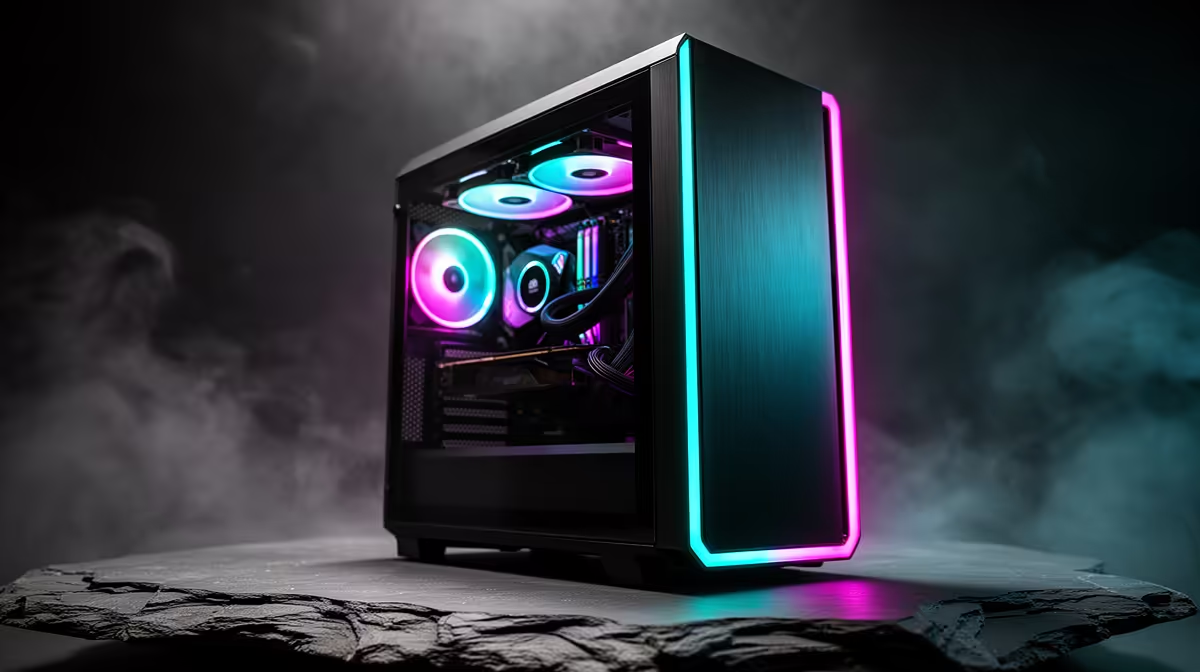
For high-end PC builds in South Africa, a quality mid-tower at R1,800 to R2,800 handles the vast majority of ATX configurations. A full-tower at R3,000 to R4,800 is justified only when you need E-ATX board support, 420mm front radiator mounting, or 420mm to 450mm GPU clearance for the largest current-gen cards.
Mid-Tower: Where the Value Is at High-End 💰
A premium mid-tower in the R2,000 to R2,800 segment competes credibly with full-towers for most high-end gaming builds. A case in this range typically supports ATX and some EATX boards, front 360mm radiator, top 240mm or 280mm radiator, GPU clearance of 380mm to 420mm with cage removed, three to four pre-installed fans, and a push-latch tempered glass side panel. This covers an RTX 5080 build on a standard Z890 or X870 ATX board with a 360mm AIO CPU cooler, the most common configuration for high-end SA gaming builds in the R45,000 to R65,000 component range. The R500 to R1,500 saved by staying in the mid-tower tier is better directed at GPU or memory.
Full-Tower: When the Extra Spend Is Justified 🖥️
Full-tower cases in the R3,000 to R4,800 range earn their premium in specific configurations. E-ATX or XL-ATX boards for AMD Threadripper or Intel Extreme Edition platforms physically require a full-tower tray. Builders fitting a 420mm front AIO for a Ryzen 9 9950X, combined with a 360mm top radiator for additional cooling, need full-tower internal volume because mid-towers cannot support both simultaneously. For these specific use cases the R1,000 to R2,000 premium over a mid-tower is a functional requirement, not a luxury.
SA-Specific Cost Comparison Over Time 🇿🇦
South African PC builders face higher component replacement costs than most markets because rand depreciation inflates prices during component generation transitions. A full-tower case purchased today at R3,500 that accommodates three GPU generations is a stronger investment than a cheaper mid-tower at R1,600 that forces a case replacement when clearance requirements exceed 400mm. Factor total ownership cost rather than upfront price. At the same time, choosing a full-tower when a mid-tower meets your actual requirements means R1,000 to R2,000 less for GPU RAM or an NVMe SSD upgrade, which has a larger day-one performance impact.
Decide on Form Factor Before the Motherboard ⚡
Choose mid-tower or full-tower based on your platform and cooling plan before selecting a motherboard. An EATX board bought for its extra PCIe lanes then placed in a mid-tower that does not genuinely support EATX results in an unsupported board and wasted spend. Platform choice drives case choice, not the reverse.
FAQ
Can a high-end gaming PC overheat in a mid-tower case?
Not if the mid-tower has adequate front-panel airflow and GPU clearance for the specific components. Thermal problems in mid-towers typically stem from solid front panels restricting intake. A quality mesh-front mid-tower at R2,200 outperforms a solid-front full-tower at R2,800 in most airflow benchmarks.
Is a full-tower significantly harder to transport?
Yes. Full-towers weigh 10 to 16 kg and are more awkward to carry due to their height. If you move your PC regularly between home and LAN events, a compact mid-tower is meaningfully easier to handle.
Do mid-towers have worse cable management than full-towers?
Quality mid-towers at R2,000 to R2,800 have cable management comparable to full-towers at the same price. The difference appears at budget price points where full-tower dimensions do not translate to better routing channels. Spend drives quality more than case size.
Not sure whether mid-tower or full-tower fits your build?
Browse Evetech's full case range and filter by form factor to find the right match for your components and budget.