Quick Answer
Built-in ARGB fans are worth it when the case costs less than buying the same case plus equivalent fans separately, which is almost always true in the R1,200 to R2,000 tier. A 360 mm radiator support is worth it for CPUs with 170 W TDP or higher, specifically Ryzen 9 9000-series and Core i9 14th or Core Ultra 9 200-series chips. Below those thresholds, a 240 mm or 280 mm AIO is sufficient and costs less.
When Built-In ARGB Fans Justify the Case Price 💰
The value calculation is straightforward: a case with six ARGB fans included at R1,800 versus a bare-bones case at R1,100 plus six mid-range 120 mm ARGB fans at R200 to R350 each totals R2,300 to R3,200. The bundle wins by R500 to R1,400. The caveat is fan quality: bundled fans in cases under R1,500 often peak at 1,000 to 1,200 RPM and generate around 18 to 22 dBA, which is quiet but may not provide enough static pressure for dense radiators. Cases in the R1,500 to R2,200 range from Lian Li, Phanteks, and Cooler Master typically include fans that perform adequately for builds up to an RTX 5070 with a Ryzen 7 CPU. The biggest bonus in a bundled setup is the pre-wired ARGB daisy-chain, which eliminates the need for a separate ARGB hub worth R300 to R500.
When 360mm Radiator Support Is Worth the Premium 💧
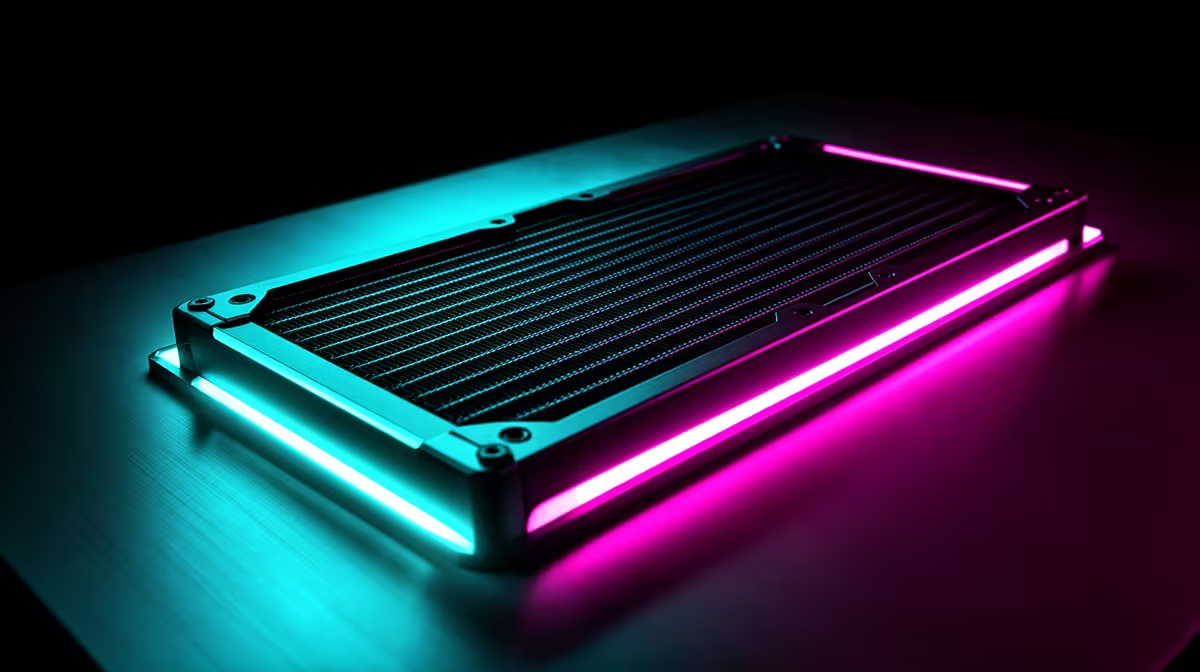
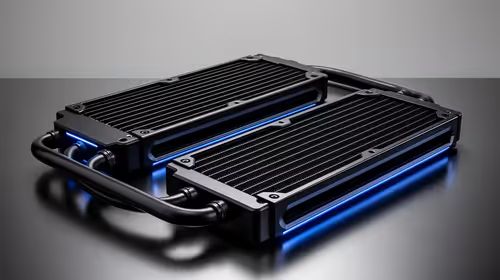
A case with 360 mm radiator support typically costs R200 to R600 more than an otherwise identical case capped at 240 mm. That premium is justified when your CPU has a 170 W or higher TDP: the Ryzen 9 9900X at 120 W base but 170 W PPT, the Ryzen 9 9950X at 170 W, and the Core Ultra 9 285K at 250 W all benefit from a 360 mm AIO versus a 240 mm unit. Practically, a 360 mm AIO keeps a Ryzen 9 9950X at 80 to 85 degrees Celsius sustained versus 90 to 96 degrees Celsius on a 240 mm under Cinebench all-core. For Ryzen 7 9700X and Core i7 13700K builds, a 240 mm or 280 mm AIO is entirely adequate and the 360 mm support is unused premium.
The Combined Case: Both Features Together 🔧
Cases that combine ARGB fan bundles with 360 mm radiator support sit at R1,800 to R2,800 in the South African market. This tier makes sense for builders planning a high-end CPU and GPU combination, specifically a Ryzen 9 9950X or Core Ultra 9 285K paired with an RTX 5080, where both the ARGB aesthetic and the 360 mm thermal capacity are used. For a Ryzen 5 or Ryzen 7 build with a mid-range GPU, paying for 360 mm support you will never use is a budget inefficiency. Redirect that R400 to R600 saving into a better GPU or additional RAM.
Match Radiator Support to Your Actual CPU TDP ⚡
Check your CPU's actual TDP before deciding whether to pay for 360mm radiator support. A Ryzen 7 9700X has a 65 W TDP (up to 88 W PPT) and will run comfortably on a 240 mm AIO at under 75 degrees Celsius in a well-ventilated case. Spending R500 more on a case for 360 mm support you will not use is a straightforward saving if you redirect it to better fans or an extra NVMe SSD.
FAQ
Is it worth paying R600 more for a case with built-in ARGB fans versus adding fans later?
Usually yes, because the total cost of adding equivalent fans plus an ARGB hub later exceeds the case price premium by R200 to R600. The exception is when you want high-performance fans from a specific brand that your case choice does not include.
Do ARGB fans bundled with cases work with Gigabyte RGB Fusion?
Yes, if the fans use a standard 5 V 3-pin ARGB header. Gigabyte RGB Fusion 2.0 supports standard ARGB devices on compatible motherboards. Proprietary connectors will not integrate without an adaptor.
At what CPU TDP does a 360mm AIO become necessary rather than optional?
At 150 W sustained TDP and above, a 360 mm AIO provides a meaningful cooling improvement over 240 mm. Below 120 W, a 240 mm unit handles the thermal load efficiently and the extra cost is hard to justify on performance grounds alone.
Want to find the right case for your CPU and budget in ZAR?
Browse Evetech's range of ARGB and radiator-ready cases with local stock and prices in rand, available for delivery across South Africa.