Quick Answer
In the South African market, the high-refresh monitor features that deliver the most value per rand are refresh rate (144Hz minimum), adaptive sync with LFC (FreeSync Premium), and 1ms GtG response time. Features like HDR400, RGB lighting, and curved OSD presets add cost without meaningful gaming improvement. Prioritise specs that directly affect how the image moves; everything else is secondary.
The Features That Move the Needle in SA 🏆
South African gamers operate in a rand-constrained environment where every R1,000 of monitor spend should buy a measurable gameplay benefit. Refresh rate is the clearest value driver: 144Hz over 60Hz is a dramatic, immediately perceptible improvement that costs R1,500 to R2,000 at 27-inch FHD. FreeSync Premium certification, now standard at R4,000 and above, adds LFC which protects frame pacing during GPU-intensive moments. The 1ms GtG spec on Fast-IPS and Fast-VA panels eliminates the worst pixel ghosting without additional cost at this tier. These three features together define the value baseline: if your target monitor has all three, it delivers the competitive minimum for modern gaming in South Africa.
Features That Rarely Justify Their Premium in SA 💸
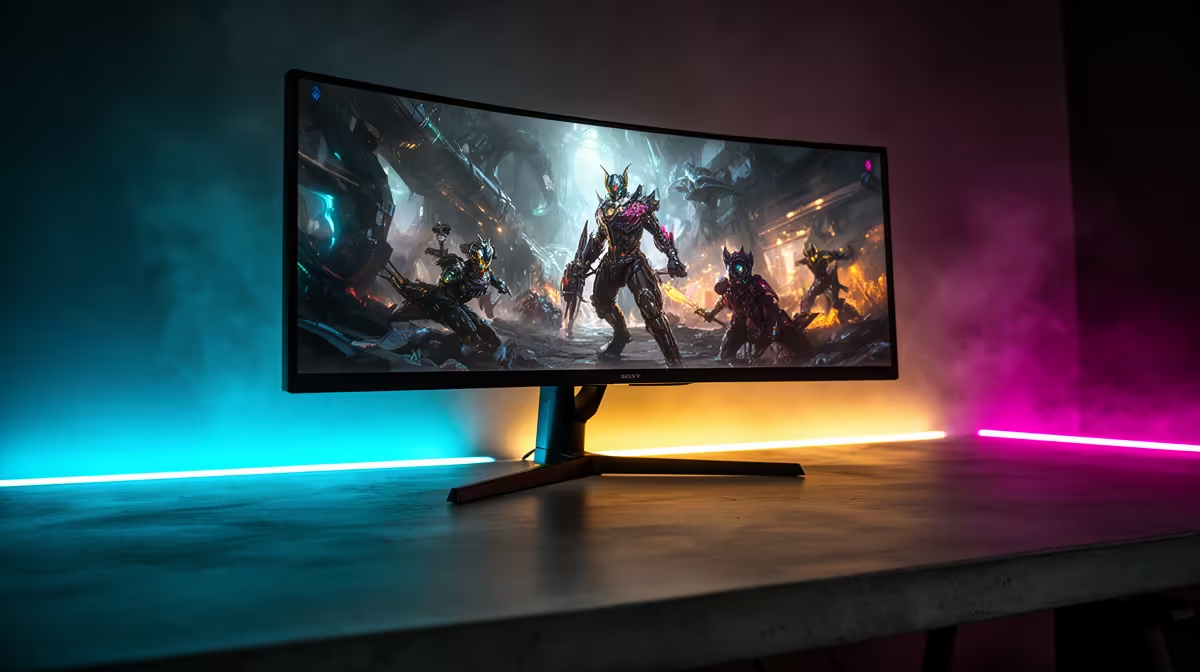
HDR400 certification is the most commonly misunderstood monitor feature in the SA market. It represents a minimum brightness spec with no local dimming requirement. In practice, HDR400 monitors display HDR-flagged content with minimal visible difference from SDR equivalent. True HDR requires HDR600 or higher with local dimming, found only on panels above R8,000 to R10,000. Paying a R500 to R1,000 premium for HDR400 over a non-HDR equivalent is a poor value decision for most SA buyers. RGB lighting on monitor stands and bezels is cosmetic and adds to street price without affecting image quality or competitive performance.
Features Worth the Step-Up Cost 🖥️
Two features are worth a deliberate spend increase. The first is 1440p resolution at 27 inches (from R7,000 upward locally): it sharpens text and fine detail substantially for productivity-gaming hybrid use cases. The second is 250Hz over 144Hz when your GPU can consistently deliver 200-plus fps in your main game. Both produce genuinely visible improvements that justify their rand cost when your use case aligns. OLED panels, currently starting around R10,000 to R15,000 locally, represent the largest per-feature jump in visual quality. For competitive gaming, a QD-OLED at 240Hz delivers near-zero pixel response and outstanding contrast that no LCD can match at any overdrive setting.
Focus on Three Numbers ⚡
comparing monitors in the SA market, focus on three numbers first: refresh rate in Hz, response time in ms GtG, and adaptive sync certification level. Write those down for each candidate before looking at anything else. These three determine competitive gaming suitability more reliably than any marketing label, panel brand name, or curvature claim on the product page.
FAQ
Is there a meaningful difference between 1ms and 4ms response time at 144Hz?
At 144Hz each frame is displayed for 6.9ms. A 4ms GtG response means the slowest pixel transitions take more than half the frame duration, which introduces visible ghosting in high-contrast motion.
What does FreeSync Premium actually do for South African mid-range GPU users?
For a gamer running an RX 7600 or RTX 4060, FreeSync Premium actively stabilises the frame rate experience during graphically intensive scenes where fps dips.
Is buying a gaming monitor from a grey-import channel in South Africa worth the savings?
Rarely. Grey imports typically offer no local warranty support, requiring costly international shipping for repairs. The R500 to R1,000 saving on a grey-import R5,000 monitor evaporates with one warranty claim.
Looking for the best feature set per rand on a high-refresh gaming monitor?
Evetech stocks a curated range of gaming monitors focused on real performance specs, all with local warranty backing.