Quick Answer
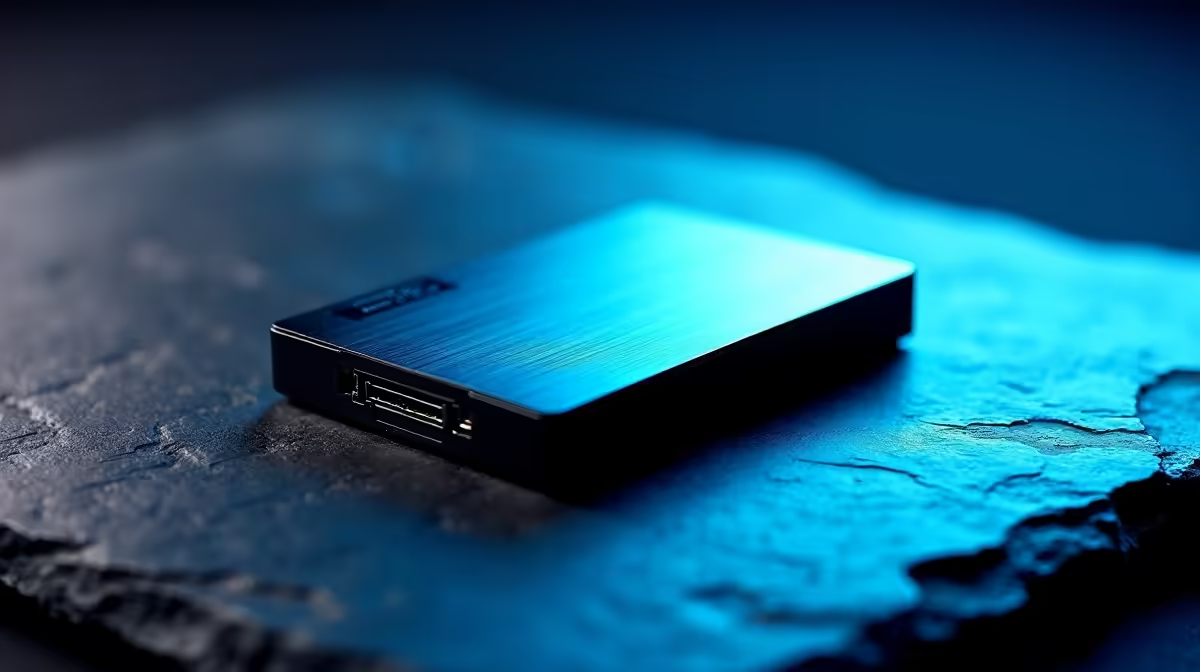
The best SSDs for students in South Africa in 2026 are the Samsung 870 EVO (SATA) for budget laptop upgrades and the Samsung 980 or Kingston NV3 (NVMe) for performance builds. For NSFAS-budgeted students, a 500GB NVMe SSD can be found for R400 to R600, making it one of the highest-impact upgrades for any student laptop.
For South African students heading into 2026, a fast SSD is arguably the single best upgrade you can make to a student laptop. Whether you are in res at UCT, studying remotely in a digs in Pretoria, or commuting as a vaalie, the difference between a laptop with a spinning HDD and one with an SSD defines whether your device boots in 7 seconds or 40 seconds - and whether compiling code, rendering a presentation, or opening 20 browser tabs for research feels snappy or agonising. NSFAS allows for laptop purchases up to R5,200, and even below that ceiling there is room to prioritise SSD storage.
What Type of SSD Do You Need?
Student laptops in SA fall into two main storage interface categories: SATA and NVMe. Older laptops (typically pre-2019 budget models) use a 2.5-inch SATA bay, while newer thin-and-light laptops use an M.2 slot that may support either SATA or NVMe (PCIe) speeds. Before purchasing any SSD, confirm which interface your laptop supports - checking your laptop's model page or opening the bottom panel to inspect the existing drive.
NVMe SSDs are significantly faster than SATA for large file operations (sequential reads of 3,000 to 7,000 MB/s versus SATA's 550 MB/s ceiling), but for everyday student tasks - writing documents, browsing, spreadsheets, and video calls - both feel fast. The practical difference shows when you are moving large video files, running virtual machines, or working with large datasets in Python or R.
Top SSD Picks for SA Students by Budget
For students with R400 to R600 to spend, the Kingston NV3 500GB offers excellent value. It delivers PCIe 3.0 NVMe speeds and uses a DRAM-less design that keeps costs low without meaningfully impacting everyday student workloads. Its 5-year warranty gives good peace of mind for a device that will be carried in a bag through SA campuses daily.
For R600 to R900, the Crucial P3 Plus or Samsung 980 500GB step up to PCIe 4.0 performance. The Samsung 980 is particularly well regarded for consistency - it does not throttle as aggressively during sustained writes, which matters if you are regularly backing up project files or running large data processing tasks.
At the 1TB capacity tier (R800 to R1,200), the Kingston NV3 1TB or WD Blue SN580 become the value leaders. Choosing 1TB over 500GB makes sense for any student who downloads course content, keeps large project files, or uses creative software like Adobe Premiere or DaVinci Resolve for video assignments.
For SATA-only laptops, the Samsung 870 EVO 500GB remains the benchmark recommendation at R500 to R700. It is reliable, well-supported, and easy to install. Avoid very cheap, no-name SATA SSDs on SA online marketplaces - they frequently use lower-quality NAND that degrades quickly under the daily read/write cycles of a student workload.
Installation and What to Expect
SSD installation on most laptops involves removing the bottom panel with a Philips head screwdriver, swapping the old drive for the new SSD, and reinstalling Windows using a USB recovery drive. Most SA students will find step-by-step video guides sufficient, and many laptop models have bottom panels that open with four to six screws.
If cloning your existing Windows installation (to avoid reinstalling everything), software like Macrium Reflect Free handles this without cost. The process takes 30 to 60 minutes depending on how much data you are migrating.
After installation, expect boot times under 15 seconds, application launches 3x to 5x faster than an HDD, and a significant reduction in the lag that plagues budget laptops during multitasking. It is the upgrade that makes a R5,000 student laptop feel like a R10,000 device.
Reliable Everyday Performance
SA students face a unique hardware risk: sudden power cuts during an unexpected outage can interrupt a laptop mid-write, potentially corrupting data. SSDs are significantly more resilient to sudden power loss than HDDs - they have no moving parts to crash and modern NVMe drives include power loss protection circuits. However, no storage device is immune to corruption from repeated sudden shutoffs. Keeping your laptop charged and having a habit of saving work frequently remains essential.
Frequently Asked Questions
Q: Can I use an NSFAS allowance to buy an SSD upgrade in South Africa? A: NSFAS provides a laptop allowance rather than a component allowance, so NSFAS funds typically go toward a complete laptop purchase. However, if you already own a qualifying laptop and have discretionary funds, an SSD upgrade is one of the highest-ROI student tech purchases available under R1,000 in SA.
Q: What is the minimum SSD capacity for a student laptop in 2026? A: 500GB is the practical minimum for most SA students. Windows 11 occupies roughly 40 to 50GB; student software, browser cache, and project files can quickly consume another 100 to 200GB. If you work with video or large datasets, go straight to 1TB.
Q: Is there a quality difference between Samsung, Kingston, and Crucial SSDs available in SA? A: All three are reputable brands with locally-available warranty support. Samsung consistently leads in write consistency and endurance ratings, making it the best choice for heavy workloads. Kingston and Crucial offer better value at equivalent capacities for lighter student use.
Q: Will an SSD upgrade void my laptop warranty in South Africa? A: This depends on your laptop manufacturer. Some brands (Lenovo, HP, Dell) allow user-serviceable storage upgrades without voiding warranty. Others may void the warranty if the bottom panel is opened. Check your specific model's documentation before proceeding, or request the upgrade to be performed by an authorised service centre.
Ready to Find Your Perfect Match? Shop SSD upgrades and student laptop deals at Evetech South Africa