Quick Answer
The best tablet for productivity in South Africa in 2026 depends on your workflow, but Android and Windows tablets in the R8,000 to R18,000 range offer the strongest combination of performance, local availability, and value.
What Makes a Tablet Genuinely Productive in 2026
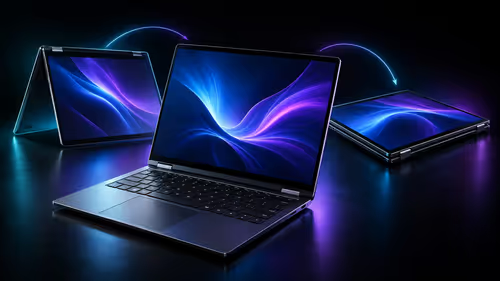
Productivity from a tablet goes far beyond browsing and video calls. To replace or meaningfully supplement a laptop, a tablet needs a responsive keyboard attachment, strong multitasking capability, and software that handles your actual work - whether that means spreadsheets, document editing, project management tools, or communication platforms. In 2026, the line between tablet and laptop has blurred significantly, with several Windows-based tablets running full desktop software and high-end Android tablets capable of true split-screen multitasking.
For South African professionals and students, local factors shape the decision considerably. An unexpected outage means battery life is not just a convenience metric - it is a work continuity necessity. Compare the setup's measured battery life under the workload and screen settings you actually use. Many SA knowledge workers now use a tablet as their primary portable device paired with a home workstation or desktop, reducing their dependence on mains power during work hours.
Keyboard cover quality is another underrated factor in SA productivity. Most popular tablets support either a proprietary magnetic keyboard or a universal Bluetooth keyboard. Proprietary options from the tablet manufacturer tend to offer better integration, trackpad support, and build quality - but add significantly to the total cost. Budget an additional R1,500 to R3,500 for a quality keyboard when calculating the true price of your tablet purchase.
Android Tablets vs Windows Tablets: Which Works Better for SA Professionals
Android tablets excel at communication, content consumption, note-taking, and light document work. For South African students handling NSFAS-funded devices or professionals who primarily use web-based tools like Google Workspace, Slack, or Trello, a well-specced Android tablet is more than sufficient. The Android ecosystem has matured dramatically, with Samsung DeX mode on flagship Galaxy Tab devices providing a near-desktop experience when docked.
Windows tablets - also called 2-in-1 detachables - run full Windows 11 and every desktop application you might need, including the full version of Microsoft Office, Adobe Creative Cloud, and specialist professional software. This is the critical advantage for accountants, engineers, legal professionals, and anyone whose workflow depends on Windows-only software. The tradeoff is battery life (typically 6-9 hours versus 10-14 hours on Android) and a higher price point.
For NSFAS students with a R5,200 allowance, the options narrow considerably. At that price point, an Android tablet with a keyboard cover represents the most functional option, though it will require careful software selection to cover all academic needs. Mid-range Windows tablets typically start above the NSFAS allowance but represent an excellent investment for students studying engineering, commerce, or design who need full desktop software capability.
Key Specs to Prioritise When Buying a Tablet in South Africa
When evaluating tablets for productivity, four specifications matter most. RAM is the starting point - 8GB should be the absolute minimum for any productivity use case, with 12GB being the comfortable baseline for multitasking without slowdowns. Storage affects how much you can keep offline during an unexpected outage when cloud access is interrupted; 128GB is the minimum, with 256GB being strongly recommended for professionals who work with large files.
Display quality directly impacts how long you can work without eye fatigue. Look for at least a 2K resolution display (2560 x 1600 or better) with 90Hz refresh rate for smooth scrolling through long documents. High-brightness panels (500 nits or above) are important if you work in varied environments including outdoor or bright office settings.
Connectivity is often overlooked but critical in South Africa. A tablet with a physical USB-C port that supports USB 3.2 or Thunderbolt allows connection to external monitors, docking stations, and storage devices - dramatically expanding your work setup at home or in the office. LTE or 5G connectivity is worth considering if you work from locations without reliable Wi-Fi, which remains a real constraint in many parts of South Africa.
Top Configurations Worth Considering in 2026
At the R8,000 to R12,000 tier, mid-range Android tablets from established brands with 8GB RAM, 256GB storage, and AMOLED displays offer the best value for students and mobile professionals. These handle everyday productivity tasks without compromise and provide excellent battery life for outage resilience.
At the R14,000 to R18,000 tier, premium Android tablets with 12GB RAM and high-refresh displays enter full productivity territory, particularly when paired with a quality keyboard cover and stylus. These are ideal for creatives, educators, and professionals who live primarily in the Google or Samsung ecosystem.
For full Windows capability, entry-level Windows tablets and 2-in-1 devices at R12,000 to R20,000 deliver desktop-class software compatibility. These make the most sense for professionals tied to Windows-specific tools, developers, or anyone who needs to run desktop-grade applications on the go.
Frequently Asked Questions
Q: What is the best productivity tablet for under R10,000 in South Africa?
A: At under R10,000, a well-specced Android tablet with 8GB RAM, 256GB storage, and an optional Bluetooth keyboard cover delivers strong productivity for Google Workspace, Microsoft 365 web apps, note-taking, and communication tasks. Focus on display quality and battery life as your primary selection criteria at this price point.
Q: Can a tablet fully replace a laptop for work in South Africa?
A: For most knowledge workers using cloud-based tools, communication platforms, and Microsoft 365, a premium tablet with a keyboard cover can functionally replace a laptop. However, professionals requiring specialist Windows desktop software, extensive local processing power, or large external monitor setups will still benefit from a laptop or desktop as the primary device.
Q: How important is battery life for a productivity tablet in SA?
Aim for a tablet rated at 10 hours or more of real-world use. Tablets with efficient ARM-based chips (Android flagships) generally outlast x86 Windows tablets on a single charge, which matters when power cuts interrupt your workday.
Q: Does a stylus improve productivity on a tablet?
A: Yes, particularly for professionals who annotate documents, take handwritten notes, or work in creative fields. Many modern tablets support low-latency active styluses that make digital note-taking feel natural. For pure typing-based work, a quality keyboard cover is a higher priority than a stylus.
Also at Evetech: Graphics Card Deals | Evetech Best Sellers
Ready to Find Your Perfect Match? Shop at Evetech