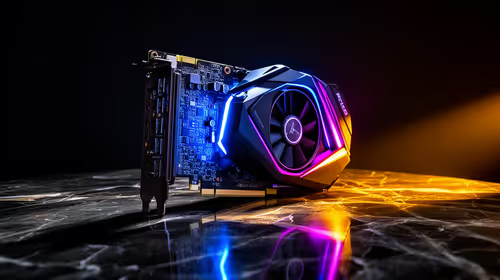
The Googlebook launch has moved from a platform promise to a choice between actual laptops. That changes the questions worth asking. Instead of debating whether Google is returning to premium portable computers, buyers can now compare screen sizes, configurations and the conditions attached to the software experience. The September announcement is useful precisely because those choices are no longer abstract.
Quick Answer
The September 2026 launch adds five named Googlebooks and published model specifications to the earlier May announcement. It also makes the difference between installed Android apps, streamed phone apps and cloud PC gaming clearer. South African Rand prices and local release arrangements remain unconfirmed by the international listings, so the new information supports a shortlist rather than a local purchase promise.
💻 Five devices turn the idea into a hardware decision
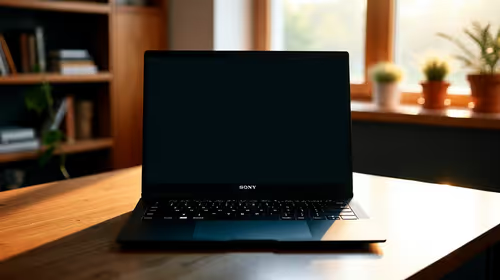
The initial range includes Acer Googlebook 14, ASUS Googlebook 14, XPS Googlebook, HP Googlebook 14 and Lenovo Googlebook 15. The sizes span a compact 13.4-inch display through three 14-inch options to a 15.3-inch panel. That range creates meaningful choices for someone carrying a laptop every day or working primarily with two windows at a desk.
Processor families also differ. Some configurations use Intel Core Ultra, while the XPS and HP entries use Snapdragon X Elite. The correct comparison starts with the operating system and applications, then the exact machine. A familiar processor badge is not evidence that an existing desktop program will run unchanged.
The published US listings show 16GB memory and 512GB storage, but these are particular listed configurations. Regional specifications can vary. Write down the complete model identifier before comparing a specification screenshot with a quotation; the same family name can conceal a different capacity or processor option.
For an immediate replacement, Evetech laptop best sellers offer a separate view of current listed alternatives. A category link is a place to compare available products, not confirmation that any newly announced Googlebook is stocked there.
🧩 The software routes are easier to separate
Google describes native Android applications from the Play Store alongside phone-based features. Cast My Apps, Continue On and Quick Access solve different problems: opening a phone app, moving a supported task and reaching phone files. They should not be collapsed into a single claim that everything on a phone transfers automatically.
The same distinction matters in gaming. Installing a mobile game is different from streaming a PC title through GeForce NOW. The latter introduces service eligibility and network performance into the experience. A powerful-looking laptop does not remove those dependencies, and a game mentioned in launch material is not proof of native PC installation.
Gemini features now have more concrete descriptions, including cleaner voice drafting and content-based file search. Their usefulness depends on the action a buyer repeats. Someone who regularly searches for poorly named documents may value retrieval more than a visual AI demonstration; someone writing short notes may care more about dictation quality.
🌍 The remaining gap is local purchase certainty
An international pre-order button does not establish South African delivery, a Rand total or a local repair route. Those are separate facts that need a local announcement or a complete quotation. Likewise, an overseas subscription promotion has its own country and account restrictions. It should not be treated as money saved by every reader.
Use the launch as a three-column exercise: hardware that is specified, software that fits your essential tasks, and local purchasing details still outstanding. This prevents excitement about one column from silently filling in another. A screen specification may be settled while the support arrangement is not.
If your current laptop needs replacing soon, translate the same tasks into the AI laptop finder. Compare practical requirements such as portability, file handling and creative software rather than treating every AI-branded computer as interchangeable. The most useful change since May is that Googlebook can finally be assessed through concrete choices, provided those choices remain tied to the actual model and market.
Frequently Asked Questions
How many Googlebook models are in the launch lineup?
Five models are listed: Acer 14, ASUS 14, XPS Googlebook, HP 14 and Lenovo 15.
What is more concrete than the May announcement?
Published model specifications now identify screen sizes, processor families, memory and storage configurations.
Are all five Googlebooks the same size?
No. The published lineup includes 13.4-inch, 14-inch and 15.3-inch screens.
Does the launch confirm a South African price?
No verified local Rand quotation is established by the international launch listings.
Do PC games install like Android games?
Google describes Android downloads and GeForce NOW PC-game streaming as separate routes.
Turn the launch into a useful shortlist Compare laptop options at Evetech against the screen size, software and local support your next purchase needs.