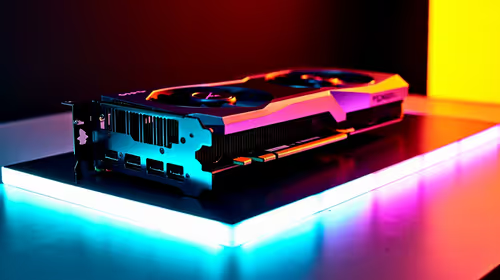
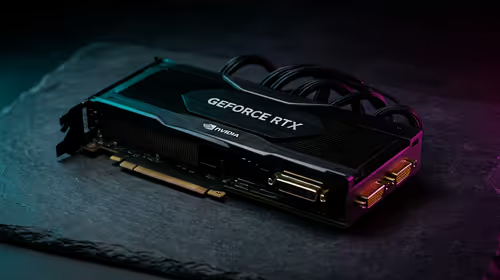
Phantom Blade Zero launched on 29 October, and its published recommended target reads 1440p at 60 FPS on an RTX 3060 Ti or RX 6700 XT. The detail that matters for buyers is the condition attached to that line: the target assumes upscaling, not native rendering. A card that meets Phantom Blade Zero 1440p recommended specs on paper may be rendering well below 1440p underneath.
Quick Answer
Yes. The publisher's 1440p 60 FPS target pairs the recommended RTX 3060 Ti or RX 6700 XT with upscaling, so it is not a native-resolution promise. If you want a newer generation than that tier, Evetech sells 8GB RTX 5060 cards from R9,199. Judge the upscaler setting before you judge the card.
🔍 What the target actually says
Three things sit inside one line: a resolution (2560x1440), a frame rate (60) and a method (upscaling). Remove the third and the first two get harder. 1440p is 3.7 million pixels per frame, roughly 78 percent more than the 2.07 million pixels of 1080p. Native 1440p is a heavier ask than the headline suggests, so a card sold as "recommended" is being measured under the lighter rule.
This is a published requirement and not a benchmark. Nobody has promised how it behaves on your PC.
🧮 What upscaling does to the pixel count
Upscaling renders internally at a lower resolution and rebuilds the image to your screen size. Games usually offer quality, balanced and performance modes. As a rule of thumb, a quality mode renders around 67 percent of the output resolution per axis, which for a 1440p screen is about 1700x960. That drops the pixels the card draws by more than half, which is where the frame-rate headroom comes from.
Which upscaler you use matters too. Nvidia cards can use DLSS, AMD cards can use FSR, and the image differs between modes. Quality modes preserve fine detail better, performance modes show softer edges.
🖥️ Your monitor decides how much you need
A 1080p screen asks far less of the card, so it can skip upscaling more often. A 1440p 144Hz panel is the case where upscaling earns its keep. On a Pretoria student desk with one monitor and a first gaming PC, matching the card to the screen you already own saves more money than chasing the highest tier.
If you do want a step up, the Nvidia GeForce shelf starts with 6GB RTX 3050 cards at R4,399, but those sit below the RTX 3060 Ti line. The 8GB RTX 5060 cards, at R9,199 and R9,499, are a newer architecture than the RTX 3060 Ti, which is the class the target is built around. Compare more in the graphics card deals.
🛠️ Check the rest of the machine
A graphics card is only one line of the requirements. Processor, RAM and storage are listed separately, and a fast card on a weak processor will stall. Read the full list before spending, and if the whole PC is the weak link, a budget gaming PC bundles balanced parts.
Frequently Asked Questions
Does Phantom Blade Zero need upscaling for its 1440p target?
The publisher pairs its recommended card with a 1440p 60 FPS target using upscaling. Native 1440p is a heavier ask.
What is the recommended graphics card for Phantom Blade Zero?
An RTX 3060 Ti or RX 6700 XT. That tier carries the 1440p 60 FPS target, and it relies on upscaling.
Is the published target a measured result?
No, it is the publisher's stated requirement and not a benchmark. Different upscaling modes change both the image and the frame rate.
Which Evetech card is newer than an RTX 3060 Ti?
Palit's overclocked Infinity 2 model with 8GB, priced R9,499, is a newer generation than the RTX 3060 Ti. Check your processor and RAM as well.
Can a 1080p monitor skip upscaling?
Fewer pixels is a lighter load, so a 1080p screen asks less of the card. Read the full requirements anyway.
What does upscaling actually do?
It renders at a lower resolution and rebuilds the image to your screen size. Games usually offer quality and balanced modes.
Choosing a card for Phantom Blade Zero?
See Evetech's RTX and Radeon graphics cards, then match one to your monitor and processor.