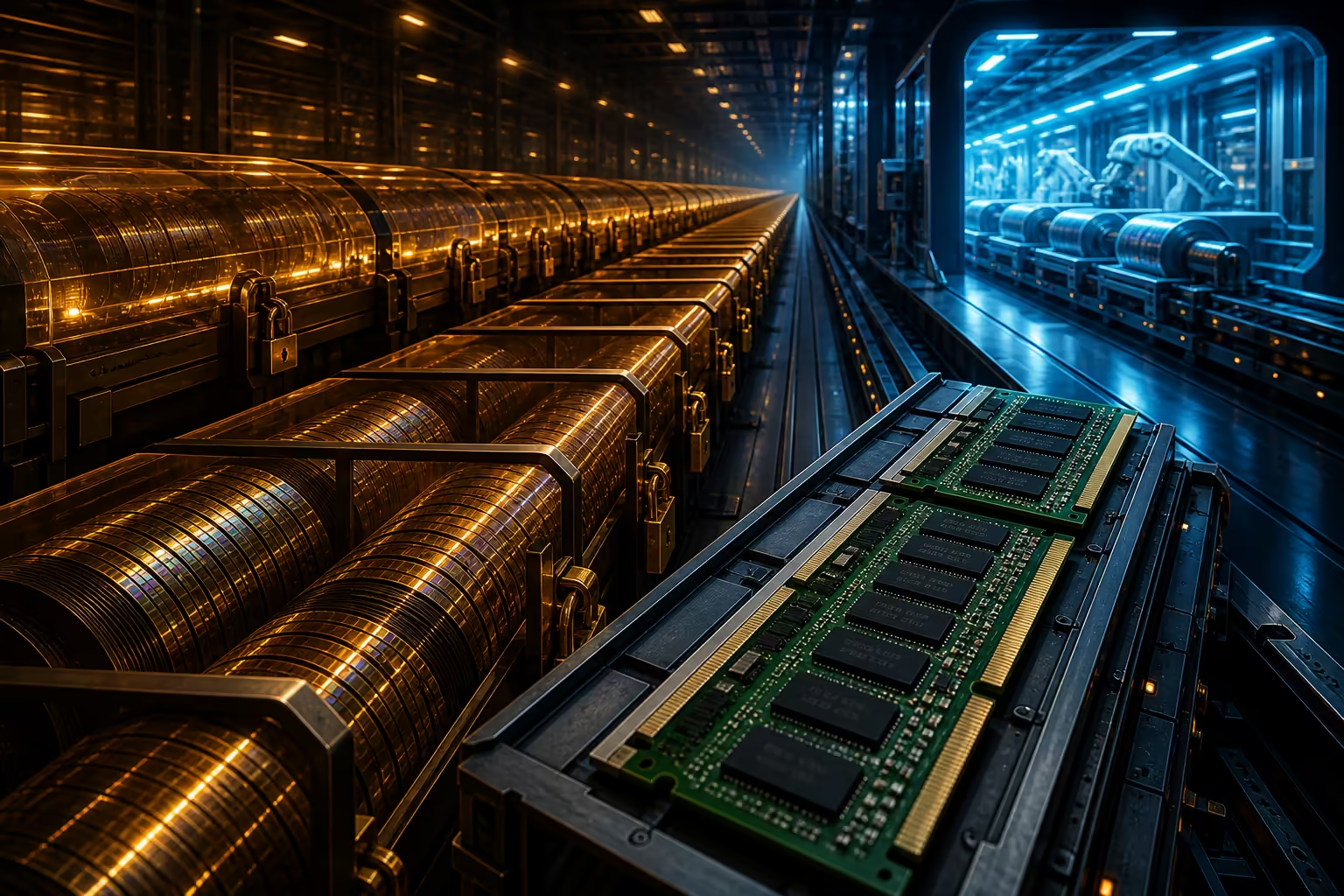
The memory supply warning has moved further out. SK hynix leadership says tight conditions could last through 2030, while separate reporting describes long-term capacity deals reaching into 2031. At the same time, CXMT is reported to have started LPDDR6 mass production. That new mobile supply is useful, but it does not instantly create interchangeable DDR4 or DDR5 desktop modules.
Quick Answer
South African PC buyers should treat the 2030 outlook as a planning signal, not a command to panic-buy. A live Evetech catalogue snapshot found in-stock desktop RAM starting at R1,599 for an 8GB DDR4 module and R3,799 for a 16GB DDR5 module. Confirm the required memory generation, capacity and module layout before buying. DDR4 and DDR5 are different platforms, and LPDDR6 is a separate mobile-memory development.
What changed in the supply story
The earlier memory discussion focused on pressure through 2027. The new statement extends the possible shortage window through 2030. Another report says about 70 percent of one major supplier's capacity has been committed through long-term arrangements that extend into 2031. If those commitments hold, a large part of nominal production cannot simply move to the spot market when PC demand rises.
Forecasts are not guarantees. New factories, weaker demand, improved yields or a shift in the mix can change the outcome. The useful conclusion is narrower: buyers planning a known build should watch real local prices and availability instead of assuming that desktop memory will become cheaper on a fixed date.
The DDR4 memory range and DDR5 memory range provide the platform split. Start there before comparing speed labels.
The live R1,599 and R3,799 baselines
The read-only catalogue check covered sixteen in-stock modules across the DDR4 and DDR5 categories. The lowest captured DDR4 option was a KLEVV BOLT X 8GB 3200MHz module at R1,599. The lowest DDR5 option was an ADATA Premier 16GB 5600MHz module at R3,799. The captured sample extended to R7,699.
The comparison needs context. The DDR4 entry has half the capacity of the DDR5 entry, so the R2,200 gap is not a clean generation premium. Module size, speed, timings, heat spreader, kit layout and platform support all affect price. The figures are live purchase anchors, not a market index and not a forecast.
LPDDR6 does not solve a desktop DIMM shortage
LPDDR memory is designed for tightly integrated mobile devices. It is normally soldered and tuned around power efficiency. Desktop DDR4 and DDR5 use replaceable DIMMs with different electrical, physical and platform requirements. Production progress in LPDDR6 can improve future mobile supply without adding a single compatible module to an existing desktop motherboard.
That distinction prevents a common buying mistake. A new memory standard does not automatically make the current standard obsolete or cheaper. A DDR4 board still requires DDR4. A DDR5 board still requires DDR5. A laptop with soldered memory may offer no upgrade path at all.
Buy for a defined requirement
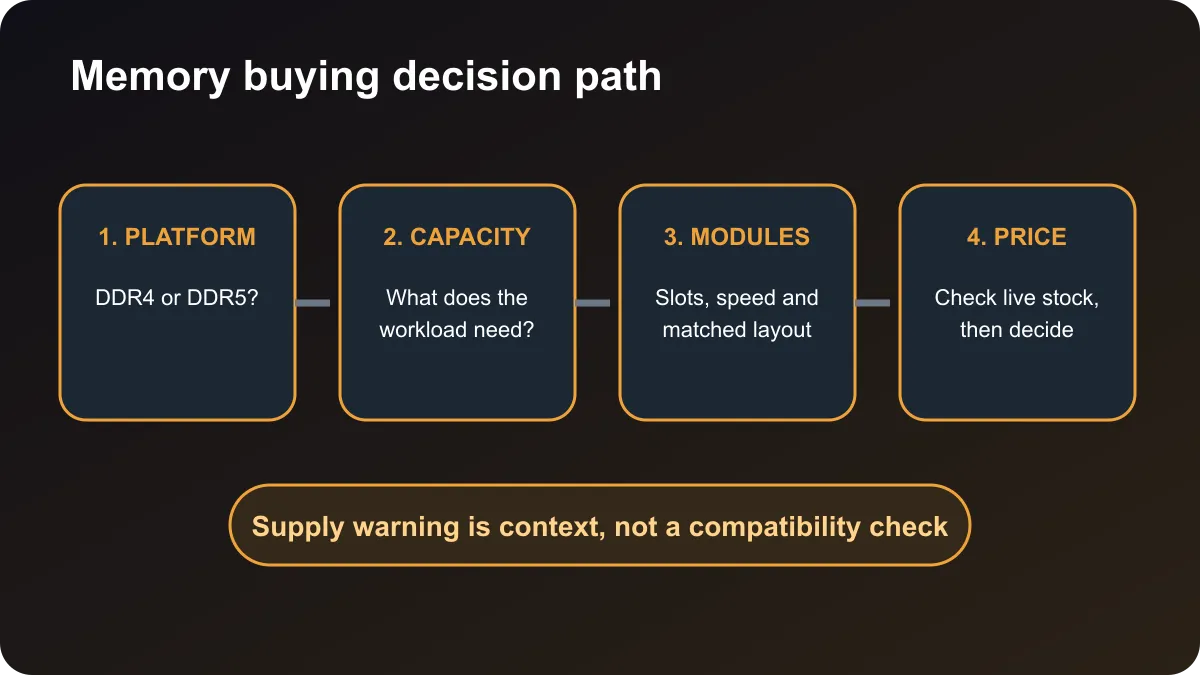
Start with the motherboard or laptop specification. Confirm DDR generation, maximum supported capacity, slot count and whether the system benefits from matched modules. Then decide whether the present workload needs more capacity. Game stutter caused by insufficient memory can improve with an upgrade, while a slow GPU will not become fast simply because the PC has extra RAM.
If a build is already funded and the exact compatible kit is in stock at an acceptable price, the long supply outlook supports buying deliberately. If the upgrade is speculative, track the memory best sellers and wait for a clear need. Avoid mixing modules merely because their headline speed matches; capacity, timings, rank, voltage and firmware training can still differ.
Frequently Asked Questions
How long could the memory shortage last?
SK hynix leadership says supply pressure could continue through 2030, although forecasts can change.
What makes this update different?
The new reporting extends the shortage horizon and describes long-term capacity commitments reaching into 2031.
Does LPDDR6 production immediately fix desktop RAM supply?
No. LPDDR6 targets mobile devices and does not instantly add interchangeable DDR4 or DDR5 desktop capacity.
What were the live South African RAM baselines?
The captured in-stock sample started at R1,599 for 8GB DDR4 and R3,799 for 16GB DDR5.
Should every buyer purchase RAM immediately?
No. Buy for a confirmed build or upgrade after checking capacity, generation, speed and motherboard compatibility.
Can a DDR4 system use DDR5 memory?
No. DDR4 and DDR5 use different electrical and physical platforms and are not interchangeable.
Planning a memory upgrade?
Match the exact DDR generation and capacity to your system before comparing live kits and prices.