Staring at the replay, you see it... that tiny mistake that cost you the podium. You felt the oversteer, but your reaction was just a fraction too late. What if the bottleneck isn't your skill, but your screen? For serious competitors, the debate around 144Hz monitor sim racing isn't just about pretty graphics; it's about raw performance. But does it really make you faster around Kyalami or Monza? Let's find out. 🏁
Why a High Refresh Rate is Crucial for Sim Racing
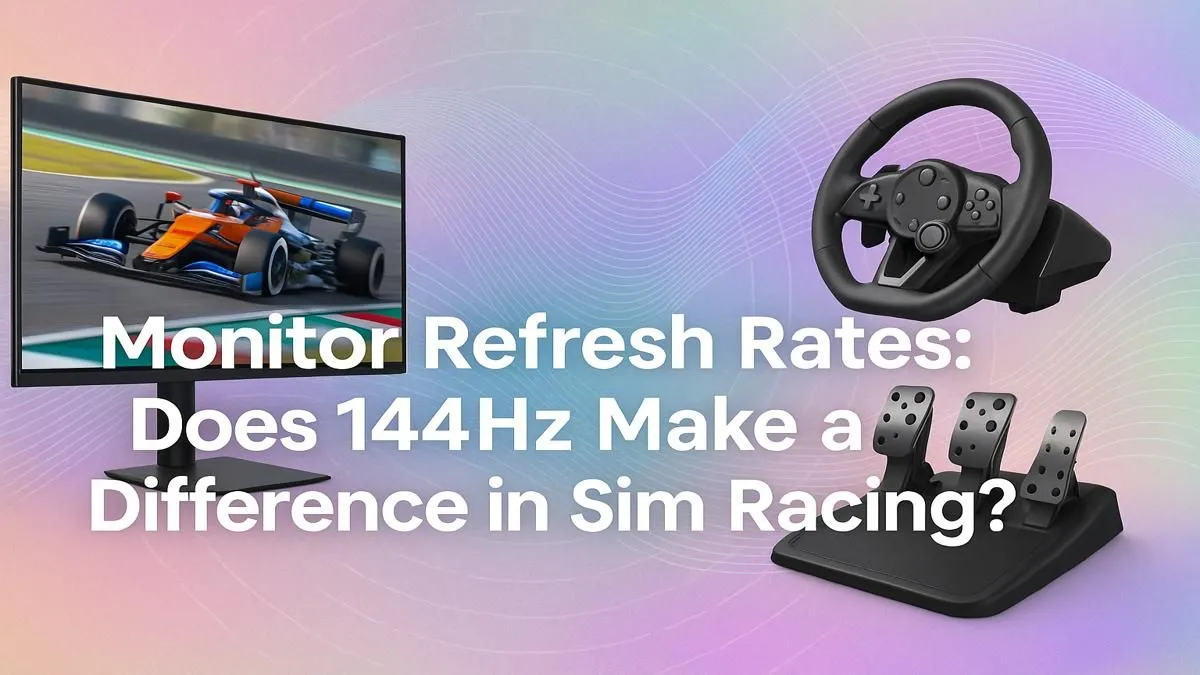
To understand the edge a 144Hz monitor for sim racing provides, we need to talk about what 'Hz' (Hertz) actually means. Think of it as the number of pictures, or frames, your monitor can show you every second. A standard 60Hz screen shows you 60 frames. A 144Hz monitor? It delivers a whopping 144 frames. This massive increase in visual data results in buttery-smooth motion, drastically reducing blur as you fly through corners and making the whole experience feel more responsive. It's a foundational piece of a complete sim racing setup that directly impacts how you perceive and react to the car.
The On-Track Advantage of 144Hz Sim Racing
Okay, so it looks smoother... but how does that translate to faster lap times? It comes down to receiving critical information sooner. When you're battling for position, milliseconds matter.
Nailing Your Braking Points
With a 144Hz monitor, track-side objects, kerbs, and braking markers remain sharp and clear even at blistering speeds. This clarity allows you to pick your braking point with more confidence and, more importantly, consistency lap after lap. You're seeing a truer representation of your speed relative to the track.
Catching Slides Before They Happen
This is where 144Hz monitor sim racing truly shines. That dreaded snap-oversteer? On a 144Hz screen, you see the car begin to rotate earlier. Those extra frames give your brain more time to process the slip and apply the correct counter-steer. You're no longer reacting to a slide... you're anticipating it. This is especially true when paired with a quality force-feedback wheel that tells your hands what your eyes are seeing.
Is 144Hz a Silver Bullet for Performance?
While a high-refresh-rate monitor is a huge upgrade, it's not a magic wand. To actually see 144 frames per second, your PC's graphics card needs to be powerful enough to generate them. Pushing that many frames, especially at higher resolutions, requires some serious GPU muscle. 🚀 It's about building a balanced system where no single component holds another back. Your immersion and consistency also get a massive boost when you're securely planted in a dedicated Playseat rig, preventing you from sliding around in an office chair while you're trying to hit the perfect apex.
Optimise for Max Frames ⚡
To ensure you're getting the most from your 144Hz monitor, dive into your sim's graphics settings. Lower settings that have a big performance impact but low visual payoff, like complex shadows or crowd density. Your goal is a stable frame rate that matches your monitor's refresh rate. Turn on your game's FPS counter and aim for a consistent 144+ FPS for the smoothest experience.
The Verdict: Does a 144Hz Monitor Boost Lap Times?
So, let's get back to the main question. The answer is a resounding yes... but with a condition. A 144Hz monitor won't gift you alien-like driving talent. What it will do is remove a significant hardware bottleneck, allowing you to perform at your absolute peak. The added smoothness and clarity from sim racing on a 144Hz monitor lead to greater consistency. And in racing, consistency is the key to chipping away at your lap times, turning podium dreams into reality. 👀
Ready to Shave Seconds Off Your Lap Time? The jump from 60Hz to 144Hz is one of the most significant upgrades a sim racer can make. It gives you the visual edge to brake later, catch slides faster, and hit every apex with precision. For the ultimate competitive advantage in South Africa, a high-refresh-rate monitor is non-negotiable. Explore our incredible range of high-performance gaming monitors and find the perfect display to dominate the track.