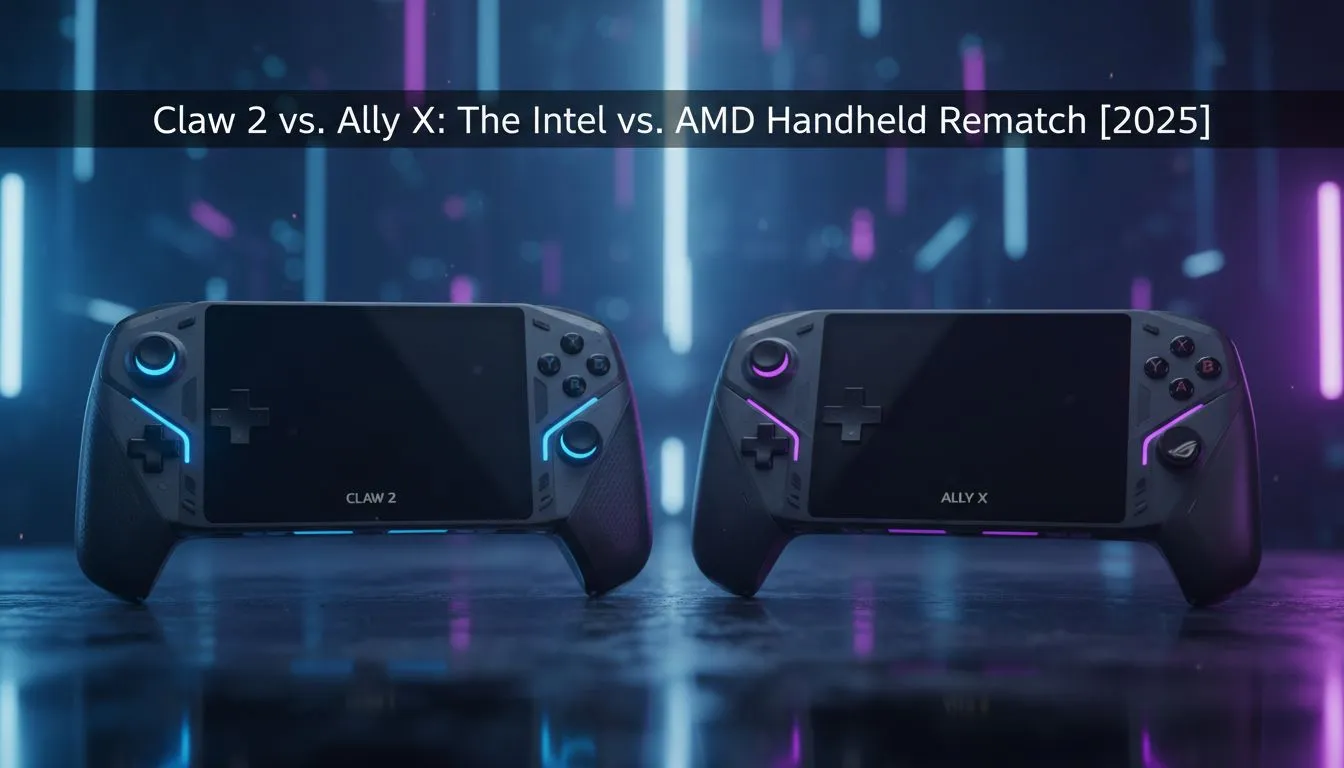
The handheld war just went nuclear. If you thought the first round was intense, the 2025 rematch between the MSI Claw 2 and ASUS ROG Ally X changes everything. We aren't just looking at minor spec bumps... we're talking massive battery gains and serious performance leaps. For South African gamers needing power on the go, the choice has never been harder. Let’s settle the score.
The Battery Life Redemption Arc 🔋
In the first generation of handhelds, battery anxiety was real. That has changed.
The ASUS ROG Ally X redefined expectations with its massive battery upgrade, effectively doubling the capacity of its predecessor to a whopping 80Wh. It isn't just about playing longer; it's about playing AAA titles at 25W Turbo mode without searching for a plug point every hour. The improved thermals also mean the device stays cooler in your hands during those humid Durban summers.
On the other side of the ring, the MSI Claw 2 (often dubbed the Claw 8 AI+) fights back with Intel’s new Lunar Lake architecture. This chip is far more efficient than the previous Meteor Lake iteration. While the Ally X relies on brute battery size, the MSI Claw series brings unique advantages in power efficiency and AI upscaling via XeSS, aiming to squeeze every drop of performance out of the watts available.
Performance: Z1 Extreme vs. Core Ultra
This is where the philosophy splits. The Ally X sticks with the tried-and-tested AMD Z1 Extreme chip. It’s a known quantity. Drivers are mature, AFMF (AMD Fluid Motion Frames) works wonders, and compatibility is rock solid. If you want a "console-like" experience on Windows, this is close.
However, MSI is betting big on the future. The Claw 2 leverages Thunderbolt 4 connectivity—something the Ally X finally adopted—but pairs it with Intel's superior raw compute potential for creative tasks. If you use your handheld as a mini-PC docked to a monitor, the Intel platform often edges ahead in multitasking.
Handheld Battery Saver ⚡
Don't just rely on the default 'Silent' or 'Turbo' modes. On both the Ally X and Claw 2, create a custom 18W TDP profile. This is the 'sweet spot' for handhelds, offering 90% of the performance of Turbo mode but saving you significant battery life for those long flights or taxi commutes.
Ergonomics and The "Other" Heavyweight
Hand feel is subjective, but crucial. The Ally X tweaked its grips to be deeper and more comfortable for larger hands. The buttons are tactile, and the D-pad is significantly improved for fighting games. The Claw 2 has also refined its shell, smoothing out the triggers for a more natural pull.
But before you drop your hard-earned ZAR, you have to consider the screen size. Both these devices generally stick to the 7-to-8-inch range. If you feel like 7 inches is just too cramped for strategy games or reading text, don't count out the Lenovo Legion Go if screen real estate is your priority. Its massive 8.8-inch display puts it in a different weight class entirely, even if it is a bit bulkier to carry around.
Which One Should You Buy?
If you prioritise battery life above all else and want a mature driver ecosystem, the Ally X is the current king of the hill. It feels like the device the original should have been.
However, if you are an Intel loyalist who values Thunderbolt versatility and the potential of AI-driven performance boosts in 2025 titles, the Claw 2 is a formidable machine. It handles modern upscaling tech beautifully.
Ultimately, exploring the wider world of handheld gaming consoles available locally reveals that we are in a golden age of portable PC gaming. Whether you choose Team Blue or Team Red, you are getting a machine more powerful than the gaming laptops of just a few years ago.
Ready to Power Up Your Pocket?
The battle between MSI and ASUS is fierce, but the real winner is the gamer. Whether you need the marathon battery of the Ally X or the next-gen tech of the Claw 2, we have the stock. Shop our full range of handheld gaming consoles and take your Steam library anywhere in South Africa.