Dreaming of playing the latest AAA titles on max settings without dropping R30k on a new graphics card? Cloud gaming promises just that. It’s a fantastic concept, but for us in South Africa, there’s one massive hurdle: your internet connection. Before you dive in, you need to understand the real-world cloud gaming internet requirements to avoid a stuttering, pixelated mess. Let’s break down what you actually need for a lag-free experience. 🚀
Understanding the Basics of Cloud Gaming
Think of cloud gaming like Netflix, but for video games. Instead of running on your local machine, the game runs on a super-powerful server in a data centre somewhere. That server does all the heavy lifting—rendering graphics, processing physics—and streams the video output to your screen. You send your controller or keyboard inputs back to the server. For this to work seamlessly, your connection needs to be fast and, more importantly, incredibly stable.
The Core Internet Requirements for Cloud Gaming
It’s not just about a high download speed. Three key factors determine your experience, and neglecting any one of them will lead to frustration. Getting these cloud gaming internet requirements right is non-negotiable.
### Download Speed: The Bare Minimum vs. The Ideal
This is the number most people focus on. It determines the quality of the video stream you receive. A higher speed allows for higher resolution and frame rates.
- 720p at 60fps: You need a minimum of 15 Mbps. This is the absolute baseline.
- 1080p at 60fps: Most services, like NVIDIA's GeForce Now, recommend at least 25-35 Mbps for a stable Full HD experience.
- 4K at 60fps: For the premium experience, you're looking at a sustained 50+ Mbps connection.
While these speeds are achievable, remember that this bandwidth must be consistently available just for you. If others in your home are streaming 4K movies, your gaming session will suffer. For many, investing in solid hardware from our range of budget gaming PCs offers a more reliable path to 1080p gaming.
### Latency (Ping): The Real Killer of Cloud Gaming
This is the most critical factor for a lag-free experience. Latency, measured in milliseconds (ms), is the time it takes for your input (like pressing a button) to travel to the game server and for the server's response to travel back to your screen. High latency is what causes that noticeable "input lag."
- Ideal: Below 20ms
- Good: 20-40ms
- Acceptable (just): 40-60ms
- Problematic: Anything over 60ms will feel sluggish and unresponsive, especially in fast-paced shooters.
Fibre is generally the best for low latency in South Africa.
Loadshedding-Proof Your Connection ⚡
Loadshedding can knock out your internet even if you have power. Invest in a small, affordable Mini-UPS for your fibre box (ONT) and Wi-Fi router. This simple device can keep your internet running for hours during an outage, ensuring your cloud gaming session (or work) isn't interrupted.
### Data Consumption: The Hidden Cost
Cloud gaming chews through data. Streaming at 1080p can use between 10-15 GB of data per hour. A 4K stream can easily double that. If you’re on a capped internet plan, the costs can quickly add up, sometimes making the investment in one of our powerful options under R20k a more economical choice in the long run.
When a Dedicated Gaming PC is Just Better ✨
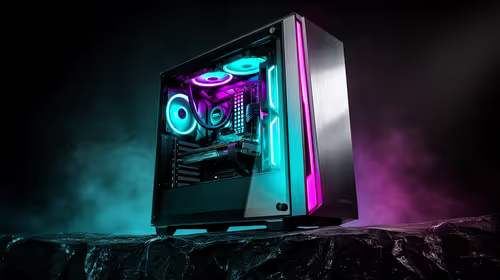
While cloud gaming is improving, it can't escape the laws of physics. The data still has to travel from your home to a server and back. For a truly competitive and reliable setup, nothing beats local hardware. If you're weighing your options, consider that even our best pre-built PC deals eliminate any concerns about internet stability affecting your framerate.
A dedicated PC gives you:
- Zero Input Lag: Your actions are registered instantly.
- Uncompressed Visuals: You see the game exactly as the developers intended, with no video compression artefacts.
- Offline Access: Your single-player games work perfectly, even when your internet is down. A huge plus in SA!
- Total Control: You choose your settings, mods, and peripherals without restriction.
For serious gamers, the consistent performance from high-performance PCs over R20k provides a peace of mind that cloud services can't yet match. The initial investment pays off with a superior, hassle-free experience every single time you play.
Ready for Uncompromised Performance? Cloud gaming is an exciting frontier, but for a truly flawless, lag-free experience you can count on... nothing beats the raw power of a dedicated gaming PC. Explore our massive range of the best gaming PC deals and find the perfect machine to own your game.