You’ve just unboxed your beastly new gaming PC. The RGBs are glowing, the specs are top-tier, and you’re ready to dominate. But the moment you launch your favourite game, a new sound fills your room… the unmistakable roar of a jet engine. Is your powerful South African upgrade just too loud? A noisy rig can ruin immersion and drive you bonkers. Let's run a quick gaming PC noise level test and find that sweet spot between power and peace.
What Makes a Gaming PC So Loud?
Before we can fix the noise, we need to find the culprit. In most cases, the noise you're hearing is the sound of air being moved rapidly by fans. The harder your components work, the more heat they generate, and the faster your fans need to spin to cool them down.
The main offenders are usually:
- CPU Cooler: The fan on your CPU cooler is often the loudest component, especially the stock coolers that come with many processors. A powerful new CPU processor generates significant heat, demanding a robust (and potentially noisy) cooling solution.
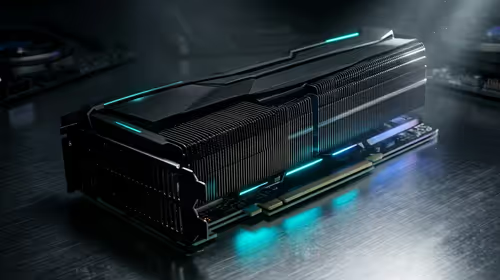
- Graphics Card (GPU) Fans: Modern GPUs have two or three fans that spin up aggressively under load.
- Case Fans: These are essential for overall airflow but can contribute to the racket if they're cheap or poorly configured.
- Power Supply (PSU) Fan: A lower-quality PSU might have a fan that is constantly audible.
Performing a Basic Gaming PC Noise Level Test at Home 🔧
You don't need fancy acoustic equipment for a basic test. A smartphone app can give you a surprisingly useful baseline.
- Download a Decibel Meter App: Search for "Decibel Meter" or "Sound Meter" on your phone's app store.
- Measure Your Baseline: In a quiet room, place your phone about 30cm from your PC and measure the noise level while it's idle (just showing the desktop). This is your idle noise floor. A quiet PC should be around 30-35 dBA.
- Stress Test It: Launch a demanding game or a benchmark tool. Let it run for 10-15 minutes to get the components heated up and the fans spinning at full tilt. Measure the noise level again. This is your under-load noise. Anything over 50 dBA can become distracting during quiet moments in-game.
This simple gaming PC noise level test gives you a concrete number to work with. Now, let's make it lower.
Top Tips for a Quieter Gaming Rig ✨
Achieving a near-silent gaming rig is all about smart component choices and optimisation. It’s not just about adding more fans; it’s about making them work smarter, not harder.
Choose Your Foundation Wisely
Starting with the right core components can save you a lot of acoustic headaches later. A well-matched motherboard, CPU, and case combination provides a solid, quiet foundation. Exploring pre-configured options like Intel barebone kits can be a great starting point, as they are often designed for balanced performance and thermals.
Optimise Your Airflow
A PC case with restricted airflow forces fans to spin faster to achieve the same cooling. Ensure your cable management is tidy and not blocking fans or vents. Consider a case designed for high airflow or silent operation. For those building from the ground up, high-quality AMD barebone kits often provide an excellent chassis and motherboard pairing to build upon for a cool and quiet system.
Silent Fan Curve Secret 🤫
Most modern motherboards let you control fan speeds in the BIOS UEFI. Find the 'Hardware Monitor' or 'Fan Control' section. Instead of 'Standard' or 'Performance' mode, choose 'Silent' or create a custom curve. A good custom curve keeps fans at a very low RPM until the CPU GPU hits 60-70°C, ensuring your PC is whisper-quiet during everyday tasks.
Upgrade Your Coolers
The single biggest improvement you can make is replacing stock coolers.
- CPU: A large tower air cooler (from brands like Noctua or be quiet!) or an All-in-One (AIO) liquid cooler will cool your CPU more effectively and with much less noise than a stock fan.
- GPU: While more advanced, you can undervolt your GPU using software like MSI Afterburner. This reduces its power consumption and heat output without a significant performance hit, allowing the fans to spin slower.
A powerful PC doesn't have to sound like an airport runway. With a few strategic tweaks and smart component choices, you can build a rig that delivers incredible performance in blissful silence. 🚀
Ready for a Whisper-Quiet Upgrade?
A loud PC can break your immersion and turn a great gaming session into a frustrating one. Instead of just tolerating the noise, build a PC that's both powerful and silent. Explore our massive range of PC components and craft the perfect quiet rig today.