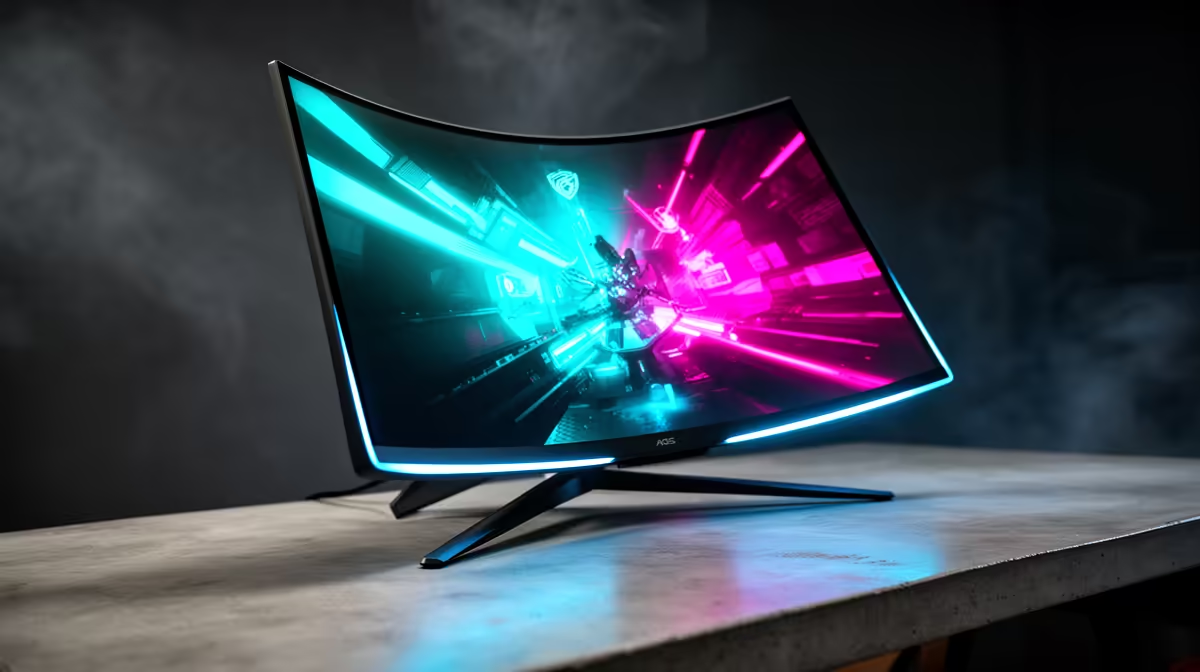
You’re in a tense final circle in Warzone. The enemy peeks from behind a rock… you line up the shot, but a jagged horizontal line rips across your screen, throwing off your aim for a split second. It’s enough. You’re back in the lobby. That annoying glitch is screen tearing, and NVIDIA’s G-Sync promises to eliminate it. But with tight budgets, the big question is: is G-Sync necessary for gaming in South Africa?
What is G-Sync and Why Does it Matter?
At its core, screen tearing happens when your graphics card (GPU) and your monitor are out of sync. Your GPU might be pushing out 87 frames per second (FPS), while your monitor is trying to refresh at a fixed 144 times per second (144Hz). When the monitor grabs a new image halfway through the GPU rendering one, you see a "tear."
G-Sync fixes this. It’s a hardware technology built into certain PC monitors that allows them to communicate directly with your NVIDIA GeForce GPU. Instead of a fixed refresh rate, a G-Sync monitor adjusts its refresh rate on the fly to perfectly match the FPS your GPU is producing.
The result? 🚀
- No more screen tearing.
- Reduced input lag compared to traditional solutions like V-Sync.
- Smoother gameplay, even when your frame rate dips.
This technology ensures that what you see is a clean, fluid, and uninterrupted picture, which can be a massive advantage in fast-paced games.
When G-Sync Truly Shines
So, where does this tech make a real, noticeable difference? Imagine you’re playing Apex Legends on a high-end rig. In quiet moments, your FPS might hit 200, but in a chaotic firefight with explosions and multiple squads, it could drop to 90. Without G-Sync, this fluctuation can cause noticeable stutter and tearing. With it, the experience remains silky smooth because the monitor adapts instantly.
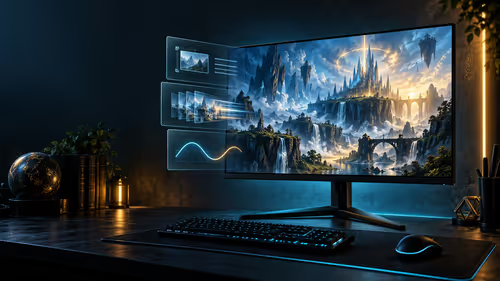
This is why G-Sync is a huge benefit for competitive gamers. It eliminates visual distractions and provides a more responsive feel. For anyone serious about climbing the ranks, having a tear-free display is less of a luxury and more of a strategic tool. When browsing for your next screen, you'll find a wide variety of all gaming monitors equipped with this powerful feature.
Understanding the Tiers: Not All G-Sync is Equal
It's important to know there are three main levels:
- G-Sync Compatible: These are typically FreeSync monitors that NVIDIA has tested and certified to provide a good baseline variable refresh rate experience. They are the most affordable option.
- G-Sync: This tier includes a dedicated NVIDIA G-Sync hardware module inside the monitor, offering a wider range of variable refresh rates and stricter quality control.
- G-Sync Ultimate: The best of the best, designed for high-end HDR gaming on cutting-edge displays like vibrant 5K and 4K monitors, ensuring top-tier performance and image quality.
Do You Really Need G-Sync for Your Setup?
Let's break it down. Whether G-Sync is necessary for your gaming experience depends heavily on you and the games you play.
For the Competitive Esports Player
If you live and breathe games like Valorant, CS2, or Fortnite, the answer is a strong yes. The elimination of tearing and the reduction in stutter give you a clearer picture of the battlefield, allowing for faster reaction times. In a world where milliseconds matter, G-Sync provides a tangible competitive edge. You can often find great performance without breaking the bank by checking out the best PC monitor deals available.
For the Single-Player & RPG Fan
If your library is filled with cinematic titles like Cyberpunk 2077 or Baldur's Gate 3, G-Sync is a fantastic "nice-to-have" but not strictly essential. These games often have less frantic camera movement, and many gamers prioritise visual fidelity over raw refresh rate. However, the smooth experience G-Sync provides can definitely boost immersion, especially in graphically intense scenes. Many gamers find that curved monitors paired with G-Sync create an incredibly engrossing world.
Don't Forget to Switch it On! 🔧
Owning a G-Sync monitor is only half the battle. Many gamers forget to enable it! Right-click your desktop, go to the NVIDIA Control Panel, navigate to 'Set up G-Sync', tick the 'Enable G-Sync, G-Sync Compatible' box, and make sure it's enabled for your preferred display mode (full screen is recommended).
For the Gamer on a Tight Budget
If every Rand in your build counts, then G-Sync might not be your top priority. A high-quality "G-Sync Compatible" (FreeSync) monitor can give you 90% of the benefit for a fraction of the cost. The key is to focus on core specs first: a decent refresh rate (144Hz+), low response time (1ms), and good panel quality (IPS for colour, TN for speed). Your money might be better spent on a more powerful GPU first.
The Verdict: Worth the Rands in SA?
So, is G-Sync necessary for gaming in South Africa?
For the majority of gamers, it's not an absolute necessity. You can have a fantastic gaming experience without it. However, for those who are serious about competitive play, have a powerful NVIDIA GPU, and are sensitive to screen tearing and stutter, G-Sync is a phenomenal technology that delivers a visibly superior experience. ✨
It transforms gaming from great to exceptional. Before you decide, also consider your complete setup, from a comfortable VESA mount to the right cables. Having the right monitor accessories can make a world of difference. And for those who attend LANs or need a second screen on the go, there are even portable monitors that bring these features to a compact form factor.
Ultimately, the choice comes down to your priorities and your budget. G-Sync isn't a gimmick; it's a premium feature for a premium experience.
Ready to Power Up Your Smooth Gameplay? A G-Sync monitor needs a great NVIDIA graphics card to unlock its full potential. Explore our massive range of NVIDIA GeForce GPUs and build the ultimate tear-free gaming rig today.