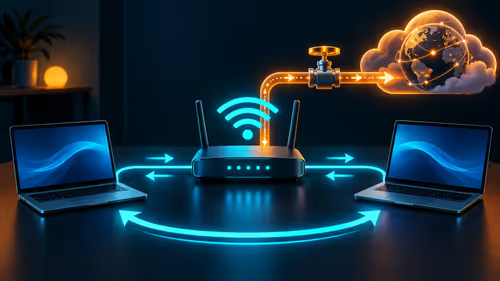
Gamers debating wired versus wireless internet often focus on raw download speed, when the variables that decide match outcomes are far more mundane. 1000Mbps Ethernet via USB-C hub delivers more than enough bandwidth for any game currently on the market. The real question is whether the connection is stable, and that depends on the adapter rather than the gigabit ceiling.
Quick Answer
Yes, Gigabit Ethernet is sufficient for online gaming. No game requires even a fraction of 1000 Mbps of bandwidth. What gaming actually demands is low latency, typically under 30 ms on local servers, and minimal packet loss. A quality Gigabit Ethernet adapter on a USB-C hub achieves both when the adapter uses a reliable controller chip and the hub is powered.
🎮 What Online Gaming Actually Needs From a Network Connection
A first-person shooter at full resolution with voice chat active uses between 20 and 80 Mbps of data. A multiplayer battle royale may consume less than 10 Mbps during active play. The bandwidth ceiling of Gigabit Ethernet, at 1000 Mbps, sits an order of magnitude above what any game currently demands. From a raw throughput perspective, Gigabit Ethernet is complete overkill, which is a good position to be in.
What matters for frame-consistent, low-lag gaming is latency and packet loss. Latency measures the round-trip time between your machine and the game server. On South African fibre lines connecting to local Cape Town or Joburg game servers, a wired connection typically achieves 5 to 20 ms. Wireless connections add variance, with brief spikes reaching 40 to 80 ms during congestion on the 2.4 GHz band. Those spikes register as lag even though the average may look acceptable in a ping test.
🔌 Why the USB-C Adapter and Hub Quality Matter
A Gigabit Ethernet adapter connects to the hub via USB, and the adapter's internal controller chip determines how reliably it translates network traffic to USB data. Budget adapters using older or low-quality controller chips can introduce micro-jitter in packet delivery, which manifests as inconsistent ping rather than high average latency. The average ping may display as 15 ms while individual packets spike to 60 or 80 ms. This pattern is particularly disruptive to competitive gaming where frame-to-frame consistency is critical.
Adapters built on established controller chipsets from manufacturers like Realtek or ASIX are generally more stable. Buying a reputable branded adapter rather than an unbranded one at the lowest price is meaningful for gaming, even though bandwidth numbers between them look identical.
Hub power also matters. An underpowered hub that cannot supply adequate current to the Ethernet adapter may cause occasional dropped packets during peak load, such as a large map load while simultaneously receiving voice and game data. A powered hub, drawing current from the mains rather than from the laptop's USB budget, removes that variable entirely.
📊 Wired vs Wireless: The Stability Argument
Wireless connections share spectrum with neighbours, microwave ovens, and Bluetooth devices. In a densely occupied block of flats in Cape Town or Joburg, the 2.4 GHz band may be saturated by competing signals. Wi-Fi 6E adds 6 GHz spectrum, but wall penetration at higher frequencies is weaker.
A wired Gigabit Ethernet connection via USB-C hub eliminates that interference. Packets travel a copper path rather than a shared radio channel, delivering consistent latency rather than an average that hides spikes.
Frequently Asked Questions
Does Gigabit Ethernet matter for gaming if my internet plan is 100 Mbps?
Yes, but not for bandwidth. Gigabit Ethernet still provides a stable, low-latency wired path to your router even when your ISP connection is slower. The adapter communicates with your local network at 1000 Mbps; the internet speed is determined by your ISP line, not the adapter.
Can a USB-C Ethernet adapter cause lag spikes?
Yes, if the adapter uses a poor-quality controller chip or receives inadequate power from the hub. Choosing an adapter with a reputable controller and a powered hub minimises this risk significantly.
Is a 2.5G Ethernet adapter worth it over Gigabit for gaming?
Not for competitive gaming. South African ISP plans rarely exceed 1 Gbps for home users, and games consume a small fraction of that. A 2.5G adapter offers no practical gaming benefit over Gigabit in this context.
How do I reduce packet loss on a USB-C Ethernet connection?
Use a powered hub, choose a quality Ethernet adapter, and connect directly to your router rather than through a network switch if possible. Short, undamaged Cat 5e or Cat 6 cables also reduce noise on the physical connection.
Will the Ethernet port on a USB-C hub work with SA fibre?
Yes. Fibre broadband in South Africa delivers your connection over fibre to an ONT device, which then provides a standard Ethernet output. Your USB-C Ethernet adapter plugs into that same network using a standard RJ45 cable. Compatibility is universal.
Want a rock-solid wired connection for gaming or working from home?
Evetech's USB-C hub and docking station range includes Gigabit Ethernet options built for stable, consistent connectivity. Take a look at what is available.