Quick Answer
For AIO liquid coolers, a push-pull fan configuration delivers the best cooling performance by increasing airflow volume through the radiator. Push-only is the most common single-fan-layer setup and works well in most cases. Pull-only is the least efficient option. The performance gain from push-pull over push-only is typically 2-5 degrees Celsius at load.
Understanding Push, Pull, and Push-Pull Configurations
Fan configuration on an AIO radiator describes the direction fans move air relative to the radiator fins. In a push configuration, fans sit on the outside of the radiator and push air through the fins toward the case exhaust or intake. In a pull configuration, fans sit on the inside of the radiator (between the radiator and the case panel) and pull air through the fins. In a push-pull configuration, fans are mounted on both sides of the radiator, with one set pushing and one set pulling simultaneously.
The physics are straightforward. A fan performs most efficiently when it moves air against a restriction. A radiator creates that restriction. Fans in push orientation face free air on one side and restricted air on the other, which is close to optimal. Fans in pull orientation face restricted air on one side, making them work slightly harder for the same airflow. Push-pull doubles the fan area moving air through the same restriction, increasing total volume and reducing temperature.
For most South African gaming builds, push-only with the radiator mounted as a front intake is the standard recommendation. This draws cool ambient air through the radiator before it heats up from GPU and CPU exhaust, which matters especially during SA summer months when ambient temperatures are higher.
Push-Only: The Practical Default
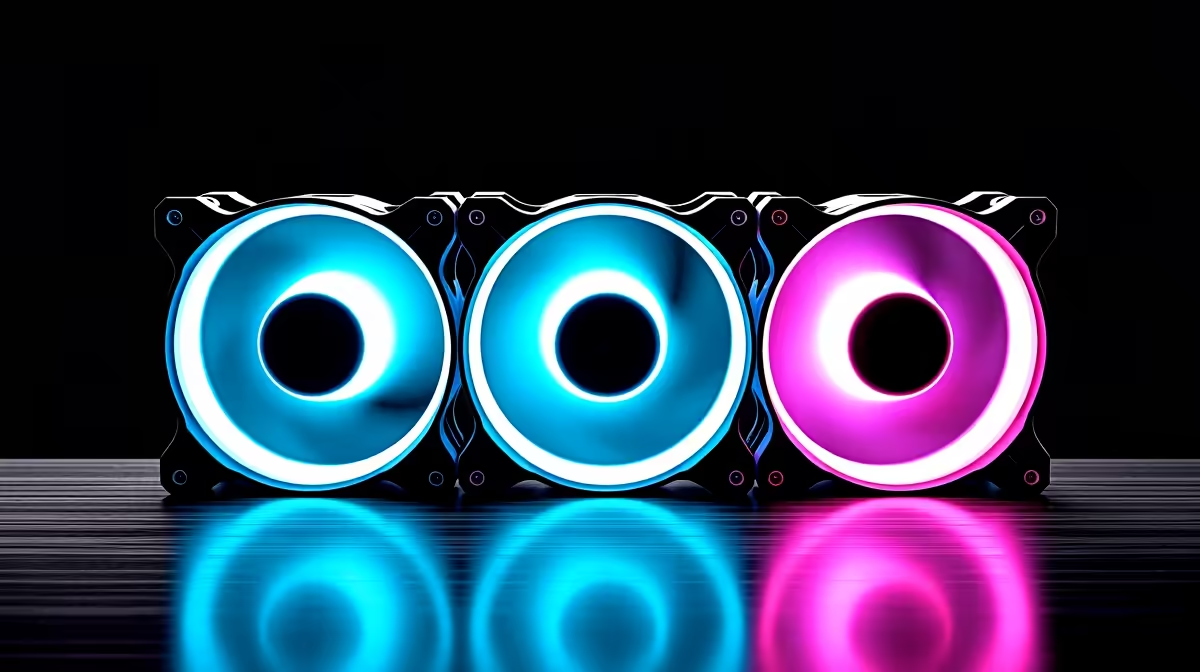
Push-only is the configuration most AIOs ship with from the factory. Three 120mm fans or two 140mm fans are attached to one side of the radiator. This setup is simpler to install, quieter than push-pull (fewer fans running), and more cost-effective since no additional fans are required.
Push-only performs within 2-3 degrees Celsius of push-pull in most real-world gaming scenarios. For a mid-range CPU like the Ryzen 5 or Core i5 tier, push-only on a 240mm or 280mm AIO is more than sufficient to keep temperatures in a safe range. Overclocking enthusiasts pushing high-end CPUs hard will notice the additional benefit of push-pull more clearly.
Cable management is also simpler with push-only since all fan cables are on the same side of the radiator. This matters in builds with tempered glass side panels where cable routing is visible.
Pull-Only: When and Why
Pull-only is rarely recommended for AIOs but has niche use cases. If a case design prevents mounting fans on the outside of the radiator, pull-only is the fallback. Performance is slightly below push-only at the same fan speed due to the aerodynamic disadvantage of pulling against a restriction from the outside.
Some builders use pull-only when they want to mount the radiator flush against a case panel for aesthetic reasons, with fans positioned inward where they are hidden from view. Functionally the difference from push-only in a typical gaming build is around 1-2 degrees Celsius, which is within the margin of error for most thermal measurements.
Push-Pull: Maximum Cooling for High-TDP CPUs
Push-pull is the configuration of choice for high thermal load scenarios. Overclocked flagship CPUs such as the Core i9 or Ryzen 9 series generate substantial heat that a single fan layer struggles to dissipate quickly. Adding a second fan layer on the opposite side of the radiator increases total airflow volume without requiring a larger radiator.
The tradeoff is noise. Running six fans on a 360mm radiator in push-pull creates significantly more acoustic output than three fans. Using high-quality fans with optimized blade geometry reduces noise at a given airflow target. Buying PWM fans and linking them to the AIO pump header allows the system to ramp fans only when needed, keeping the build quiet during light workloads and letting it breathe during heavy gaming sessions.
In South Africa, push-pull is particularly relevant for builders who also use their PC as a workstation. CPU-heavy tasks like video rendering, 3D modelling, and large spreadsheet calculations sustain high TDP for longer periods than gaming, making the additional cooling headroom worthwhile.
Frequently Asked Questions
Does fan orientation matter in push configuration? Yes. Fans have a defined intake and exhaust side indicated by arrows on the frame. In push configuration, the exhaust side faces the radiator so air is pushed through the fins.
Is push-pull worth the cost of extra fans? For standard gaming on mid-range CPUs, the 2-5 degree improvement may not justify the cost of additional fans. For overclocked high-end CPUs or workstation builds, it is worth the investment.
Can I mix fan brands in push-pull? Yes, but matching fan models is recommended. Different fans have different airflow curves and noise profiles. Mismatched fans can create turbulence that reduces the efficiency gain of push-pull.
What radiator size should I pair with push-pull in an SA build? A 240mm radiator with push-pull performs comparably to a 360mm radiator with push-only. If case space is limited, push-pull on a 240mm is a space-efficient alternative to a larger radiator.
Also at Evetech: Liquid CPU Coolers | Graphics Card Deals
Ready to Find Your Perfect Match? Shop AIO CPU Coolers at Evetech