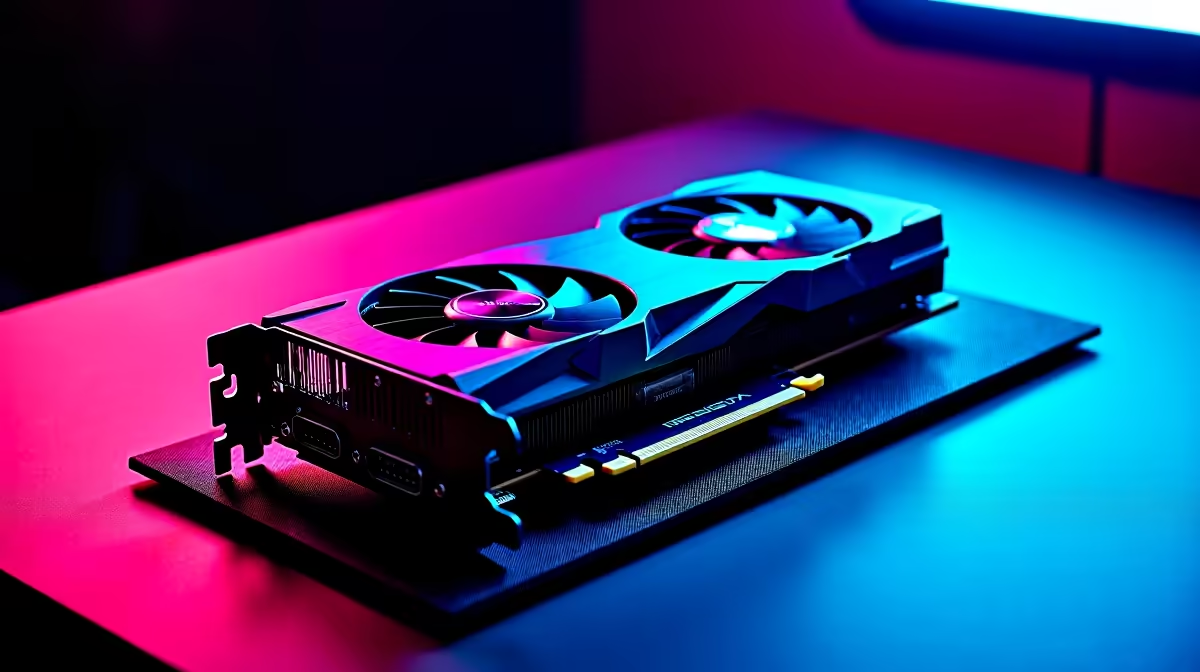
The RTX 5090 and RTX 5080 represent NVIDIA's Blackwell generation flagships, and for South African gamers dropping serious rands on a GPU, the price-to-performance calculation matters enormously. The rand pricing premium on high-end GPUs is significant - understanding where you get diminishing returns versus real-world value separates a smart build from an overspend.
Quick Answer
RTX 5090 vs RTX 5080 for SA gamers in 2026 - which is worth it? For most SA gamers, the RTX 5080 delivers outstanding 4K performance at a meaningfully lower price point. The RTX 5090 offers 15–25% more raw performance in demanding titles but typically costs 40–60% more in rand terms, making it a niche purchase for those gaming at 4K/144Hz+ with no compromises or doing GPU-accelerated creative work.
🔧 Performance Differences at Each Resolution
1080p and 1440p: At these resolutions both cards are massively overkill for gaming purposes alone. The RTX 5080 is CPU-limited before it is GPU-limited in most competitive titles at 1440p. Buying an RTX 5090 for 1440p gaming does not make financial sense.
4K/60Hz: Both cards handle 4K/60Hz in every current title with settings maxed and ray tracing enabled. If 4K/60Hz is your target, neither card is the right purchase - an RTX 5070 Ti delivers this with budget to spare.
4K/120Hz and 4K/144Hz: This is where the two cards diverge in meaningful ways. The RTX 5080 maintains 120+ fps in most titles at 4K with high settings. The RTX 5090 pushes into 140–170+ fps territory in those same titles, making it relevant for gamers with 4K/144Hz monitors who want a locked high-refresh experience without DLSS as a crutch.
4K with full ray tracing and path tracing: The RTX 5090's larger compute budget and memory bandwidth advantage is most visible in path-traced titles like Cyberpunk 2077 with full path tracing enabled. The 5090 leads the 5080 by 20–30% in this scenario. If you play these titles and have a 4K/144Hz display, the premium is more defensible.
DLSS 4 with Multi Frame Generation: Both cards support DLSS 4's multi-frame generation, which multiplies effective frame rates significantly. With DLSS 4 active, the performance gap between the 5080 and 5090 in raw output terms narrows - both can push well above 144 fps at 4K on the same titles, which diminishes the practical case for the 5090 in gaming-only use.
📊 SA Pricing Reality in 2026
GPU pricing in SA is directly tied to the rand/dollar exchange rate and import margins. At the time of writing, the RTX 5080 sits at roughly R18,000–R22,000 depending on the AIB model and stock availability, while RTX 5090 cards land in the R28,000–R38,000 range.
That means the 5090 premium in rand terms is often R10,000–R16,000 over the 5080 for 15–25% more gaming performance. Put differently, that money could instead go toward a higher-refresh-rate 4K monitor, faster storage, or a top-tier CPU that removes other bottlenecks in your system.
For creative professionals doing GPU-accelerated AI workloads, video rendering, or 3D work - the RTX 5090's 32GB GDDR7 VRAM versus the 5080's 16GB becomes a more relevant differentiator. Many SA freelancers and small studios are finding the 5090 earns its premium through faster turnaround on render jobs.
💡 Which One Should You Buy?
Choose the RTX 5080 if: You game at 4K up to 144Hz and want the best value flagship. You plan to use DLSS 4. You have a sensible total build budget and don't want GPU spend to crowd out other components. This covers 95% of SA gamers who would consider either card.
Choose the RTX 5090 if: You have a 4K/240Hz display and demand native (non-DLSS) performance. You run GPU-accelerated creative workloads where the extra VRAM and compute are billable hours saved. Budget is genuinely not a constraint and you want the absolute best available.
❓ Frequently Asked Questions
Does the RTX 5090 overheat in SA ambient temperatures? High-end GPUs generate significant heat regardless of ambient conditions. In hotter SA regions, ensure your case has adequate airflow. Most RTX 5090 AIB models run coolers with 3-fan configurations that handle heat well, but case airflow remains the critical variable.
Will the RTX 5080 be bottlenecked by older CPUs? Yes. At 1080p especially, an older CPU like a Ryzen 5 3600 will bottleneck an RTX 5080 in CPU-dependent games. Pair either card with at minimum a Ryzen 7 7700X or Intel Core Ultra 7 for 4K gaming, where bottlenecks shift to the GPU.
How long will either card last before needing an upgrade? At 4K gaming, both cards should remain relevant for 4–6 years based on generational performance curves. The RTX 5080's 16GB VRAM may become limiting for very high-resolution texture packs or AI-assisted upscaling modes beyond this generation, while the 5090's 32GB provides more headroom.
Evetech stocks RTX 5090 Gaming PCs and RTX 5080 Gaming PCs — browse current SA pricing and availability online.
Ready to Find Your Perfect Match? Shop at Evetech