Quick Answer
The Ryzen 9 9900X is AMD's Zen 5 flagship that delivers a meaningful generational uplift over Zen 4 and Zen 3 chips in both gaming and productivity. For South African builders weighing a platform switch, the decision hinges on motherboard compatibility, current ZAR pricing, and the workloads you actually run day to day.
What Changed Between Ryzen Generations
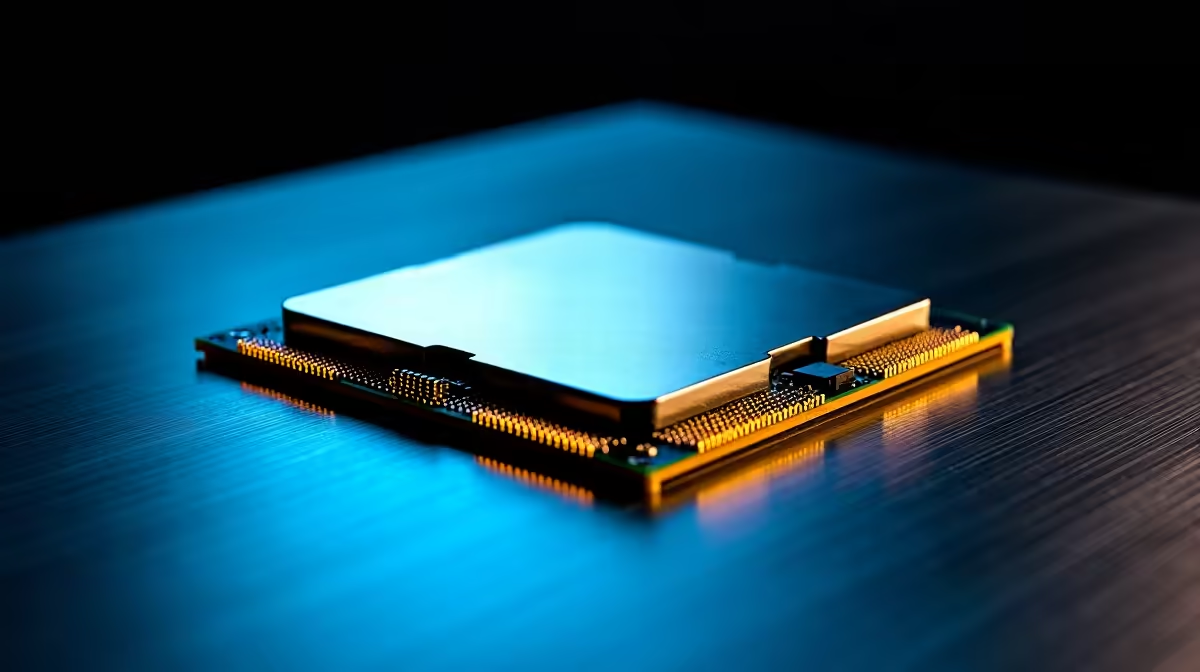
AMD's Zen 5 architecture, which powers the 9900X, introduces wider front-end decode, improved branch prediction, and a redesigned FPU compared to Zen 4. The 9900X ships with 12 cores and 24 threads at a 4.6 GHz base and 5.6 GHz boost, supported by the AM5 platform that AMD has committed to through at least 2027.
Zen 4 processors like the Ryzen 9 7900X were already strong performers, so the question is whether the Zen 5 uplift justifies spending again in rands. In synthetic workloads such as Cinebench R24 and Blender, Zen 5 shows roughly 10 to 16 percent better instructions-per-clock over Zen 4 at the same thread count. Single-threaded scores benefit more noticeably than multi-threaded tasks where thread count previously bottlenecked results.
For Zen 3 owners on AM4 (Ryzen 9 5900X territory), the generational gap is much wider. Moving from AM4 to AM5 means a full platform change including a new DDR5 motherboard, so the total upgrade cost in ZAR is substantially higher than just the CPU price.
SA Upgrade Cost Reality Check
In South Africa the 9900X sits in the premium CPU bracket. When you factor in AM5 motherboard costs if you are coming from AM4, DDR5 memory, and the CPU itself, the total outlay can exceed R15,000 for a full platform rebuild. That is a significant commitment compared to dropping a Ryzen 9 5900X onto an existing B550 board for far less.
For users already on AM5 with a Ryzen 7000-series chip, the picture is different. A same-board swap retains your DDR5 kit and motherboard investment, reducing the upgrade to just the CPU cost. In that scenario the performance per rand improves considerably, especially for content creators and video editors who push the CPU hard during loadshedding recovery periods when work backlogs up.
Evetech ships countrywide, so whether you are in Cape Town, Johannesburg, Durban, or Pretoria you can order and receive the processor without needing to source from grey-market channels. Warranty support through local retailers also matters when a component fails during rolling power outages that stress systems.
Gaming vs Productivity: Where the 9900X Wins
In gaming at 1080p where the CPU is most visible, Zen 5 shows clearer gains in minimum frame rates rather than average frames. Games with heavy physics or AI simulation threads benefit from the wider FPU and improved memory latency tuning. Titles like Cyberpunk 2077 and Forza Horizon 5 show the IPC gain more clearly than older engine games.
Productivity workloads tell a more one-sided story. Video encoding in HandBrake, 3D rendering in Blender, and code compilation all scale well with Zen 5's improved throughput. If your workflow involves frequent renders or large data processing, the upgrade from a Zen 3 chip pays back faster in time saved.
For pure gaming on a budget, a Ryzen 7 9700X or even a Ryzen 7 7800X3D with its 3D V-Cache would outperform the 9900X in many titles at lower cost due to the cache advantage. The 9900X makes most sense when you need both strong gaming and strong productivity from a single chip.
Is It Worth Upgrading From Each Previous Gen?
From Zen 3 (Ryzen 9 5900X): Yes, with caveats. The IPC gain is significant and you gain DDR5 bandwidth, but the platform change cost is real. Only upgrade if you are also refreshing your motherboard for other reasons.
From Zen 4 (Ryzen 9 7900X): Marginal for most users. The IPC improvement is real but smaller, and you will not recoup the cost in gaming performance. Content creators who render daily may find the productivity gain worthwhile.
From Zen 4 with 3D V-Cache (Ryzen 9 7950X3D): Do not upgrade. The cache advantage of 3D V-Cache chips in gaming and heavily threaded cache-sensitive workloads makes them competitive well into the Zen 5 cycle.
Frequently Asked Questions
Does the Ryzen 9 9900X work on existing AM5 motherboards?
Yes, most AM5 motherboards support the 9900X through a BIOS update. Check your board manufacturer's compatibility list before purchasing to confirm your specific model supports Zen 5.
Is DDR5 required for the Ryzen 9 9900X?
Yes. AM5 is a DDR5-only platform. If you are upgrading from AM4, you need a new motherboard and DDR5 memory kit in addition to the CPU.
How does the 9900X handle loadshedding stress on components?
The 9900X draws up to 170W under sustained all-core load. If you are running a UPS, account for peak system draw including GPU and storage when sizing your VA rating. Sudden power cuts during sustained renders can corrupt in-progress work if your UPS cannot handle the load.
Ready to Find Your Perfect Match? Browse the latest AMD Ryzen processors and compare prices in ZAR. Shop CPU Processors