Quick Answer
The Xigmatek Pano II and EINAREX Prisma are both budget-friendly airflow-focused PC cases designed for builders who want strong cooling performance without overspending. The Pano II edges ahead for pure airflow with its mesh front panel and open interior layout, while the Prisma offers a better visual package with more integrated RGB at a similar price point.
Overview: Two Budget Airflow Cases Head to Head
Budget PC case comparisons rarely generate much excitement, but the Xigmatek Pano II and EINAREX Prisma represent a genuinely interesting matchup for South African builders putting together gaming rigs in the R8,000 to R15,000 range. Both cases target the segment that wants respectable airflow, a modern aesthetic with tempered glass, and compatibility with full-size ATX motherboards without spending R2,000 or more on the chassis alone.
The Pano II retails locally around R900 to R1,100, while the Prisma sits in a similar bracket at R850 to R1,050. These small price differences are less important than the functional differences between them, so this comparison focuses on airflow design, build quality, ease of assembly, and long-term thermal performance.
Airflow Design and Cooling Performance
The Xigmatek Pano II takes a no-compromise approach to airflow. Its front panel is a full mesh intake that spans the entire face of the case, which means virtually no impedance to air entering the chassis. Combined with the standard fan configuration of three 120mm or two 140mm intake fans at the front and a rear 120mm exhaust, this case moves substantial air across the GPU and CPU without requiring exotic fan curves.
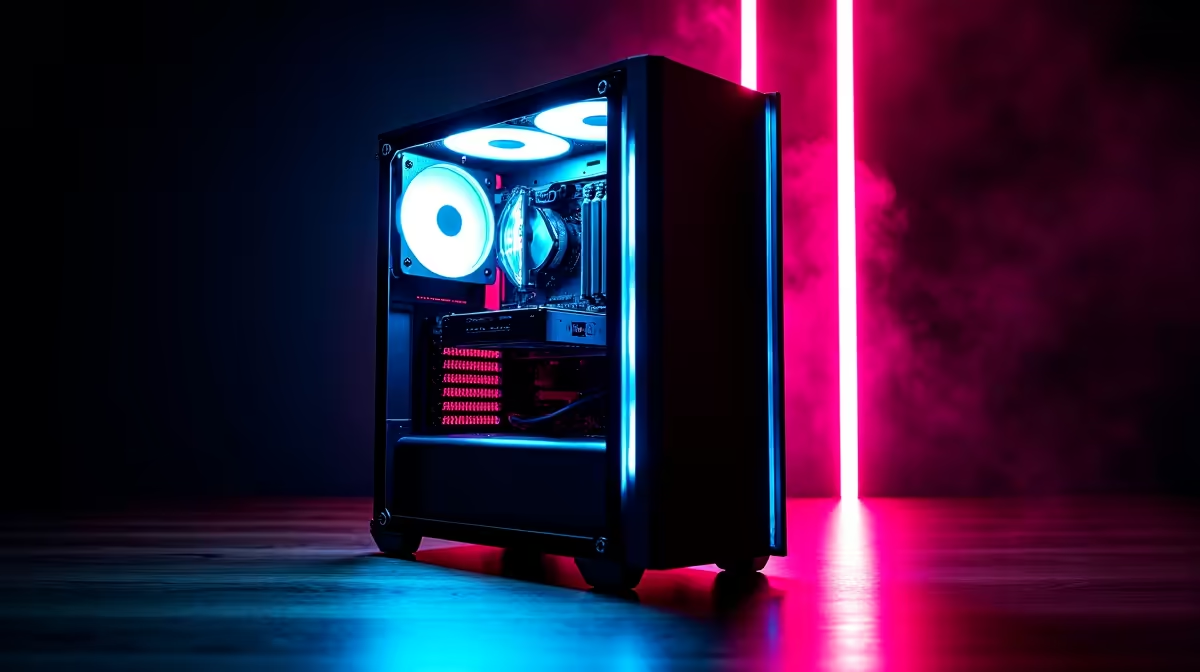
The EINAREX Prisma trades some of that raw airflow for aesthetics. Its front panel includes ARGB lighting strips behind a semi-mesh design. The lighting looks striking, but the panel is slightly more restrictive than the Pano II's full mesh face. In enclosed gaming rooms during South African summer, this difference becomes meaningful. Interior temperatures in the Prisma can run two to four degrees Celsius higher under sustained gaming loads, which is not critical but is a factor worth knowing.
Both cases support a 360mm radiator at the front and a 240mm at the top, making them compatible with most AIO liquid coolers if you plan to go that route for your CPU.
Build Quality and Ease of Assembly
The Pano II's interior is clean and uncluttered. Cable routing channels are adequately sized for modular power supply cables, and the three included fans are basic but functional. The tempered glass side panel swings open on a hinge rather than sliding, which is a minor convenience advantage during iterative builds. Steel thickness is on par with competitors at this price, meaning slight flex in the chassis is expected but not problematic.
The Prisma offers a slightly more polished interior finish. The included ARGB fans are genuinely attractive when lit and the controller hub simplifies RGB management. Cable management routing is similarly practical. Builders at universities like UP or UJ putting together their first desktop build will find both cases forgiving to work in, though the Prisma's included fan controller adds a step to the initial setup process.
Which Case Should SA Builders Choose?
Choose the Xigmatek Pano II if your primary concern is keeping temperatures as low as possible, particularly in warm South African climates during summer months in Gauteng or KwaZulu-Natal where ambient temperatures push into the mid-30s. The full mesh front is the most reliable passive cooling advantage at this price.
Choose the EINAREX Prisma if you want a more visually complete build out of the box with coordinated RGB without buying additional lighting strips. The thermal trade-off is minor enough that it will not harm performance in most gaming scenarios, and the finished look inside the glass panel is noticeably more premium.
Frequently Asked Questions
Can both cases fit an ATX motherboard and a full-length GPU? Yes. Both the Xigmatek Pano II and EINAREX Prisma support standard ATX, mATX, and Mini-ITX motherboards. GPU clearance on both extends to around 380mm, accommodating most current graphics cards including the RTX 4080 Super and RX 7900 GRE.
Are the included fans good enough or should I replace them immediately? The included fans are adequate for light to moderate gaming loads. If you are running a high TDP CPU like a Ryzen 7 9800X3D or Core i9-14900K alongside a power-hungry GPU, adding one or two quality 120mm fans to the exhaust positions will noticeably improve thermals. Budget R400 to R600 extra for aftermarket fans if your build leans toward the hot side.
Do either of these cases support vertical GPU mounting? Neither the Pano II nor the Prisma includes a vertical GPU riser out of the box. Aftermarket risers are available locally for R300 to R600, but vertical mounting in budget cases with mesh fronts can actually reduce GPU cooling by restricting hot air exhaust paths. For thermal performance, standard horizontal mounting is recommended in both cases.
Ready to Find Your Perfect Match? Find your next PC case at Evetech. Browse the full range of airflow-optimized computer cases for every budget and build style.