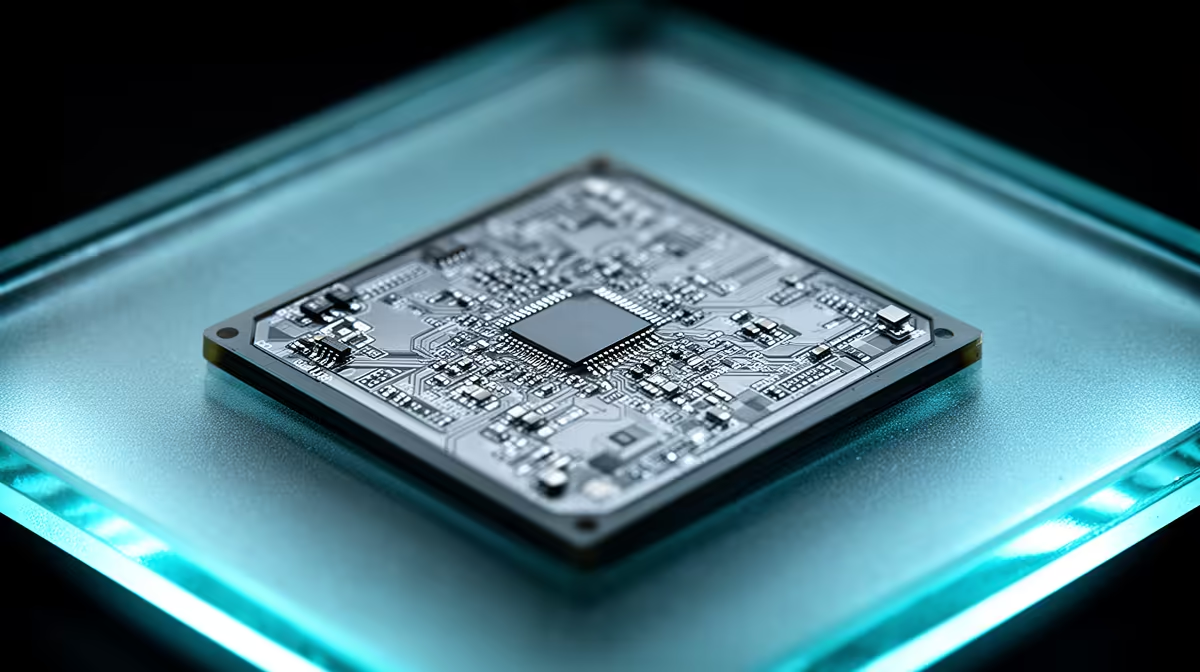
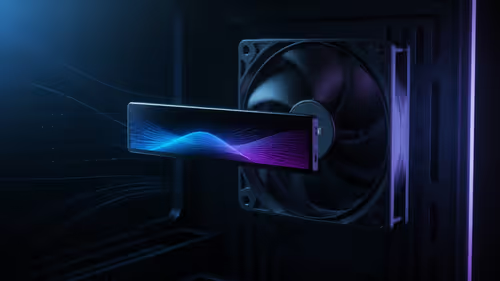
Flip open almost any webcam spec sheet and the acronym CMOS appears almost immediately, usually without explanation. The technology behind it has fundamentally changed what a small, affordable camera can do, and understanding it explains why modern webcams can stream at 1080p60 without draining a USB port or overheating on a long session. CMOS photo sensors replaced an older approach to image capture, and the advantages compound the more demanding the use case becomes.
Quick Answer
CMOS sensors read pixel data in parallel across the whole frame, enabling high frame rates like 1080p60 at low power. The older CCD approach read pixels sequentially, which was slower and drew far more current. Modern CMOS also puts processing circuitry directly on the chip, enabling real-time adjustments that CCD could not handle on-sensor.
⚡ The Speed Advantage: Parallel Readout
The fundamental difference between CMOS and older CCD technology is how each architecture moves pixel data off the sensor. A CCD passes charge along a chain of capacitors, transferring each pixel's information in sequence to a single readout point at the edge. This is inherently serial -- one pixel follows another -- which limits how fast the full frame can be read.
CMOS sensors wire each pixel to its own readout circuit. The entire row fires at once, with rows following in rapid succession. This parallel architecture is what makes 1080p60 and 4K30 achievable in a device powered by a single USB port. The same task on a CCD chip would require either a slower frame rate or significantly more power to drive the sequential transfer fast enough.
For streaming and gaming facecams, that frame rate headroom is not theoretical. A 60fps feed captures fast head movements and expressions without the motion blur a 30fps chip produces when the subject moves. The footage is visibly smoother, particularly on larger screens.
🔌 Power Consumption and Long Sessions
CCD sensors require a higher operating voltage than CMOS, and that difference compounds across a multi-hour stream. A USB-powered CCD camera draws more current from the port, generating more heat from both the camera body and the USB controller.
CMOS runs at a lower supply voltage and stays cooler. Cameras that run warm over long sessions introduce thermal noise into the image -- a gradual increase in the random speckle visible in dark areas. A CMOS sensor's lower operating temperature keeps this effect minimal even through a four-hour stream, which is a real consideration for South African streamers running sessions into the evening.
🧠 On-Chip Processing
The transistor-per-pixel architecture that makes CMOS fast also provides space for processing logic at the pixel level. Exposure control, noise reduction, and automatic gain adjustments can be handled on the sensor itself rather than offloaded entirely to a separate image signal processor.
This matters for live streaming because the camera makes continuous real-time decisions about exposure. When a streamer leans back and a bright window enters the frame, the sensor needs to react within milliseconds to prevent the face from darkening. On-chip processing handles that reaction faster than a two-stage pipeline where data must travel off-sensor before any decision is made.
Back-illuminated CMOS designs, often labelled BSI-CMOS on spec sheets, go further by flipping the pixel layer structure so light reaches the photodiode before passing through the wiring layer. This increases light sensitivity in the same physical area, which is why newer BSI webcams outperform earlier CMOS designs of the same resolution in dim rooms.
Frequently Asked Questions
Why did webcam manufacturers move away from CCD sensors?
CMOS offered faster readout, lower manufacturing costs, and dramatically reduced power consumption -- all practical requirements for a USB-powered device. The image quality gap that once favoured CCD in low light has closed as CMOS architectures improved, particularly with back-illuminated designs, leaving no practical reason to keep CCD in this product category.
Will a CMOS webcam struggle in a dark room?
Standard CMOS sensors need reasonable light, around 300 to 400 lux, to produce a clean high-frame-rate image without pushing gain into noisy territory. BSI-CMOS designs need less light for the same result. Pointing a basic desk lamp or a budget diffused light panel at your face -- something that runs R300 to R600 at most -- usually produces a more noticeable quality jump than swapping the camera body.
Is a higher-resolution CMOS sensor always sharper?
Not automatically. A 4K CMOS sensor downsampling to 1080p output uses pixel binning that can deliver a sharper result than a native 1080p sensor, because more raw data is condensed into each output pixel. Lens quality and the compression codec used for the output stream matter as much as the sensor resolution.
Do all webcams use CMOS sensors now?
Virtually all current webcams do. The cost, size, speed, and power advantages of CMOS have made CCD obsolete in this product category. The variation between webcams today lies in the specific CMOS architecture -- standard, back-illuminated, stacked -- and the quality of the lens and processing pipeline around the sensor.
Ready to put a proper sensor to work on your stream?
Browse the streaming and conferencing webcam range built for South African creators and professionals, and find a CMOS-powered camera that matches your frame rate and resolution needs.