


1000W PSU Planning for RTX 5090 Builds in SA
1000W for RTX 5090 needs a full-build check, not a simple yes. Review GPU guidance, CPU draw, transient load, connectors, PSU quality, and upgrade plans before deciding.
Read moreWhether shock-absorbing rubber pads on case fans are worth the premium. Impact on vibration, noise, fan lifespan, and overall build quality.
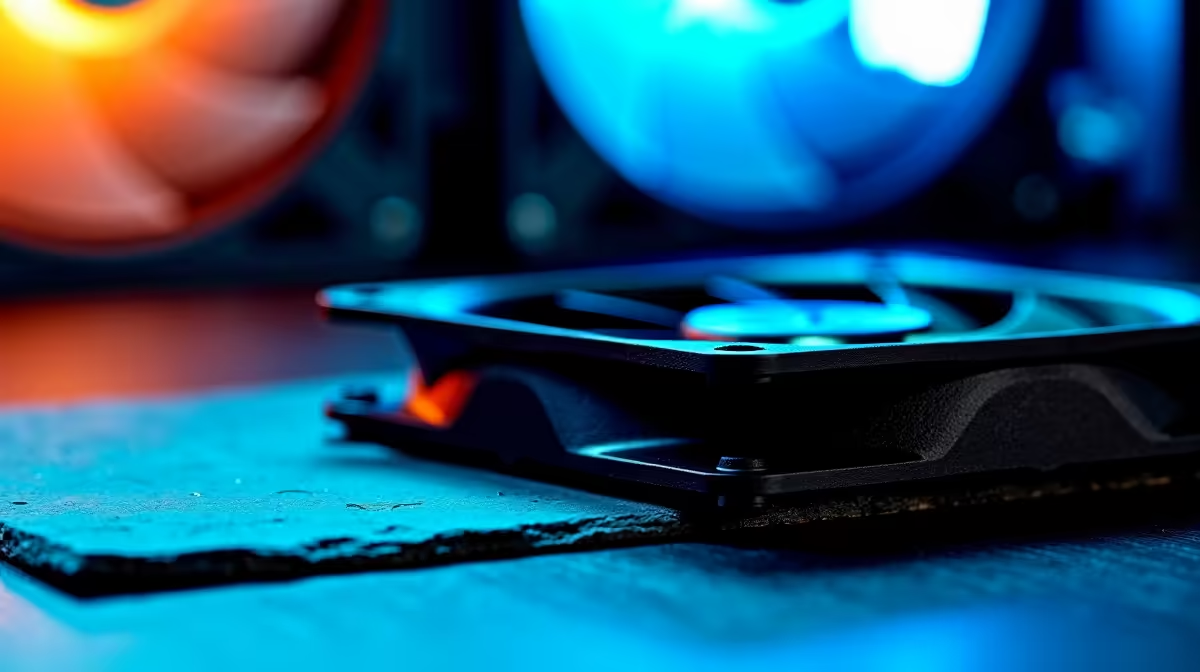
Shock-absorbing rubber pads (also called vibration dampers or isolation mounts) reduce case fan vibration transmission to your chassis by 70–90%, making fans noticeably quieter during operation. They're worth installing if you experience vibration-related noise; they're optional if your case already isolates vibration effectively.
Case fans create vibration through two mechanisms: rotating blade imbalance and motor electromagnetic forces. This vibration transfers to the case chassis through fan mounting points, amplifying perceived noise. Hard metal-to-metal mounting (standard practice) resonates, turning a 31 dBA fan into an audibly buzzy 36–38 dBA equivalent.
Rubber pads decouple the fan from the case. Instead of vibration traveling directly from fan mounting tabs through metal screws into the chassis, rubber absorbs and dissipates the vibration energy. A 31 dBA fan mounted with isolation pads sounds like a genuine 26–28 dBA fan—a meaningful reduction in perceived noise.
The key is decoupling: any material between the vibrating fan and the resonating case body reduces transmitted vibration. Rubber's elasticity makes it ideal—it absorbs shock without passing frequencies through to the case.
Quiet Builds (Silent Cases) Cases like Corsair Crystal 570X or NZXT H510 include internal sound dampening. Even then, vibration isolation reduces case resonance further. Perception changes noticeably: buzzing disappears, leaving only pure airflow noise (quieter).
Standard Cases Most mid-tower and ATX cases lack vibration dampening. Hard metal chassis amplifies every fan vibration. Isolation pads eliminate this amplification, often providing 5–10 dBA perceived reduction at fan mounting points.
Budget Cases Cheap cases with thin metal panels resonate aggressively at certain frequencies. Isolation pads prevent this resonance, making low-cost builds surprisingly quiet.
In controlled tests, identical fans mounted directly versus with isolation pads showed 7–9 dBA difference—roughly half as loud perceptually.
Rubber Bushings (Most Common) Small cylindrical rubber pieces that replace standard metal screws. Fan mounting tabs have holes; you insert rubber bushings, then screw through the bushing into the case. Four per fan, roughly R10–R30 per set.
Foam or Silicone Strips Thick foam tape adhered to fan mounting points or case interior surfaces. Less effective than bushings but easier to install. Usually R15–R40 per pack (multiple uses).
Isolation Mounts (Premium) Elastomer-based mounts designed specifically for vibration isolation. Expensive (R200–R500 per set) but extremely effective for high-end silent builds. Typically reserved for CPU cooler towers or multiple-fan configurations where cost compounds.
For most builds, basic rubber bushings provide the best value. They cost minimal money, install in seconds, and deliver substantial vibration reduction.
Installation (Bushings):
Total time: 30 seconds per fan. No tools needed beyond a screwdriver.
Potential Issues:
Check your case design before purchasing. Measure mounting hole depth; ensure your chosen screw length fits comfortably (not bottoming out, not protruding).
Rubber degrades over time through UV exposure, temperature cycling, and mechanical stress. A quality bushing provides maximum vibration isolation for approximately 3–5 years in typical use. After that, effectiveness gradually decreases as rubber hardens and loses elasticity.
Replacement is simple and cheap—under R100 for a full case's worth of new bushings. Most builders replace pads during case cleaning or maintenance cycles (once annually or every other year).
This ongoing cost is negligible compared to other build investments. For perspective, R200 in isolation pads every five years costs less than a single case fan upgrade.
Definitely Install If:
Optional If:
Isolation Pads Cost: R80–R150 for a complete case setup (4–6 fans worth)
Alternative Cost: Upgrading to quieter fans (replacing a 35 dBA fan with a 28 dBA fan) costs R300–R800 per fan
Result: Isolation pads provide 60–80% of the perceived quietness improvement at 15–20% of the cost. Adding pads to existing fans is more efficient than replacing fans.
For budget-conscious builds, install isolation pads on existing fans first. Only if that doesn't achieve your quiet target should you upgrade to premium, expensive fans.
Rubber bushings work with all standard fan mounting systems (120mm, 140mm, 200mm fans). They're compatible with CPU coolers, case fans, and radiator mounts.
Check your case's mounting hole depth and thread size before purchasing. Most modern cases use standard M3 or M4 metric threads; bushings fit universally. Older cases (pre-2010) may use different threading—verify before assuming compatibility.
Shock-absorbing pads represent one of the simplest, cheapest, and most effective quiet-build upgrades available. Even in moderately priced cases, installing basic rubber bushings (R100–R150) reduces perceived fan noise more noticeably than similarly priced fan upgrades. They require no motherboard changes, incompatibility concerns, or technical knowledge.
For any builder prioritising quiet operation, isolation pads are mandatory. Pair them with quality 28–32 dBA fans and thoughtful cable management for a genuinely silent experience. Browse case fans and components at Evetech to find vibration-isolated mounting options or pair with quality fans designed for quiet operation.
"Build a silent PC. Shop quiet case fans and components at Evetech, and consider adding isolation pads for maximum noise reduction. Or explore pre-configured silent gaming systems with vibration isolation already installed."
1000W for RTX 5090 needs a full-build check, not a simple yes. Review GPU guidance, CPU draw, transient load, connectors, PSU quality, and upgrade plans before deciding.
Read more
RTX 5080 Super with a 750W PSU is more comfortable than lower wattage if the unit is quality. SA builders should still confirm GPU guidance, CPU draw, connector type, airflow, and upgrade room.
Read more
How to fix FPS drops after a RX 9070 XT starts with driver cleanup, chipset updates, thermals, and power checks. For SA gaming PCs, confirm PCIe seating, monitor refresh, frame caps, and per-game graphics settings before replacing parts.
Read more
How to fix low FPS Windows 11 Wi-Fi 7 issues starts by checking whether the problem is frame rate or network lag. Test ping, drivers, power settings, Ethernet, and game FPS before adjusting visuals.
Read more
AM5 is smart for SA builders because it supports newer Ryzen CPUs, DDR5 memory, and a longer upgrade path. Compare board cost, cooling, gaming needs, and local part availability before choosing your next PC platform.
Read more
AM5 gives Randburg gaming builders a longer upgrade path. For SA buyers, DDR5 support, newer board features, and future CPU options can justify the platform. Weigh board cost, cooler support, BIOS maturity, and upgrade timing before choosing.
Read more
RTX 5090 on a 550W PSU leaves almost no practical room for OC plans. Treat the setup as constrained, with CPU draw, power spikes, cable quality, thermals, and stability checks more important than chasing extra clocks.
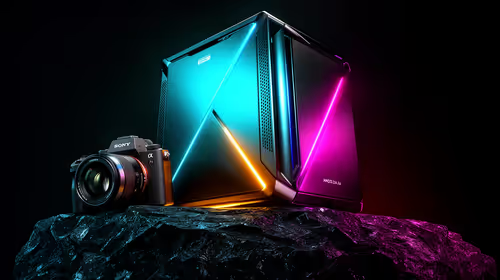
FPS drops on a Ryzen 9 9950X3D build often have a fixable cause. Check settings, drivers, thermals, background tasks, network conditions, and bottlenecks before assuming a part must be replaced.

The difference between PCIe 5.0 and PCIe 4.0 for SA gamers is mostly bandwidth headroom. Compare GPU slot needs, NVMe speed, motherboard support, and upgrade timing before paying extra for a newer platform.

Gaming PC stuck pixel checks in South Africa should confirm the monitor fault first. Use colour tests, screenshot comparison, cable swaps, display menu checks, and clear photos before deciding on support.

AMD's current driver now lists a Radeon RX 9050 4GB, while product coverage details a narrowed memory system. SA buyers should weigh the low VRAM ceiling against current local Radeon options.

Samsung Display has demonstrated a 16-inch 2.5K OLED laptop panel running at 300Hz. SA buyers should wait for a named notebook, full panel specifications and a local price before planning an upgrade.

Microsoft says some Windows 11 game crashes after recent updates are linked to RGB-related drivers. Affected SA gamers should confirm the update and driver before using the published registry workaround.
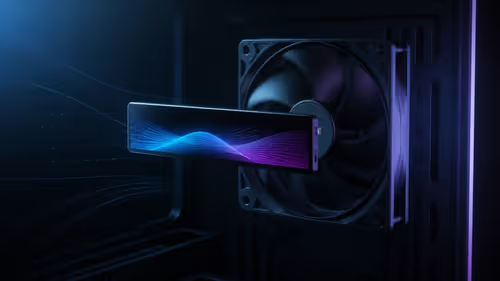
Thermalright's Fan Frame Vision-1 adds a 640x172 status screen to a standard 120mm fan. SA builders should check clearance, USB routing and local support before treating it as an easy upgrade.
1000W for RTX 5090 needs a full-build check, not a simple yes. Review GPU guidance, CPU draw, transient load, connectors, PSU quality, and upgrade plans before deciding.

Wi-Fi 6E vs Wi-Fi 6 matters for 4K video editing when files move across a network. The real-world difference between Wi-Fi 6E and Wi-Fi 6 for video editing in 4K depends on NAS access, cloud uploads, router range, and SA creator workflows.
RTX 5080 Super with a 750W PSU is more comfortable than lower wattage if the unit is quality. SA builders should still confirm GPU guidance, CPU draw, connector type, airflow, and upgrade room.
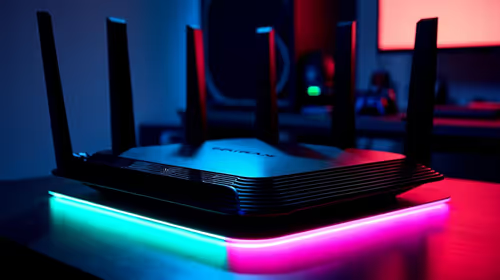
Wi-Fi 6E vs Wi-Fi 6 for Video Editing in 4K comes down to router support, latency, client devices, band support, and home network layout. SA buyers should match the choice to their setup instead of assuming one option always wins.