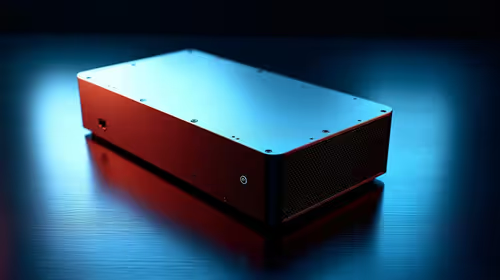
Yes, one card can sit at the centre of a 32-screen synchronization design, but the number needs context. The NVIDIA RTX PRO Sync card supports up to 32 synchronised displays within an architecture that can contain no more than eight participating RTX Pro GPUs.
Quick Answer
An RTX PRO Sync system supports up to 32 displays or projectors through NVIDIA Mosaic; the complete architecture may contain eight GPUs and two synchronisation cards.
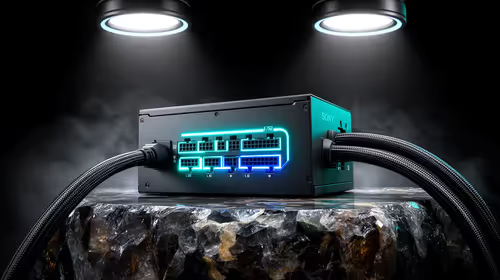
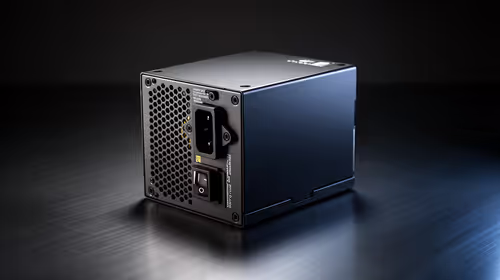
One PNY RTX Pro Sync card supports as many as 32 synchronised displays. It costs R19,599 and combines that capacity with support for eight NVIDIA RTX Pro GPUs, Genlock, Frame Lock and Mosaic.
3️⃣2️⃣ Treat 32 as a ceiling
The number describes maximum synchronized screen capacity, not a recommended wall size. Begin with the display count the content and audience require, then check how much approved growth remains below 32.
Lay out every panel on a drawing and compare screen candidates through Evetech's PC monitor range. Physical placement, bezel geometry and viewing distance still need their own design even though the sync card provides the digital capacity.
8️⃣ Count graphics processors too
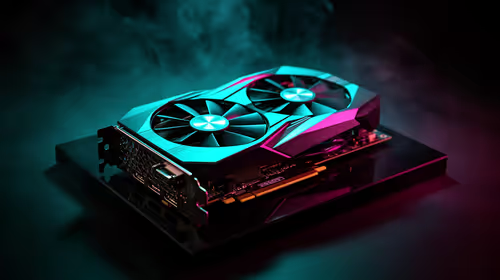
The system also has an eight-GPU boundary. Assign outputs and applications to each proposed RTX Pro processor before deciding that the display count fits. A 32-screen total alone cannot prove the rendering architecture is complete.
Review Evetech's workstation graphics card category after workload ownership is clear. The design can use fewer than eight GPUs, and often should when the smaller allocation meets every requirement.
🧩 Understand what accompanies capacity
The PNY RTX Pro Sync product costs R19,599 and includes NVIDIA Mosaic for the arranged display surface. Genlock deals with the required reference relationship; Frame Lock keeps frames aligned among the graphics resources.
These functions explain how the card fits a professional wall, but the project still determines the content system, signal architecture, mounting and acceptance process. Capacity is useful only when the rest of the design can support the intended screen group.
🧪 Prove the chosen scale
Test the actual configuration with moving content that crosses the most demanding display and GPU boundaries. Observe from normal viewing positions, record active processors and repeat the expected operating modes. Do not wait until the wall reaches 32 panels to create a commissioning method.
Choose related items from Evetech's graphics card accessories section once the architecture is fixed. Keep the R19,599 synchronization component separate from processors, displays and project work.
Build a capacity table before approaching 32
Give each display a row containing its content purpose, owning GPU and Mosaic region. Summarise the table by processor and by screen group. This reveals empty capacity as well as overloaded parts of the design, and it prevents the headline number from hiding an uneven allocation.
Add a column for future state only where expansion has a named use. A proposed 32-screen wall should show how every group contributes to the audience or operator task. If several rows have no content purpose, reduce the initial design and keep the remaining space as optional headroom.
Review the table whenever a processor or screen is replaced. The supported ceiling remains unchanged, but output ownership and the boundaries that need testing may move.
The new detail is important for the title: 32 is the simultaneous system capacity, not an unlimited number attached to any arbitrary card layout. The primary package includes four 12-inch sync cables and two 24-inch versions for integration. Map the displays across the participating GPUs and cards, then verify that the designed system remains within both the 32-output and eight-GPU ceilings.
Frequently Asked Questions
Does one card really cover 32 displays?
Yes. One PNY RTX Pro Sync card has a supported ceiling of 32 synchronised displays in the professional multi-GPU design.
How many GPUs can take part?
Participation stops at eight NVIDIA RTX Pro graphics processors, although the project may use a smaller number.
Which synchronization features are included?
The card carries Genlock, Frame Lock and NVIDIA Mosaic, covering distinct timing, frame and canvas roles.
Can the design go past 32 screens?
This card's supported ceiling is 32. A larger requirement needs a different architecture review rather than an assumption of extra capacity.
How should a 32-display proposal be reviewed?
Require a purpose, owning GPU and acceptance boundary for every screen group. Summarise the total by processor, then show how important content moves across the canvas. A full-capacity proposal should demonstrate why 32 panels are necessary and how the team will commission them, not rely on the product ceiling as its design argument. Include a rollback state for staged acceptance because the complete wall may not be proven in one step. The operating team should review the final allocation too.
Their review confirms that the map is usable after handover.
Ready to plan within the 32-display boundary?
Use Evetech's graphics, monitor and accessory categories to cost the exact wall you intend to commission, not an abstract maximum.