Quick Answer
Core i7-14700K plus RX 9060 XT is mostly GPU-limited at 1440p, with the CPU strong enough for high-refresh esports. For SA buyers, this kind of pairing usually belongs in a broad R30,000-R55,000 gaming PC depending on GPU, RAM, and storage. Target 1440p first; 4K shifts more pressure to the GPU and makes the CPU less of the main concern.
Where The Limit Shows Up
At 1080p low settings, fast CPUs can matter because the GPU finishes frames quickly. At 1440p high settings, the graphics card usually becomes the main limiter. At 4K, even strong GPUs work harder and the CPU gap becomes less visible. Check frame pacing, not only average fps, because stutter can make a technically fast build feel poor.
Sensible Parts Around This Pairing
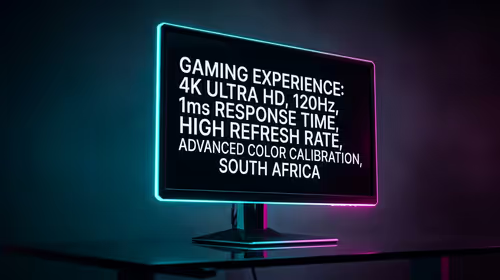
Use 32 GB DDR5, a 1 TB or 2 TB NVMe SSD, and a quality 750 W to 850 W PSU depending on the final GPU. RX 9060 XT should sit in a case with clear intake and enough PCIe power cable space. If you play competitive shooters, pair the system with a 165 Hz or 240 Hz monitor so the hardware gain is visible.
SA Buying Context
Broad local prices move with stock, so compare the complete tower instead of one headline component. A cheaper motherboard or PSU can erase the value of an expensive CPU and GPU. Local warranty support is especially important on graphics cards because diagnostics are easier when the full build can be checked as one system.
FAQ
Is Core i7-14700K too strong for RX 9060 XT?
It may have extra headroom, but that is not a problem if the build targets stable high-refresh gaming. The GPU will still decide most 1440p results.
Should I upgrade the CPU or GPU first?
Upgrade the GPU first when 1440p or 4K fps is the problem. Upgrade the CPU first only when low-resolution esports fps or stutter is clearly CPU-bound.
How much RAM suits this build?
32 GB DDR5 is the practical target. It gives gaming and background apps room without making the system unnecessarily expensive.
Performance check
Test Core i7-14700K and RX 9060 XT at your real monitor resolution before judging bottleneck results from low-resolution benchmarks.