A render can wait for compute while a complex scene waits for memory. Treating those two limits as one number leads to expensive mistakes. In the CUDA cores vs GPU memory debate, the biggest impact comes from whichever resource the application and project exhaust first, not the specification that looks more impressive.
Quick Answer
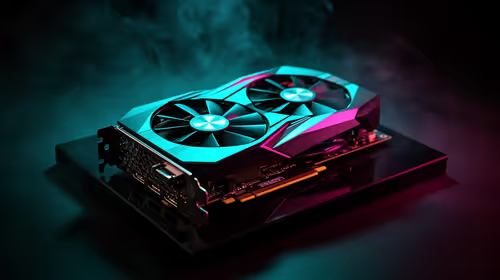
On the RTX A1000, 2,304 CUDA cores handle supported parallel work while 8GB GDDR6 at 192GB/sec holds and moves active graphics data; neither replaces the other.
Neither CUDA resources nor VRAM dominates every professional task. Identify the constrained stage with application guidance and a controlled file. At R12,099, the A1000 offers 2304 CUDA cores for compute and 8GB GDDR6 for active data; 128-bit identifies its interface, with Ampere defining the architecture.
🧭 Recognise a compute-bound task
A supported renderer or GPU compute operation may divide suitable work across CUDA resources. The benefit depends on software implementation, scene, settings and architecture. A core count therefore gives comparison context, but it cannot state the completion time of a named job.
Confirm that the application has selected the intended device. Then repeat one fixed operation and record elapsed time. If the task uses the GPU heavily without approaching a memory limit, compute resources may deserve greater weight in the next shortlist.
🧭 Spot a capacity boundary
VRAM holds geometry, textures, frames and other working data required by the GPU. When the active set becomes too large, the application may change behaviour, reduce responsiveness or fail an operation. The exact signs vary, so use the program's diagnostics and a representative file.
The A1000's capacity is 8GB GDDR6. Its 128-bit interface is a separate characteristic and does not add capacity. Buyers comparing the card at R12,099 can browse the workstation graphics-card department for other balances of memory and compute.

🧭 Build a two-axis comparison
Create a simple matrix with project memory demand on one axis and accelerated compute time on the other. Test the same file on each candidate. A card that clears memory capacity but offers weak results in the accelerated stage is not balanced for that workload; the reverse can be equally limiting.
Use the RTX A1000's exact configuration as one measured point: Ampere, 2304 CUDA cores, 8GB GDDR6 and 128-bit memory. Avoid combining results from unrelated projects, because that hides which resource changed the outcome.
🧭 Keep system constraints visible
The CPU may prepare data, system RAM may hold project state and storage may feed large files. A GPU upgrade cannot automatically remove delays in those stages. Monitor the complete sequence and isolate the slow component before spending.
AI-assisted professional work adds another support question. The AI PC category can broaden the platform review, but model compatibility and memory demand still need direct checking. CUDA support for one operation does not imply that every AI feature will use the card.
Diagnose mixed constraints in sequence
Some tasks alternate between memory-heavy and compute-heavy stages. Divide the workflow into checkpoints and observe each one separately. A scene may fit during setup, approach capacity during rendering and then wait on storage during output.
Write the sequence as a timeline with the observed constraint beside each stage. The next GPU should improve the critical path, not merely one short phase that does not affect delivery. This prevents a balanced card from being rejected because another component dominates the total job.
When two constraints appear, price the card and the accompanying system change together. Solving compute while leaving an immediate memory boundary can produce an upgrade that looks stronger but still misses the required project.
The card reinforces that division with separate resources for specialised operations: 18 RT cores and 72 Tensor cores sit beside the CUDA array. FP32 capability tops out at 6.74 TFLOPS. Ray tracing is rated at 13.2 TFLOPS, while the Tensor path reaches 53.8 TFLOPS. A useful professional assessment therefore connects the slow stage to compute type, memory capacity or transfer demand instead of choosing one headline number.
Frequently Asked Questions
Do CUDA cores matter more than GPU memory?
Only when the active workload is compute-bound and supports the relevant CUDA path. Memory matters more when capacity is the immediate constraint.
What balance does the RTX A1000 provide?
It combines 2304 CUDA cores with 8GB GDDR6, connected through a 128-bit interface and built on NVIDIA Ampere architecture.
Why can VRAM become a project limit?
Working graphics data needs space close to the GPU. A project that exceeds practical capacity may force asset changes or different processing behaviour.
What evidence produces the strongest buying answer?
A repeatable test using the team's software, typical settings and difficult files is stronger than a generic ranking or one isolated specification.
Ready to find the resource your workflow actually needs?
Use Evetech's professional GPU range to compare memory and compute only after identifying the stage that currently loses time.