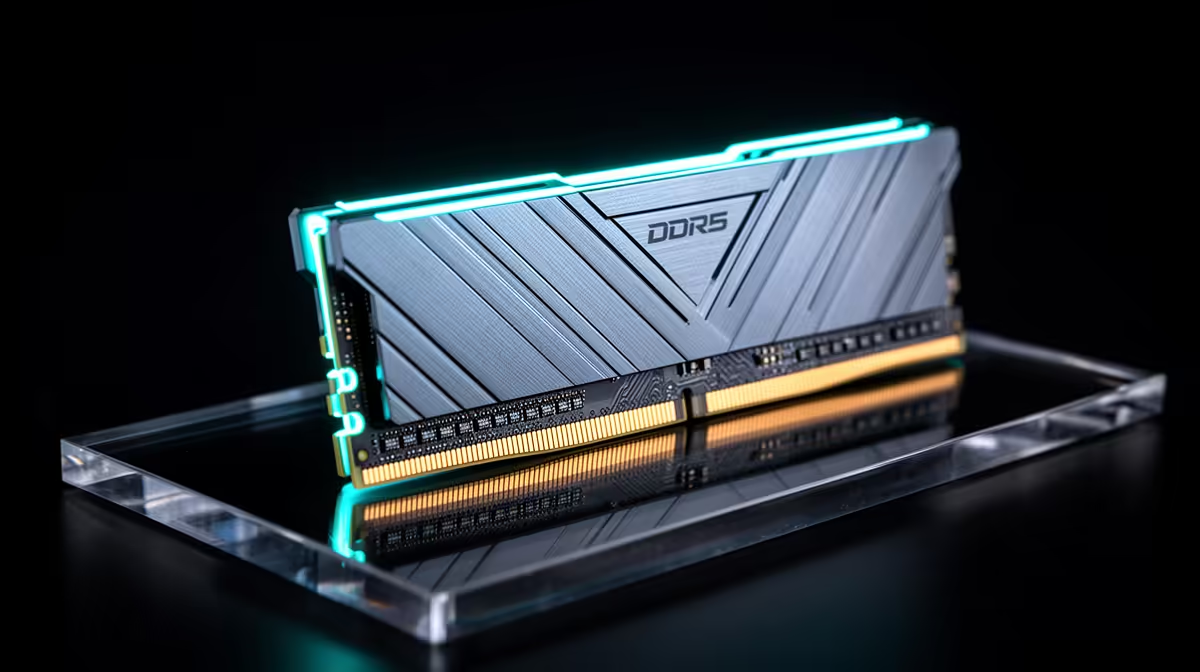
Every Ryzen build reaches the same fork eventually: chase the lowest CAS latency number on the box, or push for the highest DDR5 frequency the platform allows. Benchmarks settle this argument more consistently than forum threads do, and a b650e motherboard matters as much to the outcome as the memory kit itself.
Quick Answer
For Ryzen gaming, raw DDR5 frequency tends to move frame rates more than shaving a few nanoseconds off latency, provided EXPO is switched on in BIOS. This AM5 board tops out at 8000MT/s and sells for R3,499, so a 6000MT/s or 6400MT/s EXPO kit will generally beat a tighter-latency but slower kit across most game engines.
⚡ Why Higher Frequency Usually Wins
Ryzen's Infinity Fabric links the CPU cores to memory, and its clock typically scales with DDR5 frequency up to a practical ceiling. Feeding it faster memory keeps that fabric link running quicker, which shows up as smoother 1% lows in CPU-bound titles rather than one huge jump in average FPS. A chipset that only certifies lower speeds caps this benefit before it even starts, so support stretching to 8000MT/s leaves the ceiling with the processor rather than the board.
When the Fabric Ratio Breaks Down
Push DDR5 frequency high enough on some Ryzen chips and the Infinity Fabric can no longer hold a 1:1 ratio with the memory controller, at which point gains shrink and latency becomes the more relevant number again. Sticking to a frequency the fabric can still match 1:1 is usually the safer target than chasing the single highest number a kit advertises.
🧮 Where Latency Still Counts
Latency matters more when comparing two kits at the same MT/s but different CAS timings. In that narrower case, the kit with the lower CAS figure will edge ahead in 1% lows and input-to-frame responsiveness, though the gap is smaller than what a jump to a higher frequency kit typically delivers.
Reading a Kit's Timings Correctly
CAS latency alone does not tell the full story; true latency is roughly CAS divided by the data rate, multiplied by 2000. A 6000MT/s CL30 kit and a 6400MT/s CL32 kit land close together on that measure, which is another reason frequency deserves priority when picking DDR5 for this platform.
🛠 Getting the Most From an 8000MT/s Ceiling
None of this matters without hardware built to carry it. AM5, EXPO support and Resizable BAR all come together here, and headroom up to 8000MT/s gives enough runway that most gamers will hit their kit's rated speed with EXPO switched on rather than fighting the board for it. Weigh it against other AM5 boards in the B650 lineup before locking in a RAM kit, since not every board in that class certifies the same ceiling.
💰 Weighing Frequency Against Total Build Cost
A faster DDR5 kit usually costs more than a tighter-latency one at the same capacity, so the smarter spend is often a mid-frequency EXPO kit paired with a board that will not bottleneck it. At R3,499, this board's listing leaves more of a Ryzen build's budget for the RAM kit and graphics card rather than the chipset itself.
Frequently Asked Questions
Does higher DDR5 frequency always beat lower latency?
In most Ryzen gaming scenarios, yes, provided the Infinity Fabric can still hold a 1:1 ratio with the memory clock.
What DDR5 speed should I target on this platform?
A 6000MT/s to 6400MT/s EXPO kit is a practical sweet spot, comfortably inside the 8000MT/s ceiling this board supports.
Do I need to enable anything for the speed gains?
Yes, AMD EXPO must be turned on in BIOS; without it, DDR5 runs at a much slower default speed.
Is CAS latency worth checking at all?
Only when comparing two kits at the exact same frequency; otherwise frequency differences matter more for gaming performance.
Will a cheaper board limit my DDR5 kit?
Some boards cap officially supported speeds well below 8000MT/s, so check the spec sheet against your kit's rated speed before buying. Browsing Evetech's full AMD motherboard selection makes that comparison quick.
Ready to tune DDR5 the way Ryzen actually likes it?
The ASUS B650E MAX Gaming WiFi waits under Evetech's AMD B650E motherboard lineup, set to test whether DDR5 frequency or latency moves Ryzen gaming performance more.