Cost-effective signage is not the cheapest wall; it is the design that pays only for functions the content and operating plan will use. In South Africa, digital signage and video wall systems should be sized from audience needs, display zones and synchronization risk before a maximum-capacity product enters the conversation.
Quick Answer
RTX PRO Sync is cost-effective when signage or a video wall genuinely needs coordinated high-resolution output across multiple professional GPUs and up to 32 screens.
Use professional synchronization where signage content must form a coordinated multi-screen field or remain aligned across graphics hardware. PNY's R19,599 RTX Pro Sync option provides Mosaic, Genlock and Frame Lock. Its signage architecture cannot exceed eight GPUs or 32 synchronised displays.
🎯 Start with the communication job
Define what the audience should notice, how long it will view the content and whether imagery crosses screen boundaries. Independent menu boards and one continuous promotional canvas have different needs even when they use the same number of panels.
Compare suitable screens in Evetech's PC monitor range after the content zones and viewing distance are drawn. The panel layer should earn its cost through readability and layout, while the synchronization layer addresses a separate risk.
🧩 Pay for the functions the canvas needs
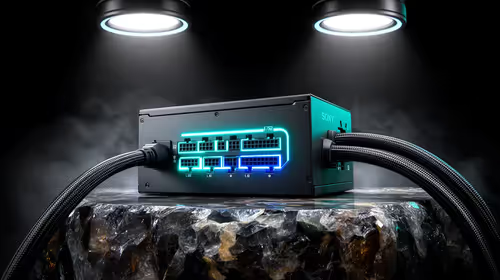
For signage that spans panels, NVIDIA Mosaic supplies the canvas arrangement. Genlock ties the required equipment to reference timing; Frame Lock maintains agreement across the GPUs involved. A project needing this complete set can use the PNY synchronization card at R19,599.
Give each chosen feature a sentence explaining the business consequence of omitting it. If no meaningful consequence can be described, revisit whether that capability belongs in the budget.
📈 Scale to actual coverage
The signage design may grow to 32 synchronised screens, while PNY limits its graphics layer to eight NVIDIA RTX Pro GPUs. Those figures define possible scale, not cost efficiency. Count the panels needed for the intended audience and assign their outputs to the smallest justified architecture.
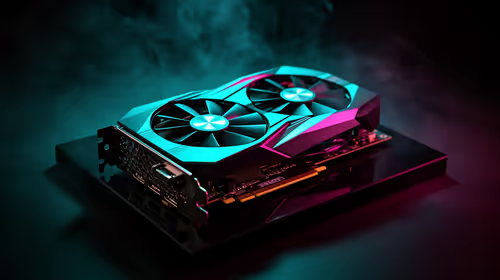
Use Evetech's workstation graphics card category after the playback or visual workloads have owners. Reserve future capacity only for an approved expansion phase with a purpose and date.
🧪 Test value through content
Run the signage material that creates the hardest boundary: a moving product, a wide line of text or a synchronized change across zones. Observe it from normal audience positions. A static proof in front of one screen cannot validate the complete wall experience.
Keep the R19,599 card separate from panel, processor and installation costs. Once the design passes, compare required graphics card accessories for that architecture. This makes future changes easier to price because every part has a documented job.
Compare cost against the communication outcome
Create one evaluation row for each audience outcome: legible information, coherent motion across the intended canvas and dependable changes between content zones. Assign every hardware cost to the outcome it supports. If a proposed part cannot be connected to an outcome or a necessary technical dependency, send it back for justification.
This method also exposes false savings. Removing a synchronization role that the motion test needs is not cost-effective, while buying unused capacity is not future-proofing. The strongest design is the least expensive complete proposal that passes the content, scale and coordination tests the signage brief actually requires.
The R19,599 package contains the primary card plus four 12-inch and two 24-inch synchronisation cables. A full system may use eight GPUs and two cards, providing a known expansion path instead of requiring maximum scale on day one. Windows 10, Windows 11 and Linux support also prevents the hardware choice from imposing an unnecessary operating-system migration on an otherwise suitable signage stack.
Frequently Asked Questions
When is a sync card justified for signage?
It is justified when the content or graphics design has a real need for arranged multi-screen presentation, reference timing or cross-GPU frame coordination.
How many signage screens can PNY RTX Pro Sync serve?
The supported maximum is 32 synchronised displays, within a system using no more than eight RTX Pro GPUs.
Does Mosaic contribute to the value case?
Yes, when the signage must form an arranged visual canvas. Independent screen zones may not need that role.
Can R19,599 prove the lowest project cost?
No. It is one component price. A fair comparison includes panels, graphics processors, installation and the functions each design actually uses.
How can a team prove the design is cost-effective?
Compare complete proposals against the same audience outcomes, content tests and capacity plan. The lower-cost option must still pass every essential role; the higher-cost one should show a meaningful result that the simpler design cannot deliver. Documented acceptance evidence makes the value conclusion more defensible than a parts-total comparison alone.
Ready to spend around the content rather than the ceiling?
Compare Evetech's professional graphics and monitor categories with your audience map, screen zones and synchronization needs already defined.