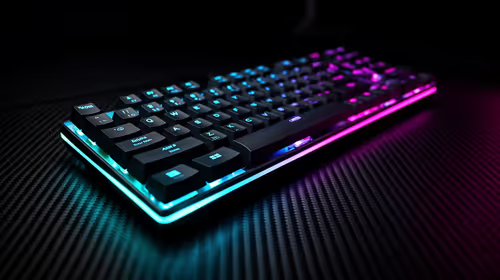
Battery gains from a switch sensor can disappear behind lighting, radio use and firmware choices. Judge TMR keyboard battery life on the complete wireless board, with the same settings and workload, rather than the sensing principle alone.
Quick Answer
TMR sensing can be designed for lower power than some Hall-effect keyboard implementations, which makes it attractive in wireless rapid-trigger boards. It does not guarantee longer battery life by itself. Scan rate, lighting, wireless radio, firmware, sleep timing and battery size can outweigh the sensor saving. Compare manufacturer battery tests with the same lighting and connection mode, then read independent measurements for the exact keyboard. Choose TMR for its complete switch feel, actuation controls and wireless result rather than one sensor claim.
Why the sensor can use less power
Tunnel magnetoresistance changes electrical resistance in response to a magnetic field. A keyboard maker can build a sensitive sensing circuit that uses less power than another magnetic design.
The comparison belongs to complete implementations. A low-power sensor paired with bright RGB and a high wireless scan rate can still empty the battery faster than a restrained Hall-effect board.
No universal percentage applies. Ask which mode, brightness and polling setting produced the published runtime.
Rapid trigger still depends on firmware
TMR can support adjustable actuation and rapid trigger when the keyboard controller and software implement them. The sensor name alone does not promise a good calibration range or stable release point.
Test the configuration tool, onboard profiles and behaviour after sleep. A wireless board must wake cleanly without losing its actuation settings.
Latency claims also need the exact wired and wireless modes. Lower sensor power does not set the radio polling rate.
Wired boards gain something else
TMR can still make sense in a wired keyboard for actuation precision, rapid trigger or switch feel. Battery saving has no value when the board takes all power through USB.
Check whether the cable is detachable, the profiles save onboard and the configuration works without an account. These details affect tournament and multi-PC use more than a wireless runtime claim.
For a laptop desk, compare receiver storage and Bluetooth switching. A board that sleeps well but loses its pairing can waste more time than its sensor saves power.
Compare battery life fairly
Set both keyboards to the same lighting state, polling rate and connection. Use them for the same hours and note sleep behaviour. USB receiver and Bluetooth modes can differ.
Charge both through their supported cable and read the low-battery behaviour. A percentage indicator, warning light and usable wired mode can matter when a long session outlasts the estimate.
Browse gaming keyboard deals for the full specification and software fit. The keyboard best-seller selection helps compare established options without treating switch technology as the whole board.
FAQ
How much battery life does TMR add?
There is no universal amount. Battery, lighting, scan rate, radio and firmware decide the complete keyboard result.
Can TMR support rapid trigger?
Yes, when the keyboard controller and software provide it. Check adjustment range and profile storage.
Should battery life be the main reason to buy TMR?
Use it as one factor. Switch feel, latency, software, layout and measured wireless runtime matter too.
Compare two keyboards at the same lighting, polling and wireless mode, then buy the complete battery and actuation result rather than the sensor label.