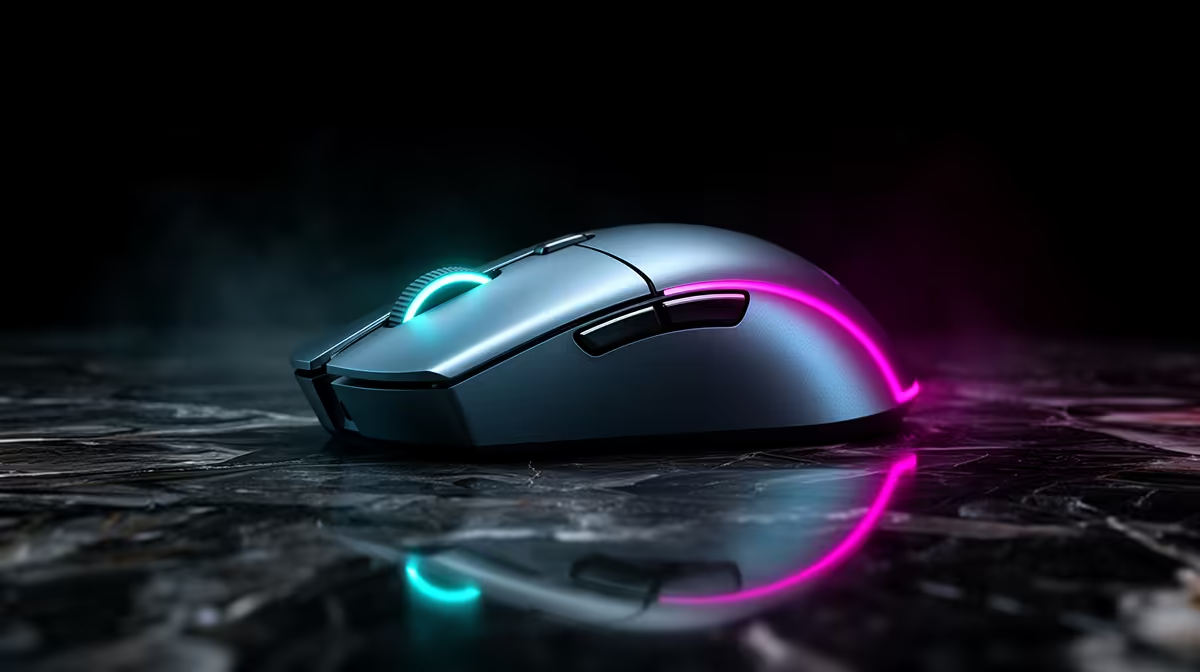
Sending mouse or keyboard reports eight times faster gives the CPU eight times as many chances to service them. The real 8000Hz polling CPU cost depends on your processor, game and frame target, so measure it rather than assuming free speed.
Quick Answer
An 8000Hz mouse or keyboard can ask the PC to process input reports far more often than a 1000Hz device. That can add CPU and USB work, and some games or weaker processors show lower FPS or worse frame-time spikes. Other systems show little change. The gain also shrinks when the game, display and frame rate cannot use the extra report timing. Start at 1000Hz, record a repeatable benchmark, then test 2000Hz, 4000Hz and 8000Hz with the same scene. Keep the highest rate that preserves smooth frame time.
Higher rate means shorter intervals
At 1000Hz, the maximum report spacing is about one millisecond. At 8000Hz, it is about one eighth of a millisecond when the device and system sustain the setting.
That is report timing, not total click-to-photon latency. Sensor processing, USB scheduling, game input, frame time and display refresh all remain.
Moving a mouse creates more reports than leaving it still, so benchmark with the same fast swipe pattern.
Watch frame time, not average alone
Use an offline repeatable scene and a frame-time graph. Record average FPS, low-percentile performance and visible spikes while moving the device.
Close overlays and background work. Keep resolution, graphics settings, USB port and game version unchanged.
If 8000Hz adds spikes, step down. A stable 2000Hz or 1000Hz setup can feel better than a higher label on a CPU-limited game.
Check the full device path
Use the supported cable or high-rate receiver mode. Update firmware through the manufacturer and avoid an overloaded hub.
The game must handle high-rate input well. Test every title separately and keep an onboard profile for the stable rate.
Match the rate to the display pipeline
An 8000Hz report stream gives the game more input samples, but a 60Hz display updates every 16.7ms. A high-refresh monitor and high frame rate create more chances for the newer sample to affect a visible frame.
That does not make the gain eight times larger than 1000Hz. End-to-end latency includes scan timing, game processing, render queue and pixel response.
Use the monitor's correct refresh rate and a stable frame cap during the test. A fluctuating CPU-limited frame rate can hide or outweigh the polling change.
Check USB and firmware
Connect the high-rate receiver or cable to a supported port. Remove an overloaded hub and close duplicate device software.
Update through the manufacturer, then confirm the active polling rate with a reputable tool. A selected 8000Hz option does not prove every report arrives at that rate.
Compare peripheral best sellers for current input options. The gaming accessories range can help match receivers, pads and ports to the desk.
FAQ
Does 8000Hz always lower FPS?
No. The cost depends on CPU, game, device, USB path and movement. Measure frame time on your system.
Is 8000Hz worthwhile for casual play?
The timing gain is small and needs a suitable frame and refresh pipeline. Use the stable setting you can verify.
Should you start at 1000Hz?
Yes. It gives you a clean baseline before higher rates add more reports and possible CPU work.
Benchmark one repeatable scene at 1000Hz through 8000Hz and keep the highest polling rate whose frame-time graph stays clean.