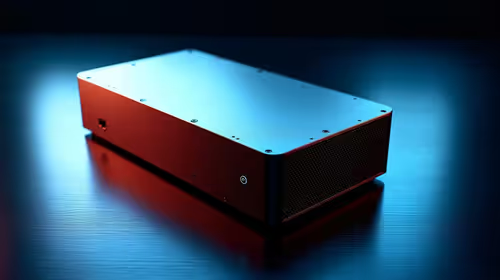
NVIDIA Mosaic is easiest to adopt when the installation begins as a numbered output plan rather than a pile of screens. Large multi-monitor installations need a defined canvas, known GPU ownership and a separate timing strategy. PNY RTX Pro Sync supports Mosaic together with Genlock and Frame Lock for professional layouts reaching eight RTX Pro GPUs and 32 synchronised displays.
Quick Answer
NVIDIA Mosaic can arrange up to 32 displays or projectors in an RTX PRO Sync system, creating one coordinated high-resolution visual environment.
Begin by counting the displays, deciding how the visual surface should be arranged and identifying how many RTX Pro GPUs will take part. The PNY synchronization card costs R19,599 and gives the design Mosaic support plus Genlock and Frame Lock.
🗺️ Sketch the canvas before shopping
Draw a rectangle for every screen and label its intended output. Then mark whether the installation should behave as one broad visual surface or as several independent regions. That decision gives Mosaic a clear purpose instead of treating it as a generic feature to enable later.
Use the sketch to browse PC monitors at Evetech. Panel choice, placement and physical alignment remain separate from GPU synchronization, so the drawing should carry those requirements without assigning them to the sync card.
🧮 Count processors and displays together
A 32-screen ceiling is paired with an allowance for eight NVIDIA RTX Pro processors. Keep both totals visible on the same worksheet. Display quantity alone cannot show how rendering and outputs will be divided among the graphics resources.
Choose only the GPU scale that the real project needs. Evetech's professional workstation GPU selection is the next comparison point once applications, outputs and display groups have owners.
🕰️ Add timing requirements separately
Within this starter plan, Mosaic shapes the joined workspace. Genlock keeps the signal environment tied to its intended reference. Frame Lock handles frame agreement among the graphics processors. The PNY RTX Pro Sync option puts those three roles together at R19,599.
Do not reduce the design to one "synchronization" checkbox. Write the required lock function beside each output group, then ask the integrator to confirm how the approved system will satisfy it. This keeps a layout choice from being mistaken for a timing choice.
🧪 Prove a small version first
Use a representative section of the final wall to validate the visual path. Test content should cross panel boundaries and include motion that makes discontinuity visible. Confirm the expected arrangement, then repeat the observation with the operating modes the installation will actually use.
Keep notes on the active GPUs, displays and lock functions. That baseline supports later expansion because each new group can be tested against an accepted result. Once the pilot architecture holds, use Evetech's graphics card accessories category for supporting parts without casually changing the design.
Prepare content for panel boundaries
Ask the content team to review the Mosaic drawing before final production. Wide headlines, faces and controls may need placement that avoids physical seams, even when the digital canvas is behaving correctly. A short storyboard with the most important frames is enough to expose these issues early.
At handover, save the storyboard beside the output map and the passing test. Future content can then be checked against the same boundary rules instead of rediscovering the wall's geometry during a live presentation.
Mosaic belongs inside a scalable hardware plan. The supported system can contain eight professional NVIDIA GPUs and two sync cards, while the supplied cabling includes four 12-inch and two 24-inch pieces. Begin with the final canvas and GPU output map, then use those physical limits to decide card locations. The software can run under Windows 10, Windows 11 or Linux.
Frequently Asked Questions
Is NVIDIA Mosaic supported on the PNY card?
Yes. Mosaic is included alongside Genlock and Frame Lock, giving the project separate tools for the arranged canvas and synchronization roles.
What should be counted first?
Count intended screens and participating RTX Pro GPUs together. The product boundaries are 32 synchronised displays and eight GPUs at most.
Does a Mosaic plan automatically determine mounting?
No. Physical placement, bezel spacing and support structures remain part of the installation design rather than the graphics synchronization function.
How much should be budgeted for the sync component?
Buying PNY's NVIDIA RTX Pro Sync card uses R19,599 of the budget; price graphics processors, panels and project work independently.
How should a first Mosaic pilot be documented?
Save the small canvas drawing, active GPU ownership, chosen lock roles and the motion sequence used to approve it. Note the viewing position and the boundaries that were observed. Those details give the next expansion phase a working reference instead of asking the team to remember why the pilot appeared correct.
Ready to turn a screen sketch into a Mosaic plan?
Compare Evetech's workstation graphics, monitor and accessory categories with the display map and timing worksheet in hand.