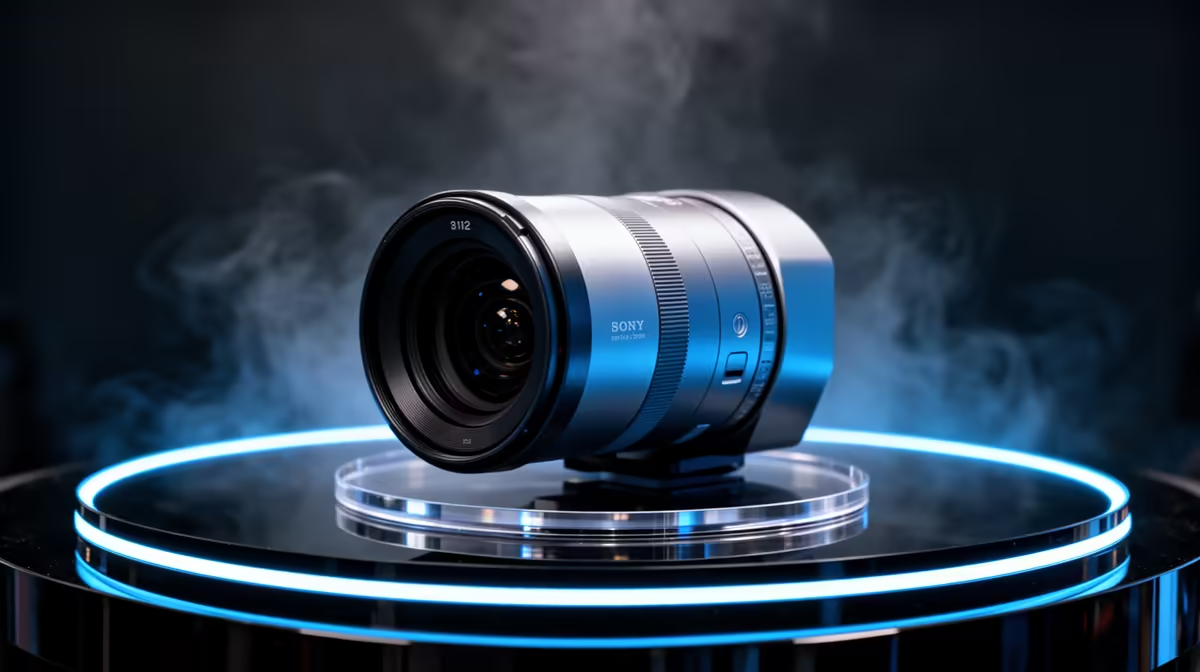
A zoom range that reaches 40 times its starting focal length sounds impressive on a spec sheet. What a streamer or educator actually needs to know is how far that translates to in a real room, and which portion of that range delivers genuinely usable sharpness versus extended reach that softens under scrutiny. 40X hybrid optical zoom covers both questions, pairing a clean optical zoom with AI-extended reach so you can frame a subject 25 metres away without moving the camera from the desk.
Quick Answer
A 40X hybrid zoom frames a head-and-shoulders crop of a person standing 25 to 30 metres away. The optical portion runs to around 12X and stays fully sharp throughout. The AI-extended reach to 40X softens slightly at maximum but holds cleanly on static subjects like a stage or whiteboard.
🔭 Understanding the Two Zones of a Hybrid Zoom
The word "hybrid" signals that two different processes share the 40X range. The optical section uses physical glass elements inside the lens to magnify the image without discarding any sensor data. Up to approximately 12X, every frame uses the camera's full imaging capability.
Beyond 12X, AI processing extends the apparent magnification by analysing the image and interpolating additional detail. This is not simple digital zoom, which crops existing pixels, but an inference step that reconstructs detail based on learned image patterns. The result is sharper than raw digital zoom, though it does not match the precision of the optical portion.
The optical range suits shots where fine detail or moving subjects matter. The extended range works well for static subjects, a locked podium, a fixed whiteboard, or a stage where the presenter is not moving quickly enough to expose interpolation artefacts.
📏 Real-World Distances in a South African Streaming Context
For a streamer or educator in a home office or classroom, the distances that matter are typically 1 to 10 metres. Within the optical range, those distances are handled perfectly with no AI extension needed.
For live event coverage, the key question is whether the zoom can frame a stage from the back of the room. A conference hall typically puts the back row between 20 and 30 metres from the stage. The 40X reach comfortably frames a presenter at that distance in a tight crop, while a wider stage shot sits well within the optical portion.
⚡ Autofocus Behaviour at Long Reach
Autofocus at maximum zoom operates differently than at short range. The depth of field is considerably shallower at 40X, so the AF system works within a narrow focus window. When a subject is completely static, the camera locks and holds without issue. When a presenter shifts slightly, there is a brief refocus moment that can look like a soft frame on a live stream.
For fixed positions, a locked manual focus or a narrow AF zone prevents hunting entirely. Lighting also plays a larger role at long zoom reaches. At 40X the lens gathers light from a much narrower angle, and a poorly lit stage challenges both AF and sensor in ways that do not appear at shorter focal lengths.
Frequently Asked Questions
How far away can a 40X zoom frame a single person clearly?
Around 25 to 30 metres for a usable head-and-shoulders crop. At that distance the zoom is near maximum reach, and the subject reads clearly on stream if lighting is adequate and the subject is relatively still. A stage presenter at the front of a conference room is the typical use case this distance covers.
At what point does zoom sharpness start dropping?
Sharpness is consistent throughout the optical portion, up to roughly 12X. The AI-extended range maintains reasonable quality but does not match the optical section, particularly on moving subjects where interpolation has less time to settle. For a static subject like a fixed lectern, the extended range holds well at maximum reach.
Is there any way to keep autofocus stable at long zoom distances?
A narrow AF zone aimed at the subject's face or a specific anchor point prevents the system from hunting when peripheral movement enters the frame. For a completely fixed subject, switching to a focus-lock mode after initial acquisition eliminates the brief soft frames that appear during minor subject movement at long reach.
Does a 40X zoom eliminate the need to physically reposition the camera?
For most single-subject situations, yes. It covers the range from a wide desk frame to a tight face crop, and from a close subject to a stage 30 metres away, all from a fixed camera position. Physical repositioning still helps when you need a completely different angle rather than a different focal length.
How important is lighting for a long-range zoom shot?
Very important. At maximum zoom the lens gathers light from a narrow view of the scene, making exposure and autofocus more sensitive to lighting conditions than at shorter focal lengths. A well-lit subject against a neutral background delivers the clearest result. A dark stage with mixed ambient light makes both exposure and AF considerably harder.
Ready to frame any subject from any corner of the room?
Browse the optical zoom streaming camera range and find the model that reaches as far as your broadcast setup demands.