Screen tearing on one panel and a frame mismatch across an entire wall are not automatically the same fault. In a professional multi-screen environment, screen tearing and frame mismatch should be traced through the content source, graphics boundaries, timing reference and display groups before any component is blamed.
Quick Answer
Hardware synchronisation through RTX PRO Sync is the direct answer when tearing or frame mismatch occurs across separately driven professional displays.
Use a controlled motion test to locate the mismatch, then check reference timing and frame coordination across the GPUs involved. The R19,599 PNY card adds Genlock, Frame Lock and Mosaic to the fault-finding plan. Its scope covers eight RTX Pro GPUs at most and no more than 32 synchronised displays.
🎯 Identify the visible pattern
Run a moving vertical edge across the display field and watch where the image separates. Repeat the test at several positions and with the normal content path. A fault that remains inside one panel calls for a different investigation from a discontinuity that appears consistently at a GPU or display-group boundary.
Capture the test conditions in plain language. Include which outputs were active, how the screens were arranged and where the effect appeared. This creates a baseline for comparing one change at a time.
⌛ Inspect the coordination roles
During diagnosis, Genlock is the reference-timing branch. Frame Lock is the branch for agreement among frames produced by the graphics hardware. NVIDIA Mosaic manages the arranged multi-screen canvas. Check each path independently, because changing the canvas does not prove that a reference or frame problem has been solved.
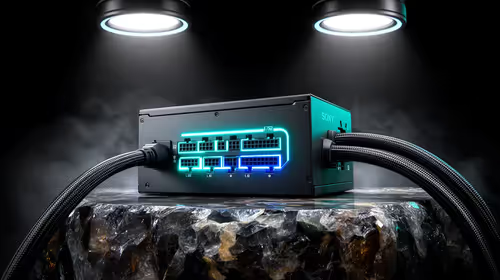
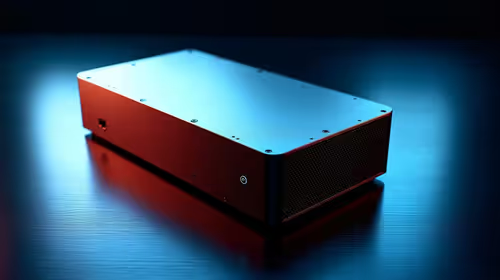
The PNY sync card includes that trio at R19,599. An eight-processor allowance for NVIDIA RTX Pro hardware makes the GPU ownership map a central troubleshooting document.
🧪 Verify a correction across the wall
After a change, repeat the original motion test before adding more variables. Then use representative application material and view it from the normal audience position. A clean short clip is useful evidence, but longer operating modes should also be observed where the installation depends on them.
If the architecture needs different processors, compare Evetech's workstation graphics cards. For panel-specific investigation, use the PC monitor category as the separate display layer rather than assuming synchronization changes physical screen behaviour.
📏 Respect the design boundaries
PNY RTX Pro Sync supports 32 synchronised screens at most. A design that exceeds either the display or eight-GPU boundary needs architectural review, not repeated adjustment. Even within those limits, the project team should define its own acceptance conditions for the complete signal path.
Supporting items can be assessed in Evetech's graphics card accessories range once the failing layer is known. This keeps troubleshooting focused and avoids replacing unrelated parts.
Keep a simple symptom matrix
Create columns for where the fault appears, whether it moves with content, whether it follows a particular output and whether it sits at a GPU boundary. Add the timing-reference state and Mosaic layout used during the observation. A few careful rows can separate patterns that look similar during a hurried inspection.
Use the matrix to choose the next test, not to declare a cause prematurely. A repeatable boundary is a clue; the correction still has to survive the original motion sequence and the real application. Retain the passing row as part of the handover so a future mismatch can be compared with the same evidence.
The system can coordinate eight NVIDIA GPUs through two sync cards while Mosaic manages a surface of 32 displays or projectors. Its primary card arrives with four 12-inch and two 24-inch sync cables, so the internal links can be checked against the planned GPU boundaries. A motion test should then reveal whether correction restored alignment across the complete high-resolution canvas.
Frequently Asked Questions
Which functions address cross-display coordination?
Genlock handles timing-reference alignment and Frame Lock handles frame coordination across participating graphics hardware. Mosaic serves the screen arrangement.
Will the PNY card remove every tearing fault?
No universal result follows from one component. Diagnose the source, graphics path, timing and display layer, then validate the whole system after changes.
How many displays can join the synchronized design?
The screen maximum is 32, and the participating NVIDIA RTX Pro processor total cannot exceed eight.
What should be budgeted for the card?
The R19,599 figure buys PNY's NVIDIA RTX Pro Sync component; diagnosis and installation work have separate costs.
Why repeat the same motion sequence?
A consistent clip makes before-and-after observations comparable. Change one configuration variable, replay the identical movement and note whether the fault stays, moves or disappears. Replacing the content at the same time weakens the evidence because the team cannot tell which change altered the visible result.
Ready to isolate a multi-screen mismatch?
Use the fault map to guide comparisons across Evetech's professional graphics, monitor and accessory categories.