


650W PSU Planning for RTX 5090 Builds in SA
650W for RTX 5090 needs a full-build check, not a simple yes. Review GPU guidance, CPU draw, transient load, connectors, PSU quality, and upgrade plans before deciding.
Read moreTo fix audio crackling and dropouts on a USB interface, raise the buffer size in your ASIO driver since crackles come from a buffer too low for the CPU to fill. A dedicated USB port and disabling USB power management in Windows resolve most remaining dropouts.
Pops, clicks and brief dropouts during recording or playback through a USB audio interface almost always trace back to one setting, and it is not a faulty cable or a dying interface. The buffer is too small for your CPU to keep filled, so the audio stream runs dry for a fraction of a second and you hear it as a crackle. Fix the buffer, sort out the USB port and power settings, and the noise stops.
Raise the buffer size in your interface's ASIO driver until the crackling stops, since crackles come from a buffer too small for the CPU to fill in time. A value of 256 or 512 samples is a stable starting point. Then plug the interface into its own USB port and disable USB power management in Windows to clear up the remaining dropouts.
The buffer is a small holding area where audio waits before it plays or records. Set it too low and the CPU cannot refill it fast enough under load, so the stream stutters and you hear crackles.
For tracking, 256 samples is a good balance. For mixing, where latency matters less, push it to 512 or higher for rock-solid stability.
If your interface "works" on the stock Windows audio path, it is still the wrong driver for recording. ASIO drivers give far lower latency and far better stability than MME or DirectSound. Download the latest ASIO driver straight from your interface manufacturer rather than relying on whatever Windows installed automatically, because manufacturer drivers often clear up dropouts that generic ones leave in place. The right monitoring gear matters too when you are chasing clean audio, and closed-back headphones from the headphones and headsets at Evetech are well suited to recording environments.
Once the buffer is right, the remaining dropouts are usually physical or power-related.
Apply these changes one at a time and listen between each step, so you can pinpoint exactly which fix resolved the problem.
Because the extra processing load means the CPU cannot fill a small buffer in time. Raise the buffer size, or freeze and bounce heavy tracks to reduce the live load on the CPU.
Start at 256 samples for recording and move to 512 or higher for mixing. Use the lowest power-of-two value on Windows that plays back cleanly, since smaller buffers lower latency but raise the risk of dropouts.
It can. Hubs share bandwidth and power across devices, which can starve an audio interface. Connect the interface directly to a computer USB port to rule the hub out as the cause.
Yes. Windows can power down USB ports to save energy, which interrupts a live audio stream and causes intermittent crackles. Disabling it for the USB Root Hubs in Device Manager removes that risk.
Chasing clean, glitch-free recordings? Pair a properly configured interface with closed-back monitoring from the headphones and headsets at Evetech, or browse the headset best sellers to see what other creators trust at their desks.
Because the extra processing load means the CPU cannot fill a small buffer in time. Raise the buffer size, or freeze and bounce heavy tracks to reduce the live load on the CPU.
Start at 256 samples for recording and move to 512 or higher for mixing. Use the lowest power-of-two value on Windows that plays back cleanly, since smaller buffers lower latency but raise the risk of dropouts.
It can. Hubs share bandwidth and power across devices, which can starve an audio interface. Connect the interface directly to a computer USB port to rule the hub out as the cause.
Yes. Windows can power down USB ports to save energy, which interrupts a live audio stream and causes intermittent crackles. Disabling it for the USB Root Hubs in Device Manager removes that risk.
650W for RTX 5090 needs a full-build check, not a simple yes. Review GPU guidance, CPU draw, transient load, connectors, PSU quality, and upgrade plans before deciding.
Read more
How to fix FPS drops Windows 11 RX 9070 XT starts with GPU drivers, overlays, power plans, and frame pacing checks. For SA gaming PCs, verify chipset updates, HAGS, refresh rate, thermals, and per-game graphics settings.
Read more
How to fix FPS drops on X870E motherboard starts with BIOS, chipset drivers, PCIe settings, and memory stability. SA gamers can check EXPO, resize BAR, thermals, display refresh, and background apps before replacing components.
Read more
RTX 5060 is popular with SA students because it can fit gaming, coursework, and creative app needs in one setup. Compare total system price, cooling, RAM, storage, and screen quality before picking a desktop or laptop.
Read more
1440p is the sweet spot for SA gamers because it balances sharp visuals, high frame rates, and GPU cost better than 4K. It is a practical monitor target for players who want smoother upgrades without the heavier hardware demands of 4K.
Read more
RAM pricing for Midrand gamers can shift with exchange rates, supply, specs, and model tier. Treat the title as a buying prompt, then compare SA warranty, timing, and build priorities.
Read more
From 1 October 2026, WhatsApp Business Platform service replies in South Africa are expected to cost about $0.0076, or 12 cents, per delivered message.
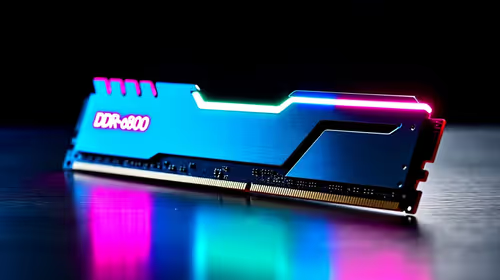
DDR5-8000 RAM Kits pros and cons depend on the build, budget, and workload. Weigh gaming needs, platform fit, power, cooling, warranty support, and South African pricing context before shortlisting it.
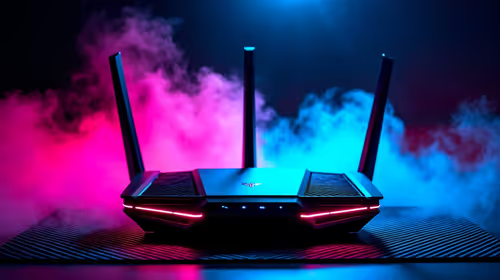
Wi-Fi 6E vs Wi-Fi 6 depends on AAA single-player gaming needs, platform limits, and budget fit. Compare compatibility, latency, upgrade path, and real setup constraints before choosing for an SA build.
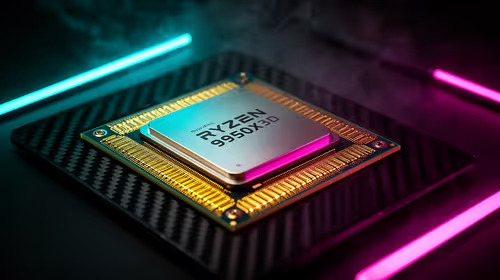
Ryzen 9 9950X3D dead pixel checks should isolate the panel first. Run colour fills, inspect the monitor menu, test another cable or input, and capture proof before linking it to the SA CPU upgrade.

YouTube will count public views from the first frame across video formats from 24 August, while earnings and eligibility remain tied to engaged viewing.
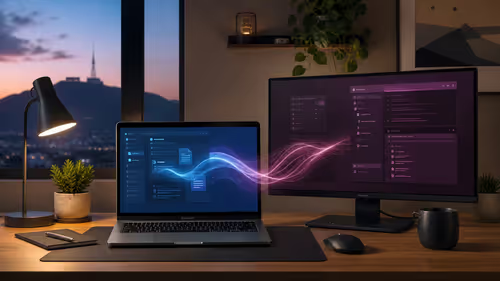
Canonical expects Ubuntu on WSL users to outnumber native Ubuntu desktop users before the end of 2026. The software is open source and runs inside supported Windows PCs.
Telkom's daily bundles pair WhatsApp access with 10 all-network voice minutes. The R15 option includes 300MB, while the R17 option uses a fair-use threshold.
A 10,000-hour test found similar image retention across older and newer OLED TVs, while newer panels were brighter and more efficient. Local OLED monitors started at R9,999.

Windows 11 update KB5121003 is linked to crashes in several multiplayer games on versions 24H2 and 25H2. Check the build, report the fault and avoid risky file or update changes unless the problem is confirmed on your PC.

Comsol's standalone 5G network covers about one million Gauteng homes and starts commercial ISP service in September. Early packages range from R275 to R875 a month, but coverage and fair-use rules still decide the real value.

Sennheiser's Momentum True Wireless 5 adds user-replaceable batteries, 12-hour playback and a $299.95 launch price. There is no confirmed South African date, so compare longevity with live earbuds from R199 to R2,999.

AVerMedia's GC531 and GC535 are professional HDMI capture devices for continuous streaming, with RGB24 capture up to 2K30 and 4K30. South African creators should compare them with live 4K capture cards from R2,099.