Video calls and live streams have made everyone familiar with the frustrating soft blob that appears when a presenter is far from the camera. Hybrid optical 40X zoom is the engineering answer to that problem, keeping a true high-definition frame at distances where digital-only zoom has already fallen apart into smudged blocks.
Quick Answer
Hybrid 40X zoom stays sharp because real glass handles the first stage of magnification, so the sensor captures an already-closer view at native resolution. AI digital extension fills the remaining reach. The result holds genuine 1080p or 4K detail far past what any pure crop-and-enlarge approach can manage.
🔧 The Two-Stage Zoom Path Explained
Think of standard digital zoom as enlarging a photograph in a photo editor. The image data is fixed, so stretching it to fill a bigger frame just spreads the existing pixels further apart. Past a certain point the gaps between them become visible, and fine edges turn into staircases of colour.
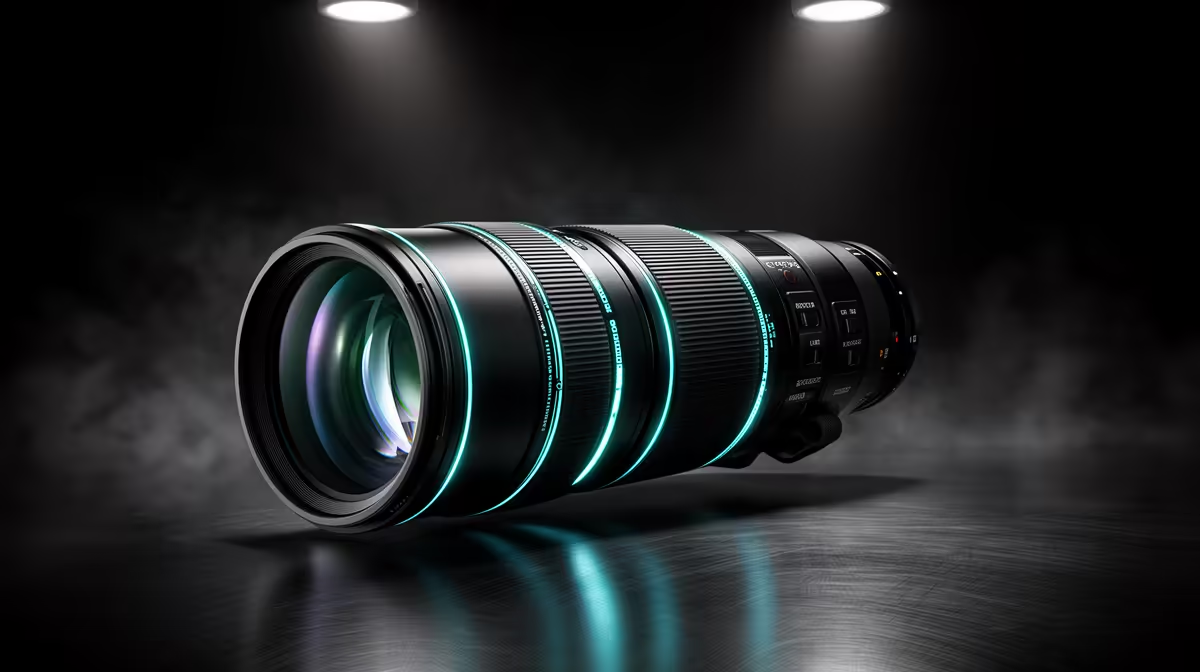
Hybrid zoom inserts a glass-movement stage before any of that stretching happens. The lens elements shift position inside the barrel, physically narrowing the field of view the sensor sees. By the time the image lands on the chip, the subject already takes up more of the frame using optical physics rather than software maths. That initial stage typically covers up to around 12X magnification.
Beyond that optical limit, an AI processing chip analyses the sharpest available frame and reconstructs detail as the zoom extends toward 40X. It is filling an inference gap rather than blindly stretching pixels, which is why the result holds far better than pure digital at comparable magnification.
🔆 Sharpness Across the Full Range
The optical stage is the load-bearing section. From 1X to around 12X, a multi-element coated glass assembly keeps the image crisp, controls colour fringing, and maintains the full pixel grid of the sensor. A 4K sensor at 12X optical is still delivering a complete 4K frame, not an enlarged crop.
Past 12X the AI extension takes over. Through roughly 30X the processing is clean enough that viewers on a 1080p stream would not notice the transition. Near 40X there is mild softening, but the subject stays readable. A pure digital 40X zoom on a standard webcam at that magnification renders a face as an unrecognisable smear by comparison.
Coated glass in the optical stage prevents chromatic aberration at high-contrast edges, a quality that matters most near the zoom extremes where any optical weakness compounds.
🎯 What This Means for a Live Presenter
For a trainer pacing across a room in Durban or a presenter working a whiteboard in a Cape Town studio, the hybrid zoom keeps them in a usable frame. Set the camera at the back of the room, dial to cover the working area, and continuous autofocus holds the subject sharp throughout. A wide shot that makes the presenter tiny, or a close camera that clips movement, are both problems this approach sidesteps.
Frequently Asked Questions
What separates hybrid zoom from a camera that only uses digital zoom?
A pure digital zoom has no optical stage. It selects a region of the sensor's frame and scales it up in software, which loses resolution as the magnification increases. A hybrid design first shifts glass elements to close the distance optically, then uses digital AI extension to stretch the remaining range. The glass stage preserves real detail that software alone cannot reconstruct.
After what point does a 40X hybrid zoom begin softening?
The glass stage holds full sharpness up to roughly 12X. AI upscaling bridges from there to 40X, with detail remaining clear and usable through most of that range. Softening becomes noticeable only near the upper limit of 40X magnification, and even there the image stays recognisably sharp compared to equivalent pure digital zoom at the same setting.
Does hybrid zoom output a full-resolution frame throughout?
Yes. The optical crop the sensor reads is a native full-resolution view of a narrower angle, not a smaller sub-frame. So a 4K sensor at 12X optical is still capturing a complete 4K image of the zoomed scene, with the full pixel count available for output or streaming downscale. Detail is not lost to cropping; it is gained by magnification.
Can AI upscaling inside a zoom system add visible artefacts?
Rarely at moderate levels. Reconstruction chips fill edge gaps cleanly enough that the result is hard to separate from a real optical image on a 1080p stream. Near the 40X maximum, slight edge smoothing on very fine text or tight fabric patterns can appear, but these are subtle and seldom noticeable on a standard broadcast output.
Does the glass quality in the optical stage actually matter?
Significantly. Multi-element coated glass controls the chromatic fringing and barrel distortion that uncoated elements introduce, especially at zoom extremes. A cheaper single-element optical stage may reach 12X but will show colour edges and softness that undermine the AI extension built on top of it. The glass quality sets the quality ceiling for the entire 40X range.
Ready to frame a sharp, close shot from wherever you place the camera? Explore the 4K webcams with hybrid optical zoom at Evetech and find the right fit for your streaming or conferencing setup.