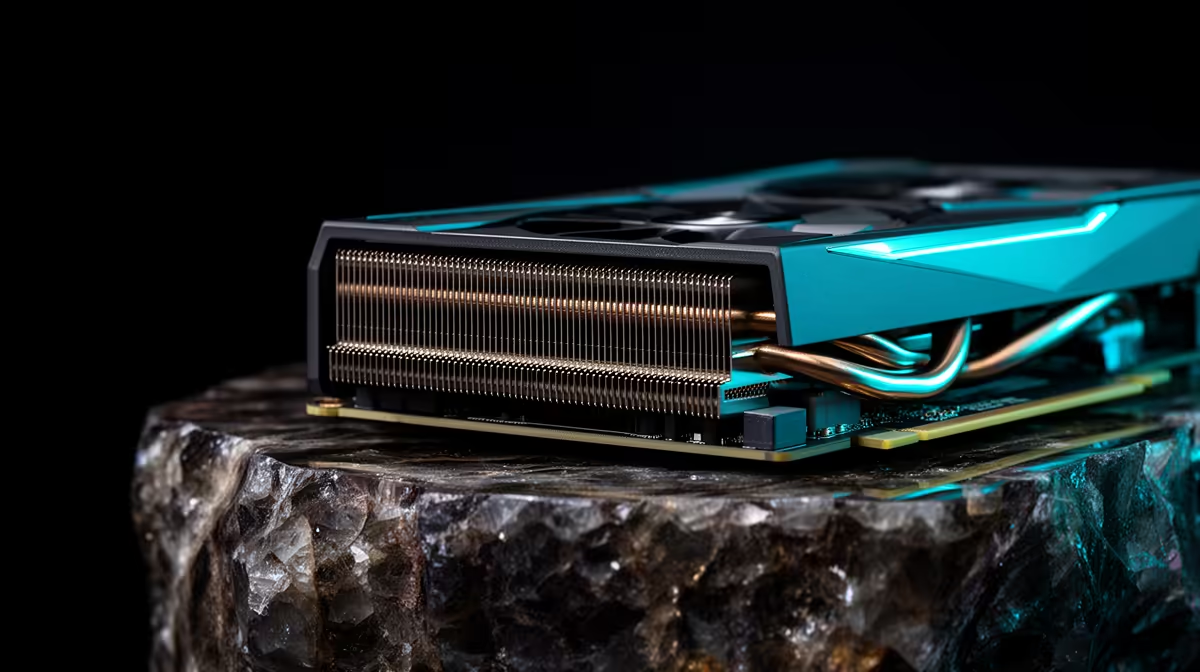
Footage resolution keeps climbing faster than most people upgrade their hardware, and 8K source files are already showing up in some professional pipelines while plenty of desktops are still catching up. A 24gb creator graphics card sits right at the point where that question actually needs answering: does that capacity hold up once the source material moves past standard 4K? Priced at R14,399, the ASRock Pro B60 Creator makes for a useful reference point.
Quick Answer
24GB of GDDR6 comfortably handles the vast majority of 4K editing and grading work, with headroom left over for early experiments with 8K source material. That capacity sits on the R14,399 ASRock Pro B60 Creator next to a 192-bit bus, keeping timeline scrubbing smooth even as project complexity grows.
🎥 4K workloads and where the ceiling actually sits
Standard 4K editing, colour grading, and effects work rarely comes close to exhausting 24GB of video memory, even with several layers, scopes, and reference clips loaded simultaneously. This is the workload the ASRock Pro B60 Creator was built around, and it is where the card's capacity feels generous rather than merely adequate.
Multi-layer composites and grading sessions
Composites stacking several 4K layers with colour tools active on each one push memory usage higher than a simple cut, but 24GB still leaves comfortable margin for most professional grading sessions.
🌐 Where 8K starts to change the picture
8K source material roughly quadruples the raw pixel data of 4K, which means memory pressure rises quickly once full-resolution 8K clips enter a timeline. 24GB still handles early 8K experimentation reasonably well, particularly when working from proxies for the rough edit and reserving full-resolution playback for final review passes.
Proxies as the practical answer for 8K
Rather than pushing full 8K footage through every stage of an edit, working from lower-resolution proxies keeps memory demands manageable throughout the process, only relinking to full-resolution source for the final export.
🧠 What actually determines whether 24GB is enough
The honest answer depends on how many applications and layers are active at once, not the raw footage resolution alone. A single 8K clip in a simple cut uses far less memory than a complex 4K composite with dozens of active layers, so project complexity matters as much as source resolution.
If 4K or early 8K work is on the table, this listing for the Pro B60 Creator has current pricing. Cards with other memory capacities sit in the workstation graphics card category, and ASRock's broader catalogue rounds out what the manufacturer offers.
Frequently Asked Questions
Is 24GB enough for standard 4K editing?
Yes, standard 4K editing and grading work comfortably fits within 24GB, even with several layers active.
Can this card handle 8K footage at all?
Early 8K work is manageable, especially when using proxies for the edit stage and reserving full-resolution playback for final review.
Does project complexity matter more than resolution alone?
Yes, a complex composite with many layers can use more memory than a simple cut using higher-resolution footage.
What memory bus does the ASRock Pro B60 Creator use?
It uses a 192-bit memory bus alongside its 24GB of GDDR6.
Should I use proxies even with 24GB available?
Proxies still help keep playback smooth during the editing stage, reserving full memory headroom for final export and review.
Ready to find out if 24GB covers your 4K and 8K files?
Browse the 24GB creator GPU from ASRock in Evetech's workstation graphics selection, now at R14,399 and helps give 4K and 8K exports the VRAM they actually need.