Quick Answer
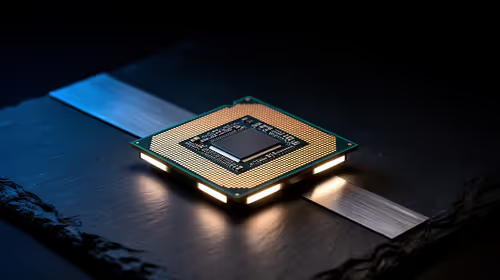
An APU build is necessary only when the budget is tight or the PC must stay compact; a discrete GPU is better for serious 1080p gaming. Ryzen 5 8600G and Ryzen 7 8700G are useful, but RX 7600 or RTX 4060 class graphics is a clear step up. Use dual-channel 16GB or 32GB DDR5 because APU graphics share system memory.
When APU build Makes Sense
APUs suit school work, media, Minecraft, Roblox, and lighter esports. Add a discrete GPU when you want high settings, higher refresh, or AAA games.
What To Measure First
Use one clear number before buying: FPS, refresh rate, CPU temperature, GPU hotspot, storage space, or stream encoder load. A R5,000 accessory can be poor value if a R1,000 fix solves the actual issue. SA buyers should also check desk size, warranty path, and whether the upgrade works with existing cables.
Better Places To Spend First
Prioritise the GPU for graphics limits, CPU for high-refresh esports limits, RAM for multitasking, and NVMe storage for load times. For peripherals, comfort and consistency beat cosmetic features. The right choice is the one that removes the bottleneck you can prove.
For SA buyers, the final check is practical: match the choice to the screen, desk, warranty route, and the exact R20,000 cash limit. Keep 32GB RAM, 1TB NVMe storage, stable drivers, and a realistic 60 fps, 144Hz, or 240Hz target in the notes so the recommendation stays measurable after checkout.
FAQ
Is APU build required for every gamer?
No. It is required only when your current setup blocks the result you want.
What number should I check first?
Check the metric tied to the problem: FPS for smoothness, Hz for display feel, ms for latency, and Celsius for cooling.
Should I buy the premium option immediately?
Only if the rest of the setup is already strong. A mid-range part with the right spec often gives better value.
Buyer Check
Take one screenshot of the current metric before checkout so the upgrade has a clear success target.