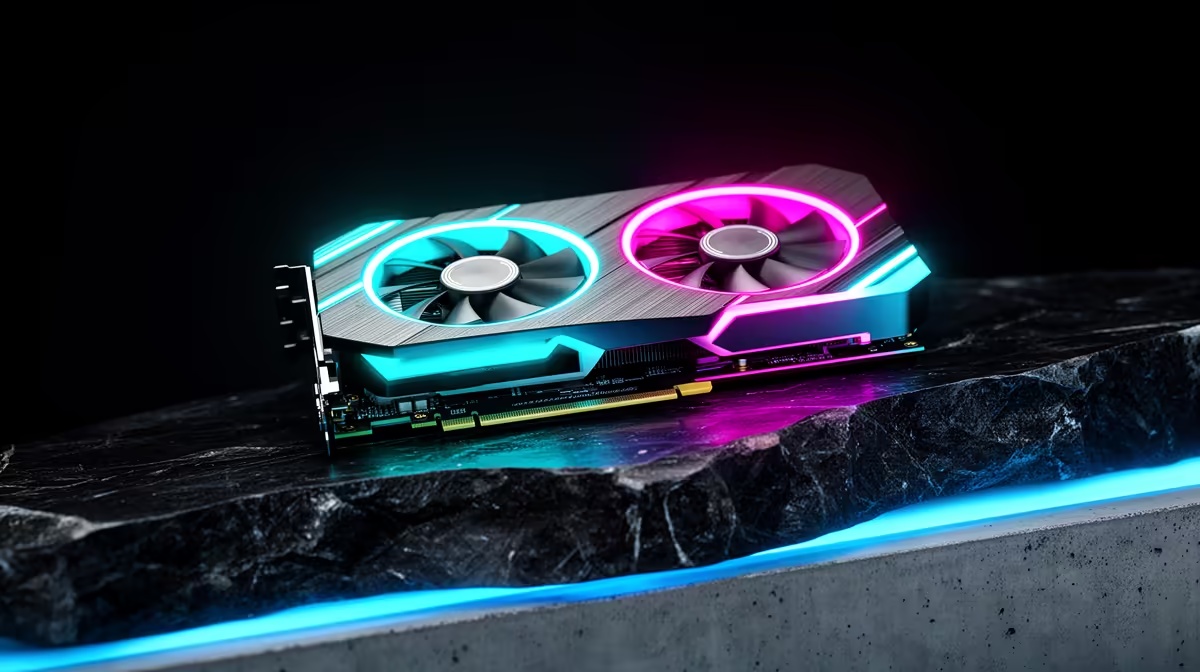
Desk space is finite, but graphics cards keep getting longer every generation, and that tension shapes every case shortlist eventually. Buyers often assume they must pick one side or the other, yet a well-designed atx mid-tower case can hold both a full-size flagship card and a footprint that still fits under a desk. The EINAREX Pulse P100 is built around exactly that balance.
Quick Answer
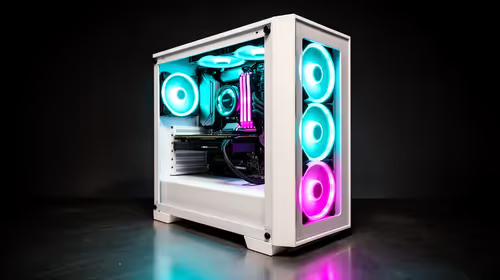
The Pulse P100 keeps a standard mid-tower footprint while still clearing graphics cards up to 330mm long, priced at R1,499. It does not shrink the chassis to save space, nor does it grow oversized to fit a big card, it simply allocates the internal room efficiently.
🧩 Why This Is Usually a Trade-Off
Compact cases typically save depth by cutting into GPU clearance, front fan mounts or radiator space, since there is only so much internal volume to divide up. A case chasing a small footprint often forces buyers into shorter, lower-power graphics cards or awkward cable routing around a card that barely fits. Keeping to a mid-tower shell rather than a mini-ITX or slim design is part of how the Pulse P100 avoids that compromise while still fitting the 330mm clearance figure.
🎮 What 330mm of Clearance Actually Covers
Most flagship and mid-range graphics cards on the market today fall within or close to the 330mm mark, including many of the larger triple-fan designs. That figure is measured with the side panel on and 3 RGB fans already installed up front, so it reflects real usable space rather than a stripped-down chassis. Builders upgrading a graphics card later do not need to remeasure the case each time, provided the new card fits under that same limit.
🛠️ Everything Else the Space Has to Fit
GPU length is only one demand on the internal volume. The same chassis needs to fit up to 175mm of CPU cooler height, support 360mm of front liquid cooling, and leave 24mm for cable routing behind the motherboard tray. Squeezing all of that into a genuinely compact case is far harder than doing it in a mid-tower shell, which is part of why the Pulse P100 stays at that size rather than going smaller.
Frequently Asked Questions
Will a 330mm graphics card definitely fit in this case?
Cards up to 330mm in length fit within the Pulse P100 with the side panel installed, though very long triple-fan flagship cards should always be measured against that limit first.
Does a bigger case always mean better GPU clearance?
Not necessarily. Clearance depends on internal layout and fan placement rather than overall chassis size alone.
Can I fit a shorter graphics card and still use all the front fan mounts?
Yes, shorter cards leave extra room and do not affect the 3 pre-installed RGB fans or the 360mm front radiator support.
Is a mid-tower case harder to fit on a desk than a compact one?
It takes up more depth than a mini-ITX case, but most desks and floor spots are sized around standard ATX mid-tower dimensions without issue.
Anyone cross-checking clearance against a specific card should look at the Pulse P100's product listing for the exact figures before buying. If a different size or finish suits the build better, EINAREX's other chassis options are worth comparing against this one. Builders wanting extra intake beyond the 3 fitted fans can also browse additional case fans to fine-tune airflow around a larger card.
Ready to decide between GPU room and a small footprint?
Search out this EINAREX Pulse P100 straight from Evetech for R1,499 today. It balances a compact shell with enough depth for large graphics cards.