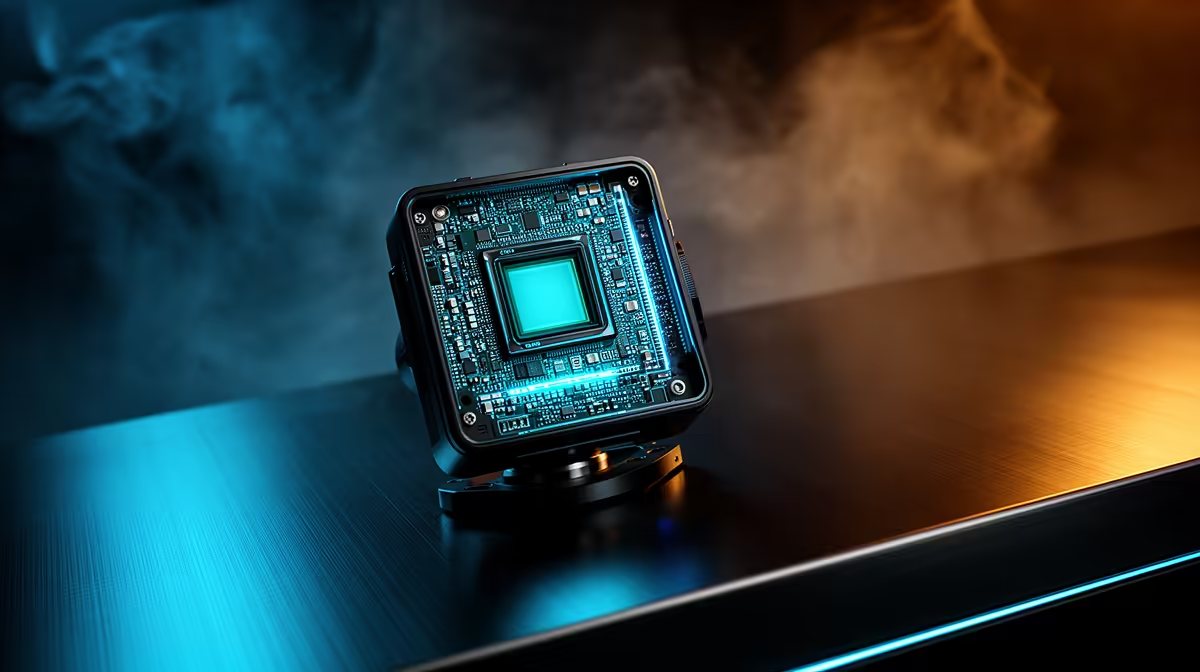
Your CMOS streaming sensor is doing exactly what it was designed to do, and it will do it well, but only if you give it what it needs. The spec sheet shows the maximum capability. What you actually see on stream is the capability minus every shortcut taken with lighting, gain, and camera settings. Close those gaps and the sensor performs near the top of its class.
Quick Answer
Give a CMOS webcam 300 to 500 lux of light, lock exposure and white balance manually, and keep gain as low as the light level allows. Those three adjustments together produce the sharpest, cleanest streaming output the sensor is capable of. Chasing a resolution upgrade without addressing settings first wastes what you already have.
🔆 Light Is the Input the Sensor Cannot Manufacture
Every CMOS sensor has a native sensitivity floor. Below it, the chip compensates by amplifying whatever signal it receives. That amplification, called gain, raises the image brightness but raises everything else alongside it, including the random electrical noise that produces visible grain.
The practical threshold for most webcam-grade CMOS sensors is around 300 to 500 lux at the subject. A standard ceiling light in a South African home commonly delivers 100 to 200 lux at desk level, which is enough to see the room but not enough for a sensor resolving fine facial detail. A dedicated LED key light at arm's reach raises subject illumination to 400 lux or above for around R400 to R800, and the quality difference is visible immediately.
Position the light to one side and slightly above eye level. A 45-degree angle preserves natural facial shadow; flat frontal light removes the depth that makes a face read well on screen.
🔧 Locking Exposure and White Balance
A CMOS sensor on automatic exposure responds to every brightness change in the scene, producing visible brightness pulses as you move or as background light shifts. For streaming, that variability reads as unprofessional.
Locking the exposure setting after your lighting is placed holds a consistent image for the entire session. Most webcam companion apps provide an exposure lock toggle. Lock white balance at the same time: set it to the colour temperature of your key light, around 5600K for daylight LEDs or 3200K for warm lamps. Automatic white balance recalculates continuously and shifts skin tones mid-stream when a second light source enters the frame.
✨ Keeping Gain Low
Gain is the setting most streamers overlook because the logic runs backwards from intuition. More gain feels like more signal, but it is equally more noise. The path to a cleaner image is less gain and more light, not the other direction.
Target the lowest gain setting where the image still looks adequately bright with your lighting running. If the image looks dark at low gain, add light rather than pulling gain up. A clean low-gain image always looks more professional than a brighter image carrying noise grain.
Frequently Asked Questions
How much light does a CMOS webcam sensor need for clean streaming output?
Around 300 to 500 lux directly on the subject. Below that level the sensor raises gain to compensate, introducing grain and softening edge detail. A desk-level key light delivers this threshold at a fraction of the cost of a camera upgrade.
What goes wrong when exposure stays on auto during a stream?
Auto exposure shifts brightness every time the scene changes, such as when you move, a window brightens, or a background light turns on. The viewer sees the image pulse, which is distracting and looks uncontrolled. Locking exposure after your lights are set keeps the image stable for the full session.
Does white balance matter as much as exposure for CMOS streaming quality?
Yes. Automatic white balance recalculates colour continuously and shifts skin tones when mixed light sources are present. Locking it to the temperature of your key light keeps colour accurate across the entire stream without the mid-session drift that auto balance produces.
How does a CMOS webcam compare to a STARVIS sensor under good light?
Under 400 to 500 lux, a quality CMOS webcam produces a sharp, low-noise image close to what a STARVIS sensor achieves in the same conditions. The difference between them becomes significant only as light drops, where STARVIS retains clean detail at levels that push CMOS into noticeable grain.
Ready to get the most from your CMOS streaming sensor?
Browse the webcam and LED lighting range at Evetech to find the combination that gives your sensor the light and settings it needs to perform at its best.