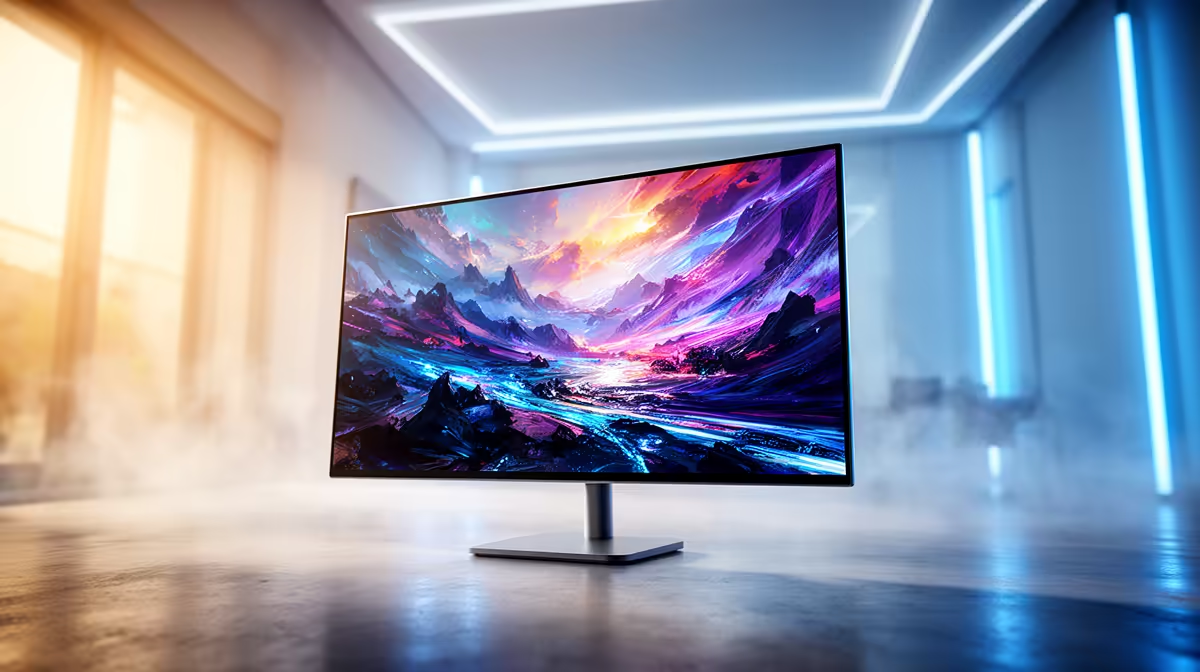
Is Mini-LED the Smarter Buy Than OLED for a Bright Room?
Quick Answer
Mini-LED is often the easier monitor to use in a bright room because a strong LCD backlight can sustain a bright desktop and fight ambient light. OLED delivers deeper blacks and cleaner pixel response, but full-screen brightness can be lower or change with the image.
Do not buy from panel category alone. Window placement, screen coating, full-screen brightness and local-dimming quality determine the result.
Choose mini-LED for long bright desktop work and daytime HDR punch. Choose OLED when you can control reflections and value perfect black, motion and per-pixel lighting.
Why OLED Brightness Moves
OLED pixels emit their own light. Monitors manage heat and panel life by limiting output under bright large-area content. A white document can appear dimmer than a small HDR highlight.
The behaviour varies by model, mode and firmware. Check measured brightness at several window sizes and whether transitions distract you.
Room reflections can matter more than the number. A glossy screen opposite a window may be hard to see despite strong highlight brightness.
What Mini-LED Gains and Gives Up
Mini-LED uses many small backlight zones behind an LCD panel. It can sustain brighter broad scenes and produce strong HDR highlights.
Each zone lights more than one pixel, so a bright object on black can create a halo. Zone speed and algorithm quality vary.
OLED controls every pixel and avoids blooming. It carries uneven-wear risk from long repeated static content, while mini-LED does not use emissive OLED pixels.
Test Your Room
Note direct reflections at the times you use the screen. A blind or changed desk angle can improve either panel more than another brightness tier.
Read full-screen SDR brightness, coating and minimum brightness tests. A monitor also needs to dim comfortably for night use.
If the room changes from hard daylight to dark evening use, save two calibrated picture modes. Keep local dimming for the content where it helps, and check whether desktop halos around the mouse pointer or text bother you. A monitor that wins one bright demo scene can still feel tiring during an eight-hour workday.
Browse current PC monitors, compare popular display choices, and inspect OLED monitor options as a separate shortlist.
FAQ
Why can OLED dim on a bright desktop?
Its protection and power management can limit large-area brightness. The degree differs by model and mode.
Is mini-LED always brighter?
No universal category result applies. Compare measured full-screen and highlight brightness for the exact monitors.
What does mini-LED lose?
Backlight zones can bloom around bright objects, and LCD pixels respond differently from OLED.
Which suits a mixed room?
Mini-LED is the low-friction bright-day option. OLED can win when blinds or desk placement control reflections at night and day.
Does mini-LED remove burn-in risk?
It does not use self-emissive OLED pixels, so it avoids OLED-style uneven pixel wear. LCD backlights and panels have their own ageing and uniformity concerns.
Map reflections in your room, compare sustained brightness and blooming measurements, and choose the panel whose weakness you will notice less.