What Monitor Suits an RTX 5080 Laptop for Desk Gaming?
Quick Answer
A 27-inch 1440p adaptive-sync monitor between 165Hz and 240Hz is a flexible desk match for an RTX 5080 laptop. It gives a premium mobile GPU room to deliver high frame rates without the full rendering demand of 4K.
Check the exact laptop's GPU power, cooling and display-port routing. Laptop RTX 5080 performance and specifications should not be inferred from desktop RTX 5080 graphics-card options.
Choose 4K when desktop sharpness and cinematic games outrank maximum refresh. Pick ultrawide for immersion after checking pixel load and game support.
Verify the Laptop First
Find its graphics power target, MUX or Advanced Optimus features and which GPU drives each external output. HDMI and USB-C ports can have different bandwidth and routing.
Check the common resolution, refresh, adaptive-sync and colour mode supported by the laptop and monitor. A dock may reduce that capability, so use a direct connection for gaming where the maker supports it.
Test in the intended performance mode with the approved charger connected. Cooling and CPU performance affect sustained frame rate.
Why 1440p Works
At 1440p, current games look sharp on 27 inches and the GPU has more high-refresh headroom than at 4K. Adaptive sync covers the difference between a demanding ray-traced game and a fast competitive title.
A 165Hz screen is enough for mixed gaming. Consider 240Hz when esports matter and the laptop CPU can sustain those frame rates.
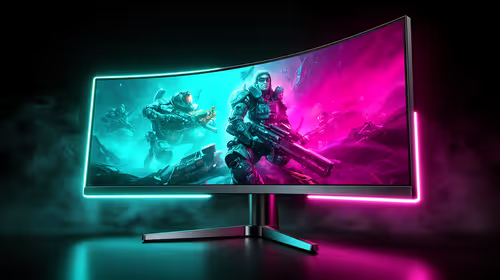
Browse current gaming monitor choices and compare popular display options by measured response, sync range and stand design.
When 4K or Ultrawide Wins
A 32-inch 4K high-refresh panel suits detailed desktop work and single-player games. Use upscaling and tuned ray tracing where needed.
A 3440 x 1440 ultrawide is heavier than standard 1440p and lighter than 4K. It gives a wider view in supported games, with possible black bars or restricted field of view elsewhere.
Neither external screen needs to match the laptop panel resolution. Each runs at its own supported mode.
Build the Desk Safely
Keep laptop vents clear and check temperature through a long session. Use a stand only when it preserves the maker's cooling path.
Set native resolution and maximum refresh in Windows, enable variable refresh, then choose a balanced overdrive mode. Test external-only and extended modes because GPU routing can differ.
FAQ
Can the laptop handle 4K?
It can in many games, with results that depend on the laptop power target, title and settings. Upscaling expands the viable range.
Does the monitor need to match the internal panel?
No. The external output can use another supported resolution and refresh.
Does a MUX switch matter?
It can change which GPU drives the display path. External ports may also connect directly to the RTX GPU. Check the exact laptop diagram.
Is ultrawide a good option?
Yes, when the game support and desk space suit you. Budget for its higher pixel load over standard 1440p.
Confirm the laptop's power target and external-port route, then choose 1440p, 4K or ultrawide around the games and desk work you use.