


1000W PSU Planning for RTX 5090 Builds in SA
1000W for RTX 5090 needs a full-build check, not a simple yes. Review GPU guidance, CPU draw, transient load, connectors, PSU quality, and upgrade plans before deciding.
Read moreTo eliminate harsh shadows on a green screen, position two 199cm light stands at 45 degrees on each side of the screen and angle the beams across the surface rather than straight on. Even side lighting flattens the green so the keyer finds no dark shadow lines.
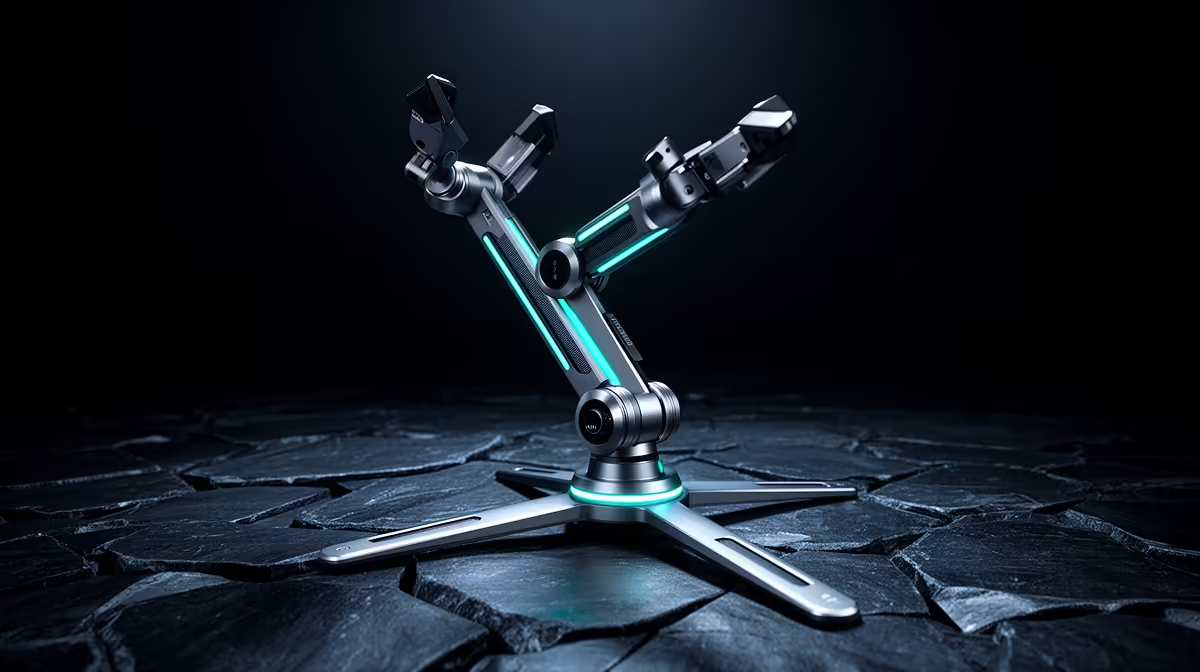
Shadow lines on a green screen are a keyer's worst problem. They show up as darker bands across the fabric that the software reads as a different shade of green, creating jagged, semi-transparent edges wherever the shadow falls. The solution is less about the gear you own and more about where you put it. Positioning 199cm light stands correctly is what turns an uneven, patchy green into a surface the keyer cuts cleanly without manual correction.
Place two 199cm stands at 45 degrees on each side of the green screen, raise them near full height, and tilt each head downward so the beams sweep across the surface rather than hitting it face-on. This crossing pattern distributes brightness evenly and eliminates the dark bands that break a clean key.
A light source placed directly in front of a surface illuminates the centre brightly and lets the edges fall off. On a green screen that gradient is a problem: the keyer samples a single colour value to cut against, and if the far edges are measurably darker than the centre, the sample does not match and edges stay soft or ragged.
Standing each light at 45 degrees and angling the head slightly inward means the beam travels across the full width of the fabric. Two sources crossing from opposite sides overlap in the middle, and the combined output levels out across the 298cm span. The keyer finds the same green value from left edge to right and cuts it cleanly.
Set each 199cm stand to near maximum height, then tilt the light head downward by approximately 25 to 30 degrees. This spreads the beam across the upper screen where side-angle coverage is hardest, and lets the output fall naturally across the lower sections by distance alone.
A stand set too low concentrates light on the bottom half, leaving the top darker. A stand at full height with the head level throws the beam over the screen entirely. Near-full height plus a downward tilt is what balances coverage top to bottom at the same time as the 45-degree offset balances it left to right.
Position each stand roughly 1.5 to 2m back from the fabric. Too close creates a bright patch near the stand with steep falloff toward the far edge. Too far and the brightness drops before covering a full 3m screen. Check the histogram on a still frame before shooting -- a wide spread of values in the green channel signals uneven coverage.
Screen lights that spill forward create green fringing on the subject's hair and shoulders. Keep the subject at least 1.5m forward of the backdrop. If the room is shallow, barn doors on each screen light stop output from spreading past the fabric edge toward the subject.
Run your key light on the subject from entirely separate stands. If you use the same source to light both the backdrop and yourself, adjusting one changes the other. Two screen lights plus one subject key on independent stands gives you three circuits to control independently without one correction undoing another.
Position one stand on each side of the screen, set back 1.5 to 2m and offset at roughly 45 degrees from centre. Angle each head toward the far edge rather than straight at the middle. The crossing beams cover the full width and flatten brightness across the surface so the keyer finds a consistent value from edge to edge.
Extend to near maximum height and tilt the head downward by approximately 25 to 30 degrees. This angle covers the upper screen where side-positioned lights struggle to reach, and natural falloff handles the lower section. A stand set too low leaves the top in shadow regardless of how much power the head is running.
A straight front-on beam creates a bright centre with dimmer edges -- a gradient the keyer reads as multiple shades of green. Beams angled across the surface sweep end to end, and with two sources crossing, the output averages out. The keyer finds one colour across the full frame and cuts it cleanly.
Rarely. A single source always leaves the far edge measurably dimmer than the near side, creating a gradient that forces the keyer into a compromise between cutting too much or too little. Two balanced stands at opposite 45-degree positions is the reliable minimum for full-width even coverage.
Ready to build a green screen setup that keys cleanly first time? Browse the light stands and continuous lighting range at Evetech to put together the balanced two-source layout that removes shadow lines for good.
Position one stand on each side of the screen, set back 1.5 to 2m and offset at roughly 45 degrees from centre. Angle each head toward the far edge rather than straight at the middle. The crossing beams cover the full width and flatten brightness across the surface so the keyer finds a consistent value from edge to edge.
Extend to near maximum height and tilt the head downward by approximately 25 to 30 degrees. This angle covers the upper screen where side-positioned lights struggle to reach, and natural falloff handles the lower section. A stand set too low leaves the top in shadow regardless of how much power the head is running.
A straight front-on beam creates a bright centre with dimmer edges -- a gradient the keyer reads as multiple shades of green. Beams angled across the surface sweep end to end, and with two sources crossing, the output averages out. The keyer finds one colour across the full frame and cuts it cleanly.
Rarely. A single source always leaves the far edge measurably dimmer than the near side, creating a gradient that forces the keyer into a compromise between cutting too much or too little. Two balanced stands at opposite 45-degree positions is the reliable minimum for full-width even coverage.
1000W for RTX 5090 needs a full-build check, not a simple yes. Review GPU guidance, CPU draw, transient load, connectors, PSU quality, and upgrade plans before deciding.
Read more
RTX 5080 Super with a 750W PSU is more comfortable than lower wattage if the unit is quality. SA builders should still confirm GPU guidance, CPU draw, connector type, airflow, and upgrade room.
Read more
How to fix FPS drops after a RX 9070 XT starts with driver cleanup, chipset updates, thermals, and power checks. For SA gaming PCs, confirm PCIe seating, monitor refresh, frame caps, and per-game graphics settings before replacing parts.
Read more
How to fix low FPS Windows 11 Wi-Fi 7 issues starts by checking whether the problem is frame rate or network lag. Test ping, drivers, power settings, Ethernet, and game FPS before adjusting visuals.
Read more
AM5 is smart for SA builders because it supports newer Ryzen CPUs, DDR5 memory, and a longer upgrade path. Compare board cost, cooling, gaming needs, and local part availability before choosing your next PC platform.
Read more
AM5 gives Randburg gaming builders a longer upgrade path. For SA buyers, DDR5 support, newer board features, and future CPU options can justify the platform. Weigh board cost, cooler support, BIOS maturity, and upgrade timing before choosing.
Read more
RTX 5090 on a 550W PSU leaves almost no practical room for OC plans. Treat the setup as constrained, with CPU draw, power spikes, cable quality, thermals, and stability checks more important than chasing extra clocks.
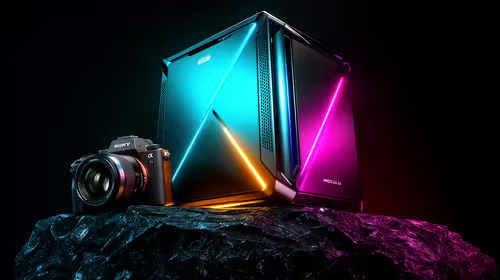
FPS drops on a Ryzen 9 9950X3D build often have a fixable cause. Check settings, drivers, thermals, background tasks, network conditions, and bottlenecks before assuming a part must be replaced.

The difference between PCIe 5.0 and PCIe 4.0 for SA gamers is mostly bandwidth headroom. Compare GPU slot needs, NVMe speed, motherboard support, and upgrade timing before paying extra for a newer platform.

Gaming PC stuck pixel checks in South Africa should confirm the monitor fault first. Use colour tests, screenshot comparison, cable swaps, display menu checks, and clear photos before deciding on support.

AMD's current driver now lists a Radeon RX 9050 4GB, while product coverage details a narrowed memory system. SA buyers should weigh the low VRAM ceiling against current local Radeon options.

Samsung Display has demonstrated a 16-inch 2.5K OLED laptop panel running at 300Hz. SA buyers should wait for a named notebook, full panel specifications and a local price before planning an upgrade.

Microsoft says some Windows 11 game crashes after recent updates are linked to RGB-related drivers. Affected SA gamers should confirm the update and driver before using the published registry workaround.
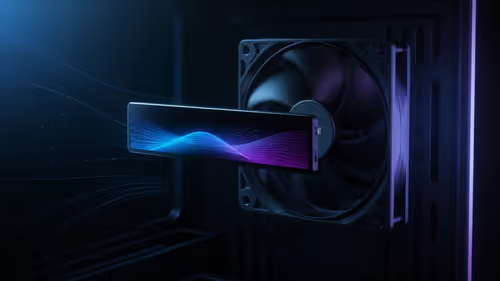
Thermalright's Fan Frame Vision-1 adds a 640x172 status screen to a standard 120mm fan. SA builders should check clearance, USB routing and local support before treating it as an easy upgrade.

Shokz OpenFit Air 2 earbuds weigh 7.2g each and use a redesigned dual-driver open-ear layout. SA buyers should choose them for comfort and awareness, not maximum isolation.

A fake 113GB GTA VI ISO reportedly used empty padding around a small malware payload. SA gamers should delete unofficial builds, keep Windows security active and wait for official channels.
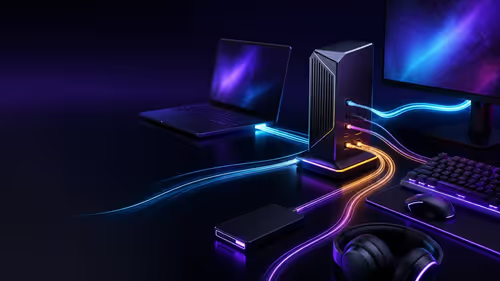
The ROG Flux Charger Dock combines 260W total output, 140W laptop charging and HDMI 2.1. SA buyers should check laptop USB-C limits, display needs and local warranty first.

ASRock's Rock 360 Digital AIO adds a 1.05-inch CPU temperature display, 360mm radiator and simplified wiring. SA builders should check case fit, socket support and local warranty.