


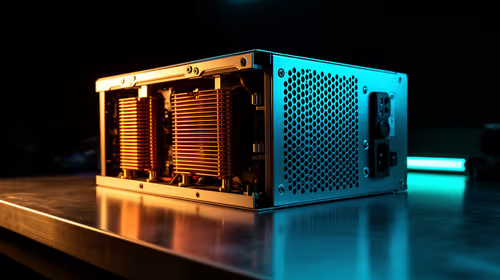
1000W PSU Planning for RTX 5090 Builds in SA
1000W for RTX 5090 needs a full-build check, not a simple yes. Review GPU guidance, CPU draw, transient load, connectors, PSU quality, and upgrade plans before deciding.
Read moreTaming harsh glare in product photography means replacing bare bulbs with softened continuous lighting so the diffused surface spreads reflections instead of burning a hotspot. Angling softboxes 45 degrees off the product kills mirror-like glare on glossy items.
Glare on product photography does not come from too much light. It comes from the wrong kind of light in the wrong position. A bare bulb pointed at a glossy surface concentrates its output into a single bright spike that overwhelms the lens and obscures the product underneath. Taming harsh glare in product photos means replacing that concentrated output with a broad, diffused source and positioning it so the bright reflection misses the camera's line of sight entirely.
Replace bare bulbs with softboxes and angle them roughly 45 degrees to the face of the product, not straight at it. The large diffuse surface scatters any reflection over a wide area instead of spiking it, and the off-axis angle keeps the brightest part of that reflection out of the lens.
Glare in photography is specular reflection -- light bouncing off a surface at the same angle it arrived, heading straight back toward the camera. Smooth and glossy surfaces behave almost like mirrors, redirecting incoming light in a predictable path rather than scattering it the way matte surfaces do.
The intensity of that specular spike depends on two things: how concentrated the original light source is, and whether the camera, the light, and the surface are aligned so the reflected beam hits the lens. A bare bulb is small and focused, creating a narrow, very bright spike. A 60-by-60cm softbox spreads the same wattage across hundreds of square centimetres of diffusion fabric, so the equivalent reflection is faint and broad -- a soft highlight rather than a hotspot.
Repositioning changes whether the reflection reaches the lens. At 45 degrees to the product face, the reflected path runs off to the side of the camera entirely.
Start with both softboxes at 45-degree angles to the subject, roughly level with the product or slightly above it. This two-light arrangement from opposite sides balances illumination and removes the dark shadow edge a single source always creates on the away side.
For products with a perfectly flat face -- a phone screen, a laptop lid, a sealed book cover -- a slight upward tilt of 5 to 10 degrees on the softbox faces pushes the brightest part of the diffuse reflection above the horizontal and out of the lens path. For curved or three-dimensional products, move the softbox slowly while watching your live view until the brightest reflection point sits outside the product outline.
Two softboxes solve the majority of glare problems on medium-to-large products. Small objects with extreme gloss -- polished jewellery, metal components, glass bottles -- present a harder version of the challenge because every face of the product is potentially reflective simultaneously.
A light tent addresses this by surrounding the product on five sides with white diffusion material. The tent walls become the reflected surface, and because they are uniformly white and large relative to the product, every face reflects a clean soft highlight rather than a distinct bright source. For products from about 5cm to 30cm, a medium light tent delivers consistent glare control that two-softbox positioning alone cannot reliably achieve.
Switch from a bare or direct light to a softbox. The large diffuse face converts the specular spike into a soft highlight by spreading the reflected light across a much wider area. Combining this with a 45-degree positioning angle removes the reflection from the lens path entirely.
A small source creates a concentrated, high-brightness reflection. A large source creates a spread-out, low-peak reflection. Softboxes work for glare control precisely because their face area is large relative to the product's reflective surface, so the reflected image of the light appears as a gentle highlight rather than a blinding hotspot.
Two is the standard: one each side at matching intensity, angled to cancel each other's shadows. This avoids the unlit dark edge a single softbox always creates. For very small, very glossy items, a light tent plus a single overhead light is often more controllable than two independent softboxes.
Yes. A polarising filter on the camera lens cuts a significant portion of specular reflection by blocking light oscillating in the reflection plane. For high-gloss surfaces, combining good softbox positioning with a polariser removes almost all the hotspot that manual light placement leaves behind.
No. Matte surfaces scatter light in all directions regardless of the source angle, so light positioning has little impact on glare. Glossy and mirror-like surfaces are highly angle-sensitive: a small movement of the light or camera changes the reflection path dramatically. For glossy products, spend time on angle adjustment; for matte surfaces, focus on even overall illumination instead.
Ready to eliminate glare from your product photography setup? Browse the studio lighting range at Evetech for softboxes and light tents built to handle glossy products cleanly.
Switch from a bare or direct light to a softbox. The large diffuse face converts the specular spike into a soft highlight by spreading the reflected light across a much wider area. Combining this with a 45-degree positioning angle removes the reflection from the lens path entirely.
A small source creates a concentrated, high-brightness reflection. A large source creates a spread-out, low-peak reflection. Softboxes work for glare control precisely because their face area is large relative to the product's reflective surface, so the reflected image of the light appears as a gentle highlight rather than a blinding hotspot.
Two is the standard: one each side at matching intensity, angled to cancel each other's shadows. This avoids the unlit dark edge a single softbox always creates. For very small, very glossy items, a light tent plus a single overhead light is often more controllable than two independent softboxes.
Yes. A polarising filter on the camera lens cuts a significant portion of specular reflection by blocking light oscillating in the reflection plane. For high-gloss surfaces, combining good softbox positioning with a polariser removes almost all the hotspot that manual light placement leaves behind.
No. Matte surfaces scatter light in all directions regardless of the source angle, so light positioning has little impact on glare. Glossy and mirror-like surfaces are highly angle-sensitive: a small movement of the light or camera changes the reflection path dramatically. For glossy products, spend time on angle adjustment; for matte surfaces, focus on even overall illumination instead.
1000W for RTX 5090 needs a full-build check, not a simple yes. Review GPU guidance, CPU draw, transient load, connectors, PSU quality, and upgrade plans before deciding.
Read more
RTX 5080 Super with a 750W PSU is more comfortable than lower wattage if the unit is quality. SA builders should still confirm GPU guidance, CPU draw, connector type, airflow, and upgrade room.
Read more
How to fix FPS drops after a RX 9070 XT starts with driver cleanup, chipset updates, thermals, and power checks. For SA gaming PCs, confirm PCIe seating, monitor refresh, frame caps, and per-game graphics settings before replacing parts.
Read more
How to fix low FPS Windows 11 Wi-Fi 7 issues starts by checking whether the problem is frame rate or network lag. Test ping, drivers, power settings, Ethernet, and game FPS before adjusting visuals.
Read more
AM5 is smart for SA builders because it supports newer Ryzen CPUs, DDR5 memory, and a longer upgrade path. Compare board cost, cooling, gaming needs, and local part availability before choosing your next PC platform.
Read more
AM5 gives Randburg gaming builders a longer upgrade path. For SA buyers, DDR5 support, newer board features, and future CPU options can justify the platform. Weigh board cost, cooler support, BIOS maturity, and upgrade timing before choosing.
Read more
A fake 113GB GTA VI ISO reportedly used empty padding around a small malware payload. SA gamers should delete unofficial builds, keep Windows security active and wait for official channels.

Wi-Fi 6E vs Wi-Fi 6 matters for 4K video editing when files move across a network. The real-world difference between Wi-Fi 6E and Wi-Fi 6 for video editing in 4K depends on NAS access, cloud uploads, router range, and SA creator workflows.

The difference between PCIe 5.0 and PCIe 4.0 for SA gamers is mostly bandwidth headroom. Compare GPU slot needs, NVMe speed, motherboard support, and upgrade timing before paying extra for a newer platform.

Gaming PC stuck pixel checks in South Africa should confirm the monitor fault first. Use colour tests, screenshot comparison, cable swaps, display menu checks, and clear photos before deciding on support.

Shokz OpenFit Air 2 earbuds weigh 7.2g each and use a redesigned dual-driver open-ear layout. SA buyers should choose them for comfort and awareness, not maximum isolation.

AMD's current driver now lists a Radeon RX 9050 4GB, while product coverage details a narrowed memory system. SA buyers should weigh the low VRAM ceiling against current local Radeon options.

Samsung Display has demonstrated a 16-inch 2.5K OLED laptop panel running at 300Hz. SA buyers should wait for a named notebook, full panel specifications and a local price before planning an upgrade.

Microsoft says some Windows 11 game crashes after recent updates are linked to RGB-related drivers. Affected SA gamers should confirm the update and driver before using the published registry workaround.
Shokz OpenFit Air 2 earbuds weigh 7.2g each and use a redesigned dual-driver open-ear layout. SA buyers should choose them for comfort and awareness, not maximum isolation.
A fake 113GB GTA VI ISO reportedly used empty padding around a small malware payload. SA gamers should delete unofficial builds, keep Windows security active and wait for official channels.

The ROG Flux Charger Dock combines 260W total output, 140W laptop charging and HDMI 2.1. SA buyers should check laptop USB-C limits, display needs and local warranty first.

ASRock's Rock 360 Digital AIO adds a 1.05-inch CPU temperature display, 360mm radiator and simplified wiring. SA builders should check case fit, socket support and local warranty.