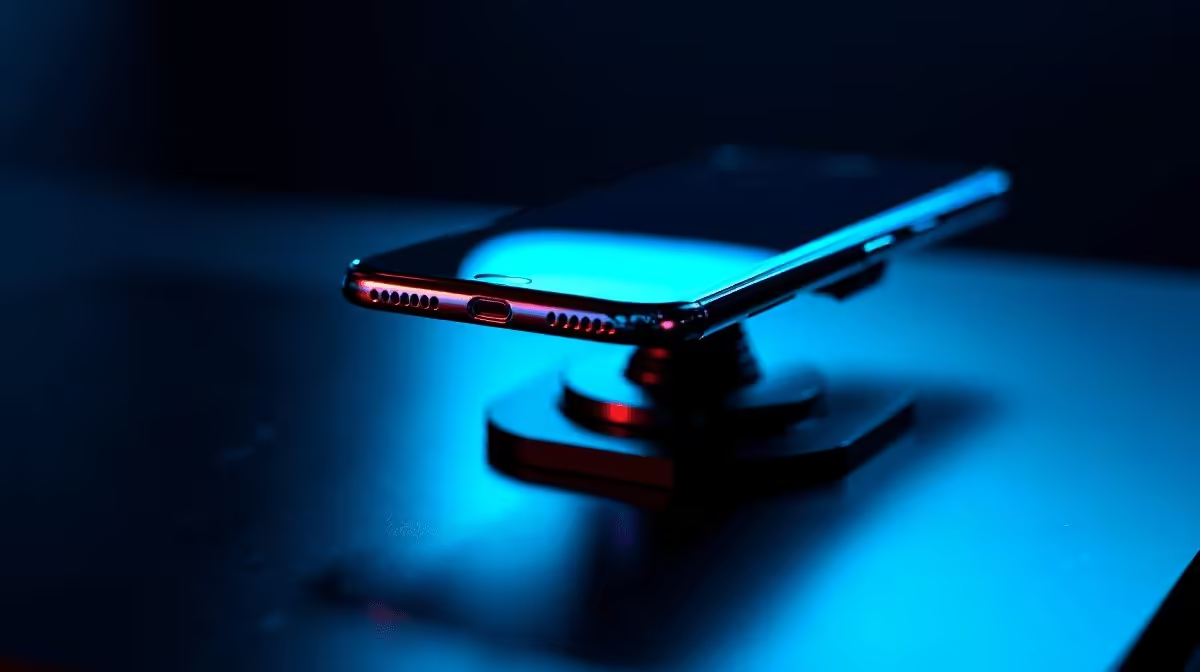
The word "universal" appears on almost every magnetic car phone mount listing, and buyers reasonably expect it to mean their phone will stick on without extra preparation. That expectation needs a quick reality check before purchase, because the vast majority of phone backs are neither magnetic nor ferromagnetic, and glass or polycarbonate panels attract nothing.
Quick Answer
Generally no: most phones will not cling to a magnetic mount without an adapter. The exception is Apple iPhone 12 and later models with MagSafe, which integrate a magnet ring that pairs directly with MagSafe-compatible mounts. Every other phone requires a thin steel plate or ring affixed to the back, or placed inside the case, to complete the magnetic attraction.
📱 Why Most Phones Need a Steel Plate
Phone backs are built from glass, polycarbonate, or aluminium. Glass and polycarbonate are non-magnetic in every sense; they neither attract magnets nor carry a magnetic field. Aluminium is non-ferromagnetic despite being a metal, so an aluminium-back phone placed on a magnetic mount simply sits there with no grip at all.
A ferromagnetic material, such as mild steel or stainless steel, is needed to respond to the mount's neodymium magnets. The thin steel plate included with virtually every magnetic mount kit supplies exactly that material. The plate adheres to the back of the phone or to the inner surface of a case, where it becomes part of the phone's effective profile without adding significant bulk. Once the plate is in place, the phone snaps firmly onto the mount and the assembly becomes genuinely universal in the sense that one mount handles any phone with any plate.
The plate is between 0.5 and 1 mm thick and most drivers position it inside their case rather than on the bare phone back, hiding it completely. A phone with no case requires the external rectangular plate, which is visible but unobtrusive.
🍎 MagSafe Phones: The True Plate-Free Option
Apple introduced MagSafe on the iPhone 12 series, embedding a ring of magnets around the rear wireless-charging coil. That ring is strong enough to snap an iPhone directly onto a MagSafe-compatible magnetic mount without any steel plate or adapter. The magnetic alignment is precise because both the phone and mount are engineered to the same geometry, and the pull force is sufficient for normal road use on most South African routes.
MagSafe mounts are labelled specifically as MagSafe-compatible and use a matching magnet ring on the mount head. They will not develop strong attraction to non-MagSafe phones, because a random Android back does not carry the internal magnet pattern needed to couple with the mount ring. Using a MagSafe mount with an Android phone still requires the standard steel plate.
Third-party MagSafe cases extend compatibility. A Google Pixel, Samsung Galaxy, or any Android phone inside a MagSafe-compatible case gains the same magnet ring and sticks to MagSafe mounts without a separate plate. These cases are available across a range of price points and handle the compatibility problem cleanly without modifying the phone itself.
🔄 Choosing the Right Adapter Path for Your Phone
For iPhone 12 and newer: a MagSafe mount is the most elegant solution. No plate, no adhesive, and the alignment is automatic. Check that the mount is explicitly MagSafe-certified rather than merely "magnet ring" designed, as certified mounts use a ring geometry matching Apple's specification.
For older iPhones and all Android phones: a standard magnetic mount with the steel ring plate placed inside the case is the practical answer. The ring plate preserves wireless charging because it surrounds rather than covers the Qi coil. If your case is fixed and you cannot insert a plate inside it, the external rectangular plate on the back of the case works, though wired charging becomes the more reliable option.
For phones without cases: the external rectangular plate is the only path. Secure it precisely over the centre of where the mount magnets will contact, and use a clean bonding surface for the adhesive to maximise longevity. Budget R30 to R80 for a standalone plate kit if you need an extra one beyond what came with the mount.
Frequently Asked Questions
Will a steel plate work with every magnetic mount brand?
Yes. The plate-to-magnet interface is entirely physical; any ferromagnetic plate will attract any neodymium magnet array. The plate included with one brand's mount kit works on a different brand's mount without modification.
Can I remove and reapply the steel plate if I change phones?
You can remove it, but the adhesive backing is single-use. The bond weakens during removal, and reapplying to a new surface usually gives poor long-term adhesion. A fresh adhesive pad or a new plate kit is the reliable solution when switching devices.
My Android phone has an aluminium back. Do I need a plate?
Yes. Aluminium is non-ferromagnetic and will not attract a neodymium magnet. A steel plate is required regardless of the phone's colour, price, or aluminium finish quality.
Is a MagSafe mount stronger than a plate-based magnetic mount?
MagSafe mounts and plate-based mounts at similar price points offer comparable grip for everyday road use. The MagSafe advantage is convenience and repeatability of alignment rather than raw holding force. High-rated plate-based mounts can actually exceed MagSafe pull-force figures.
Does using a steel plate inside a thick case still work?
It works, but grip depends on how much the case increases the gap between plate and mount magnets. A plate inside a 3 mm silicone case performs well. Inside a 6 mm armoured case, grip may be marginal on heavy phones. A mount with a larger magnet array compensates for the added gap in thick-case scenarios.
Know exactly what your phone needs?
Find a compatible magnetic car phone mount at Evetech and grab a plate kit if your phone is not already MagSafe-ready.